Loading...
Ptolemy XII Auletes vs Seleucus I Nicator
Seleucus I Nicator leads by 21.1 pts · 2 figures compared
…

Ptolemy XII Auletes
Emperor · Ancient
45.4Total
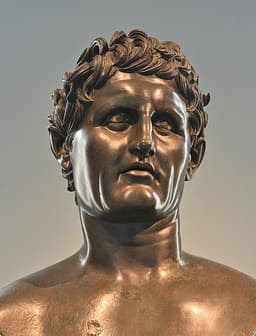
Seleucus I Nicator
Emperor · Ancient
66.5Total
Basic Information
Born
-117
-358
Died
-51
-281
Era
Ancient
Ancient
Nationality
Egypt
Seleucid Empire
Occupation
Emperor
Emperor
Civilization
Middle Eastern
Western
Score Comparison
Military (10%)
22.6
78.5
Political (20%)
37.9
72.0
Influence (20%)
53.3
62.0
Legacy (20%)
43.3
55.0
Leadership (15%)
62.2
78.0
Strategy (15%)
39.6
69.1
TOTAL
45.4
66.5
Ptolemy XII Auletes — Complete Timeline
80 BC
Accession as Pharaoh of EgyptPolitical Action◆ Major
Ptolemy XII Auletes became pharaoh of Egypt after the death of Ptolemy XI Alexander II. His reign was marked by political instability, economic decline, and increasing Roman influence. He was known for his pro-Roman policies and lavish spending.
AccessionPtolemaic DynastyRoman Influence
Impact: regional
58 BC
Exile from EgyptPolitical Action◆ Major
Ptolemy XII was driven from Egypt by a popular revolt, likely due to his heavy taxation and pro-Roman stance. He fled to Rome, where he sought support for his restoration. His daughter Berenice IV took the throne in his absence.
ExileRevoltRoman Support
Impact: regionaltragic
55 BC
Restoration to the ThronePolitical Action◆ Major
Ptolemy XII was restored to the Egyptian throne with military support from the Roman governor of Syria, Aulus Gabinius. The Roman army helped him defeat the forces of Berenice IV. He executed his daughter and resumed his pro-Roman policies.
RestorationRoman InterventionExecution
Impact: regionaldestructive
Will Naming Rome as GuardianPolitical Action◆ Major
Ptolemy XII made a will naming the Roman Republic as the guardian of his children and the Egyptian kingdom. This will later be used by Julius Caesar to justify Roman intervention in Egypt after Ptolemy's death, leading to the Alexandrian War.
WillRoman GuardianshipSuccession
Impact: regional
Seleucus I Nicator — Complete Timeline
312 BC
Foundation of the Seleucid EmpirePolitical Action◆ Major
After the death of Alexander, Seleucus established control over Babylon and the eastern satrapies. He founded the Seleucid Empire, which stretched from Anatolia to India, and adopted the title of king. This marked the beginning of the Hellenistic period in the East.
DiadochiEmpireHellenistic
Impact: globalconstructive
301 BC
Battle of IpsusWar
Seleucus I Nicator fought against Antigonus I Monophthalmus at Ipsus. The allied forces of Seleucus, Lysimachus, and Cassander defeated Antigonus, who was killed. This battle solidified the division of Alexander's empire, with Seleucus gaining control of Syria and Mesopotamia.
DiadochiBattleSeleucid Empire
Impact: regionaldestructive
300 BC
Founding of AntiochCultural◆ Major
Seleucus I founded the city of Antioch on the Orontes River, which became the capital of the Seleucid Empire. The city grew into a major center of Hellenistic culture, trade, and politics, rivaling Alexandria in importance.
Seleucid EmpireCity FoundationHellenistic
Impact: regionalconstructive
281 BC
Assassination by Ptolemy CeraunusPolitical Action◆ Major
Seleucus I was assassinated by Ptolemy Ceraunus, a son of Ptolemy I, while campaigning in Thrace. His death ended the last major Diadochi conflict and left the Seleucid Empire to his son Antiochus I, who faced challenges from within and without.
DiadochiAssassinationSeleucid Empire
Impact: regionaltragic
Expert Analysis
Origins
Ptolemy XII Auletes, born around 117 BCE, was a member of the Ptolemaic dynasty, the Macedonian Greek rulers of Egypt. He was an illegitimate son of Ptolemy IX Soter II, and his early life was marked by the dynasty's internal power struggles. His epithet 'Auletes' means 'flute-player,' reflecting his personal interest in music, but his reign was dominated by financial troubles and Roman influence.
Seleucus I Nicator was born around 358 BCE in Europus, Macedonia, to Antiochus, a general of Philip II. He served under Alexander the Great, commanding the elite infantry unit the 'Silver Shields.' After Alexander's death in 323 BCE, Seleucus rose through the ranks of the Diadochi, the successor generals who carved up the empire.
Rise to Power
Ptolemy XII became pharaoh in 80 BCE after the violent death of his predecessor, Ptolemy XI Alexander II, who had been installed by Rome. His reign was immediately challenged by economic decline and the need to secure Roman support. In 58 BCE, a popular revolt over heavy taxation forced him to flee to Rome, where he spent years lobbying for restoration. He was finally reinstated in 55 BCE with Roman military force led by Aulus Gabinius, but at the cost of ceding Cyprus and accepting Roman oversight.
Seleucus I's rise was meteoric. After Alexander's death, he initially served as a commander under Perdiccas, then as satrap of Babylon in 321 BCE. He was forced to flee Babylon in 316 BCE by Antigonus Monophthalmus, but returned in 312 BCE after a successful campaign. His victory at the Battle of Ipsus in 301 BCE, where he allied with Lysimachus and Cassander to defeat Antigonus, secured his control over Syria and Asia Minor. He then expanded eastward, establishing an empire from the Mediterranean to the Indus River.
Leadership & Governance
Ptolemy XII's leadership was characterized by weakness and dependency on Rome. He focused on securing his throne through bribery and diplomatic maneuvering, but his policies drained Egypt's treasury. He imposed heavy taxes, leading to economic stagnation and unrest. His decision to name the Roman Republic as guardian of his children in his will demonstrated his subordination. In governance, he failed to maintain Ptolemaic traditions of pharaonic authority, instead prioritizing Roman favor.
Seleucus I was a military and administrative genius. He founded over 30 cities, including Antioch, which became a major Hellenistic center. He promoted the spread of Greek culture while respecting local traditions, a policy that stabilized his vast empire. He established a centralized bureaucracy and a system of satrapies, and his coinage standardized trade. His leadership scored 78.0 in leadership, reflecting his ability to command loyalty and build institutions.
Triumph & Tragedy
Ptolemy XII's greatest success was his restoration to the throne with Roman help, securing his dynasty for another generation. He also fathered Cleopatra VII, who would become one of history's most famous rulers. However, his greatest failure was his mismanagement of Egypt's economy and sovereignty, leaving the kingdom heavily indebted and vulnerable to Rome. His pro-Roman policies undermined Egyptian independence, and his exile exposed his lack of popular support.
Seleucus I's triumphs include the foundation of the Seleucid Empire, the victory at Ipsus, and the establishment of a multicultural realm that lasted for centuries. He successfully integrated Greek and Persian elements. His tragedy was his assassination in 281 BCE by Ptolemy Ceraunus, a son of Ptolemy I, just as he was poised to consolidate control over Thrace. This death ended his ambitions and led to the eventual decline of the Seleucid dynasty.
Character & Destiny
Ptolemy XII was pragmatic but short-sighted. His musical interests and patronage of the arts contrasted with his political ineptitude. He prioritized personal survival over national strength, which led to his exile and reliance on Rome. His character scored 62.2 in leadership but only 22.6 in military, reflecting his lack of martial prowess. His destiny was to be a puppet pharaoh, remembered primarily as the father of Cleopatra.
Seleucus I was ambitious, strategic, and resilient. His determination to reclaim Babylon after his exile and his ability to forge alliances demonstrated his political acumen. He was a skilled commander, scoring 78.5 in military, and his vision for a Hellenistic empire shaped the ancient Near East. His aggressive expansionism, however, created enemies that ultimately led to his murder.
Legacy
Ptolemy XII's legacy is largely negative. His will and policies paved the way for Roman intervention in Egypt, culminating in the annexation of Egypt by Octavian in 30 BCE. His reign marked the beginning of the end for Ptolemaic independence. His scores reflect this: political 37.9, legacy 43.3.
Seleucus I's legacy is profound. The Seleucid Empire became a major Hellenistic power, influencing culture, trade, and politics for centuries. His foundation of Antioch and other cities spread Greek civilization eastward. His military and political strategies set a model for later rulers. His scores of 78.5 in military and 72.0 in political demonstrate his effectiveness.
Conclusion
Seleucus I Nicator had significantly greater impact than Ptolemy XII Auletes. With a total score of 66.5 compared to Ptolemy's 45.4, the gap of 21.1 points reflects Seleucus's superior military, political, and strategic achievements. While Ptolemy XII's reign was a footnote in Egypt's decline, Seleucus founded an empire that shaped the Hellenistic world. His legacy endures through the cities he built and the dynasty he established. Therefore, Seleucus I is the more consequential historical figure.
Rankings
🥇
Seleucus I NicatorLeader
Mil: 78.5Pol: 72.0Inf: 62.0
66.5
🥈
Ptolemy XII Auletes
Mil: 22.6Pol: 37.9Inf: 53.3
45.4
+21.1 behind
How This Comparison Works
Algorithm
Each figure is scored on 6 dimensions (0—100 scale) based on structured historical data: Military (10%), Political (20%), Influence (20%), Legacy (20%), Leadership (15%), Strategy (15%). The weighted total produces the final ranking.
Data Sources
Scores are computed from structured sub-indicators in the database. Scale factors adjust for era (Ancient ×0.85, Modern ×1.0) and civilization size (Eastern ×1.05, Other ×0.80) to account for differences in population and military scale.
Maximum 3 Figures
Comparisons are limited to 2—3 figures to ensure readability and statistical meaningfulness.
Error Margins
±5 points per dimension — Sub-scores are derived from historical records with inherent uncertainty. Two figures within 5 points on a dimension should be considered roughly equivalent in that area.
Total Score Accuracy
±3 points overall — The weighted combination of 6 dimensions produces a total score with approximately ±3 points of uncertainty. Differences of less than 3 points are not statistically significant— the figures are effectively tied.
Known Limitations
- Historical records are incomplete and uneven across civilizations
- Figures from oral-tradition societies may be underrepresented
- Occupation labels can misclassify multi-role figures
- Scores measure capability and impact, not moral character
- Quantitative scoring is a comparison tool, not absolute truth
Capability Radar
Military (10%) — Battles & Warfare
Battles
10
85
Win Rate
10
80
Expansion
5
90
Political (20%) — Governance & Reform
Reform
20
75
Diplomacy
50
80
Economy
30
70
Influence (20%) — Cultural & Global Reach
Cultural
30
60
Global
30
70
Legacy (20%) — Historical Impact
Historical
40
80
Longevity
30
75
Leadership (15%) — Power & Stability
Tenure
60
80
Stability
20
65
Strategy (15%) — Tactics & Innovation
Strategy
10
85
Tactics
10
75
Reform
5
70
Similar Comparisons
Comments & Discussion
No comments yet. Be the first to share your thoughts!