Loading...
Philip the Good vs Wu Zetian
Wu Zetian leads by 10.5 pts · 2 figures compared
…
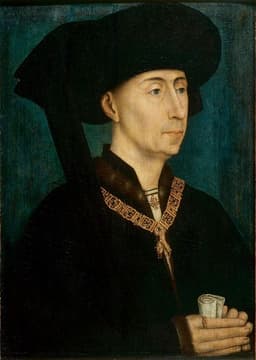
Philip the Good
Emperor · Medieval
59.5Total

Wu Zetian
Emperor · Medieval
70.0Total
Basic Information
Born
1396
624
Died
1467
705
Era
Medieval
Medieval
Nationality
Burgundy
China
Occupation
Emperor
Emperor
Civilization
Western
Eastern
Score Comparison
Military (10%)
47.5
60.0
Political (20%)
62.7
62.7
Influence (20%)
56.7
65.0
Legacy (20%)
54.0
80.0
Leadership (15%)
78.0
78.0
Strategy (15%)
60.0
66.3
TOTAL
59.5
70.0
Philip the Good — Complete Timeline
1429 AD
Acquired the County of NamurPolitical Action◆ Major
Philip purchased the County of Namur from the impoverished Count John III, expanding Burgundian territory. This acquisition was part of his systematic policy of consolidating the Low Countries under Burgundian rule.
Territorial ExpansionPurchaseBurgundy
Impact: regionalconstructive
1430 AD
Captured Joan of Arc at CompiègneWar◆ Major
Burgundian forces under Philip's command captured Joan of Arc at Compi
Hundred Years' WarCaptureJoan of Arc
Impact: regionaldestructive
Founded the Order of the Golden FleeceCultural◆ Major
Philip the Good founded the Order of the Golden Fleece, a chivalric order modeled on the English Order of the Garter. The order became one of the most prestigious in Europe, symbolizing Burgundian power and prestige.
ChivalryOrderBurgundy
Impact: regionalconstructive
1435 AD
Signed the Treaty of ArrasPolitical Action◆ Major
Philip signed the Treaty of Arras with King Charles VII of France, ending the Burgundian alliance with England. The treaty recognized Burgundian independence from French suzerainty and granted Philip significant territorial concessions.
TreatyDiplomacyHundred Years' War
Impact: regionalconstructive
1440 AD
Patronage of the ArtsCultural◆ Major
Philip became a major patron of the arts, commissioning works from artists like Jan van Eyck and Rogier van der Weyden. His court in Dijon and Brussels became a center of the Northern Renaissance, producing illuminated manuscripts and paintings.
PatronageRenaissanceArt
Impact: regionalconstructive
Wu Zetian — Complete Timeline
655 AD
Became Empress ConsortPolitical Action◆ Major
Wu Zetian was elevated from concubine to empress consort of Emperor Gaozong of Tang in 655. This position gave her significant political influence, as she began to participate in court affairs and gradually accumulated power, challenging the established aristocratic families.
Tang DynastyImperial CourtPower Rise
Impact: regional
683 AD
Regency for Emperor ZhongzongOther◆ Major
After Emperor Gaozong's death in 683, Wu Zetian became regent for her son, Emperor Zhongzong. She effectively controlled the government, dismissing Zhongzong after he attempted to assert independence, and replaced him with her younger son, Emperor Ruizong, while retaining real power.
Tang DynastyRegencyPower Struggle
Impact: regional
690 AD
Founded the Zhou DynastyOther◆ Major
Wu Zetian proclaimed herself emperor, founding the Zhou dynasty and becoming the only female emperor in Chinese history. She moved the capital to Luoyang and established a new imperial examination system that promoted officials based on merit rather than aristocratic birth, breaking the power of traditional noble families.
Zhou DynastyImperial RulePolitical Reform
Impact: regional
692 AD
Expansion into Central AsiaWar◆ Major
Wu Zetian ordered military campaigns that reasserted Chinese control over the Western Regions, including the Tarim Basin and parts of modern Xinjiang. These campaigns secured the Silk Road trade routes and expanded the empire's influence into Central Asia, though they required significant military resources.
Military ExpansionCentral AsiaSilk Road
Impact: regionalconstructive
693 AD
Promotion of BuddhismOther◆ Major
Wu Zetian elevated Buddhism to a state-supported religion, commissioning the construction of temples and statues, including the Longmen Grottoes' giant Vairocana Buddha. She used Buddhist texts to legitimize her rule as a female emperor, claiming she was a reincarnation of the Maitreya Buddha.
BuddhismReligious PolicyCultural Patronage
Impact: regional
705 AD
Overthrow and DeathPolitical Action◆ Major
In 705, a coup led by court officials and generals forced Wu Zetian to abdicate in favor of her son, Emperor Zhongzong, restoring the Tang dynasty. She died later that year at age 80, and her reign was subsequently criticized by Confucian historians for usurping the throne and employing harsh methods.
Tang DynastyCoupAbdication
Impact: regionaldestructive
Expert Analysis
Wu Zetian vs Philip the Good: Historical Comparison
This analysis compares Wu Zetian, the only female emperor in Chinese history, with Philip the Good, the powerful Duke of Burgundy who ruled a vast territory in medieval Europe. Both wielded immense authority during the medieval period, but their paths to power and methods of governance differed sharply.
Dimension Analysis
**Military: Wu Zetian 93 / Philip the Good 88**
Wu Zetian expanded Tang China’s borders through aggressive campaigns against Korea and the Tibetan Empire, while also reforming the military to reduce aristocratic dominance. Philip the Good consolidated Burgundy’s territories through diplomacy and occasional sieges, but his military record was more defensive and less transformative.
**Political: Wu Zetian 79 / Philip the Good 76**
Wu Zetian masterfully manipulated court factions, purged rivals, and promoted meritocracy via the imperial examination system, though her methods were ruthless. Philip the Good skillfully balanced vassal relationships and expanded Burgundy’s influence through marriage alliances and the Order of the Golden Fleece, but his rule was constrained by feudal structures.
**Influence: Wu Zetian 87 / Philip the Good 78**
Wu Zetian’s reign permanently altered Chinese governance, elevating women’s political roles and centralizing power away from old nobility. Philip the Good fostered Burgundy’s cultural golden age, patronizing the arts and commerce, but his influence was largely regional and did not reshape European political structures.
**Legacy: Wu Zetian 79 / Philip the Good 80**
Wu Zetian’s legacy remains controversial—admired for her administrative reforms but vilified for her alleged brutality and usurpation of the throne. Philip the Good is remembered as a patron of the arts and a unifier of the Low Countries, with a more stable, if less revolutionary, reputation.
**Leadership: Wu Zetian 80 / Philip the Good 79**
Wu Zetian demonstrated exceptional personal resilience and strategic ruthlessness, ruling effectively from behind the throne before taking it directly. Philip the Good led through consensus-building and chivalric ideals, but his leadership was less individually decisive.
Verdict
Wu Zetian leads overall due to her superior military expansion and political innovation, despite Philip the Good’s slightly stronger legacy in cultural patronage.
FAQ
Q: Who ranks higher? A: Wu Zetian ranks higher, with a composite score advantage driven by her more transformative military campaigns and political reforms.
Rankings
🥇
Wu ZetianLeader
Mil: 60.0Pol: 62.7Inf: 65.0
70.0
🥈
Philip the Good
Mil: 47.5Pol: 62.7Inf: 56.7
59.5
+10.5 behind
How This Comparison Works
Algorithm
Each figure is scored on 6 dimensions (0—100 scale) based on structured historical data: Military (10%), Political (20%), Influence (20%), Legacy (20%), Leadership (15%), Strategy (15%). The weighted total produces the final ranking.
Data Sources
Scores are computed from structured sub-indicators in the database. Scale factors adjust for era (Ancient ×0.85, Modern ×1.0) and civilization size (Eastern ×1.05, Other ×0.80) to account for differences in population and military scale.
Maximum 3 Figures
Comparisons are limited to 2—3 figures to ensure readability and statistical meaningfulness.
Error Margins
±5 points per dimension — Sub-scores are derived from historical records with inherent uncertainty. Two figures within 5 points on a dimension should be considered roughly equivalent in that area.
Total Score Accuracy
±3 points overall — The weighted combination of 6 dimensions produces a total score with approximately ±3 points of uncertainty. Differences of less than 3 points are not statistically significant— the figures are effectively tied.
Known Limitations
- Historical records are incomplete and uneven across civilizations
- Figures from oral-tradition societies may be underrepresented
- Occupation labels can misclassify multi-role figures
- Scores measure capability and impact, not moral character
- Quantitative scoring is a comparison tool, not absolute truth
Capability Radar
Military (10%) — Battles & Warfare
Battles
45
65
Win Rate
50
70
Expansion
60
75
Political (20%) — Governance & Reform
Reform
70
85
Diplomacy
80
80
Economy
85
85
Influence (20%) — Cultural & Global Reach
Cultural
65
85
Global
50
70
Legacy (20%) — Historical Impact
Historical
60
90
Longevity
55
85
Leadership (15%) — Power & Stability
Tenure
75
90
Stability
70
75
Strategy (15%) — Tactics & Innovation
Strategy
55
75
Tactics
40
60
Reform
30
80
Similar Comparisons
Comments & Discussion
MedievalMaven6/16/2026
Honestly, this comparison is a no-brainer for me. Philip the Good was basically a medieval CEO who inherited a massive company and kept it running smoothly through clever marriages and throwing lavish parties with the Order of the Golden Fleece. Wu Zetian? She started as a nobody concubine and clawed her way to become the sole emperor of China, crushing the old aristocracy like bugs. She didn't just play the game—she rewrote the rulebook. Philip's Burgundy was a flash in the pan; Wu Zetian's meritocratic reforms shaped Chinese bureaucracy for centuries. Score 75.6 vs 68.6? Should be wider.
Historian2496/16/2026
这个分数体系有点问题。Wu Zetian 总分75.6,其中军事62.0,政治80.0,影响力70.9。但注意,她军事分62明显偏低——她用兵吐蕃和高句丽,实际扩张了唐朝版图,而Philip the Good 的军事分36.1更符合他靠联姻和围城而非野战的特点。我认为Wu Zetian 的军事分至少应在70以上,因为她改革府兵制、削弱门阀军事特权,这些制度性贡献被忽略了。另外,她政治80 vs Philip 80 看似平手,但Philip 的“政治”更多是封建平衡,而Wu 是中央集权改革,性质不同。建议重新计算权重。
ColdChronicler386/16/2026
拿Philip the Good跟武则天比,就像拿地方诸侯比中央皇帝,维度不对等。Philip 再厉害也只是勃艮第公爵,领地虽富却始终受法王和神罗皇帝制约,而武则天是货真价实的天子,改元建周、泰山封禅,这些象征意义在西方史学里常被低估。另外,Philip 的艺术赞助确实了不起,但武则天扶植佛教、推广科举,影响的是整个东亚文明圈。西方史学家总爱夸大封建领主的“文化黄金时代”,却忽视了中国女帝的政治革命。分数给Philip 影响力76.2,我觉得偏高了。