Loading...
Petronius Maximus vs Seleucus I Nicator
Seleucus I Nicator leads by 11.5 pts · 2 figures compared
…

Petronius Maximus
Emperor · Ancient
55.0Total
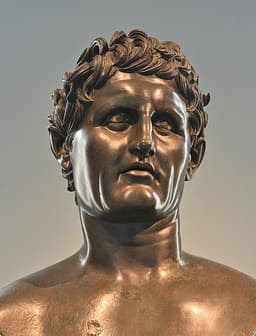
Seleucus I Nicator
Emperor · Ancient
66.5Total
Basic Information
Born
396
-358
Died
455
-281
Era
Ancient
Ancient
Nationality
Western Roman Empire
Seleucid Empire
Occupation
Emperor
Emperor
Civilization
Western
Western
Score Comparison
Military (10%)
14.4
78.5
Political (20%)
56.1
72.0
Influence (20%)
56.8
62.0
Legacy (20%)
57.5
55.0
Leadership (15%)
81.4
78.0
Strategy (15%)
43.5
69.1
TOTAL
55.0
66.5
Petronius Maximus — Complete Timeline
455 AD
Killed during the Vandal Sack of RomeWar
The Vandal king Gaiseric, invited by Licinia Eudoxia, sailed to Rome and sacked the city. Petronius Maximus attempted to flee but was killed by a Roman mob. The Vandals systematically looted Rome for two weeks, causing immense damage.
Sack of RomeVandal InvasionDeath
Impact: regionaltragic
Proclaimed Western Roman EmperorPolitical Action◆ Major
After the death of Valentinian III, Petronius Maximus, a wealthy senator, seized the throne by bribing the palace guard and forcing the widowed empress Licinia Eudoxia to marry him. His reign lasted only 76 days.
Imperial SuccessionUsurpation
Impact: regional
Seleucus I Nicator — Complete Timeline
312 BC
Foundation of the Seleucid EmpirePolitical Action◆ Major
After the death of Alexander, Seleucus established control over Babylon and the eastern satrapies. He founded the Seleucid Empire, which stretched from Anatolia to India, and adopted the title of king. This marked the beginning of the Hellenistic period in the East.
DiadochiEmpireHellenistic
Impact: globalconstructive
301 BC
Battle of IpsusWar
Seleucus I Nicator fought against Antigonus I Monophthalmus at Ipsus. The allied forces of Seleucus, Lysimachus, and Cassander defeated Antigonus, who was killed. This battle solidified the division of Alexander's empire, with Seleucus gaining control of Syria and Mesopotamia.
DiadochiBattleSeleucid Empire
Impact: regionaldestructive
300 BC
Founding of AntiochCultural◆ Major
Seleucus I founded the city of Antioch on the Orontes River, which became the capital of the Seleucid Empire. The city grew into a major center of Hellenistic culture, trade, and politics, rivaling Alexandria in importance.
Seleucid EmpireCity FoundationHellenistic
Impact: regionalconstructive
281 BC
Assassination by Ptolemy CeraunusPolitical Action◆ Major
Seleucus I was assassinated by Ptolemy Ceraunus, a son of Ptolemy I, while campaigning in Thrace. His death ended the last major Diadochi conflict and left the Seleucid Empire to his son Antiochus I, who faced challenges from within and without.
DiadochiAssassinationSeleucid Empire
Impact: regionaltragic
Expert Analysis
Origins
Petronius Maximus was born around 396 AD into a wealthy senatorial family in the Western Roman Empire. His early career was marked by high offices: he served as Praetorian Prefect, twice as consul, and held the prestigious post of Patrician under Emperor Valentinian III. His wealth and connections made him a dominant figure in the Roman Senate, but his ambition was unchecked by military or administrative experience.
Seleucus I Nicator was born around 358 BC in Macedon, likely of noble birth. He served as a commander under Alexander the Great, participating in the conquest of the Persian Empire. After Alexander's death in 323 BC, Seleucus initially served as the commander of the elite Silver Shields and later became satrap of Babylon in 312 BC, marking the start of his own empire-building.
Rise to Power
Petronius Maximus rose through political maneuvering. After Valentinian III was murdered in 455 AD by two Scythian soldiers (instigated by Maximus himself, according to some sources), Maximus bribed the palace guard and forced the widowed empress Licinia Eudoxia to marry him, thus securing the throne. His reign lasted a mere 77 days, from March 17 to May 31, 455 AD.
Seleucus's rise was forged in the crucible of the Diadochi wars. After Alexander's death, he initially supported Perdiccas, then fled to Ptolemy in Egypt. In 312 BC, he returned to Babylon with a small force and recaptured the city, founding what became the Seleucid Empire. His decisive victory at the Battle of Ipsus in 301 BC, where he commanded the allied forces against Antigonus I Monophthalmus, cemented his control over Syria and Asia Minor. Seleucus scored 78.5 in military and 72.0 in political, reflecting his dual prowess.
Leadership & Governance
Petronius Maximus's leadership was disastrous. He alienated the Roman populace by his greed and ineptitude. When the Vandal king Gaiseric, invited by Licinia Eudoxia, sailed to Rome, Maximus attempted to flee but was stoned to death by a Roman mob. His governance score of 56.1 reflects his inability to consolidate power or defend the city.
Seleucus was a skilled administrator and founder. He established the Seleucid Empire, stretching from Anatolia to India, and founded numerous cities, including Antioch, which became a major Hellenistic center. He implemented a policy of colonization and cultural fusion, settling Greeks and Macedonians throughout his realm. His leadership score of 78.0 underscores his effectiveness in building a stable state.
Triumph & Tragedy
Petronius Maximus's sole triumph was briefly attaining the imperial throne, but his tragedy was total: he was killed by his own subjects, and his reign ended with the Vandal sack of Rome, which he had failed to prevent. His legacy score of 57.5 is inflated by his position as emperor.
Seleucus's triumphs include the foundation of a vast empire, the victory at Ipsus, and the establishment of a dynasty that ruled for centuries. His tragedy came in 281 BC: after defeating Lysimachus at Corupedium, he was assassinated by Ptolemy Ceraunus, a son of Ptolemy I, while campaigning in Thrace. His death ended the last major Diadochi war and left his empire vulnerable.
Character & Destiny
Petronius Maximus was characterized by avarice and ambition without capability. His actions—murdering Valentinian III and marrying the empress—reveal a man who sought power but lacked the skill to wield it. His destiny was to be a footnote in the fall of Rome.
Seleucus was patient, strategic, and resilient. He earned the epithet "Nicator" (Conqueror) through his military successes. His character of persistence and diplomacy allowed him to survive the chaotic aftermath of Alexander's empire. His assassination cut short his ambitions of reunifying Alexander's empire.
Legacy
Petronius Maximus left no lasting positive impact. His reign is remembered only for the Vandal sack of Rome, which accelerated the collapse of the Western Roman Empire. He scores 57.5 in legacy, but this reflects the notoriety of his failure rather than constructive achievement.
Seleucus I Nicator left a profound legacy. The Seleucid Empire lasted until 63 BC, spreading Hellenistic culture across the Near East. His founding of Antioch made it a center of learning and trade for centuries. His military and political scores of 78.5 and 72.0 reflect his enduring influence. However, his legacy score of 55.0 is tempered by the empire's eventual decline.
Conclusion
Seleucus I Nicator had a far greater impact than Petronius Maximus. With a total score of 66.5 to Maximus's 55.0, Seleucus excelled in military, strategy, and leadership. While Maximus's brief reign was a catastrophic failure, Seleucus built an empire that shaped the Hellenistic world. The evidence is clear: Seleucus's achievements in founding a dynasty and spreading Greek culture outweigh Maximus's fleeting and destructive tenure.
Rankings
🥇
Seleucus I NicatorLeader
Mil: 78.5Pol: 72.0Inf: 62.0
66.5
🥈
Petronius Maximus
Mil: 14.4Pol: 56.1Inf: 56.8
55.0
+11.5 behind
How This Comparison Works
Algorithm
Each figure is scored on 6 dimensions (0—100 scale) based on structured historical data: Military (10%), Political (20%), Influence (20%), Legacy (20%), Leadership (15%), Strategy (15%). The weighted total produces the final ranking.
Data Sources
Scores are computed from structured sub-indicators in the database. Scale factors adjust for era (Ancient ×0.85, Modern ×1.0) and civilization size (Eastern ×1.05, Other ×0.80) to account for differences in population and military scale.
Maximum 3 Figures
Comparisons are limited to 2—3 figures to ensure readability and statistical meaningfulness.
Error Margins
±5 points per dimension — Sub-scores are derived from historical records with inherent uncertainty. Two figures within 5 points on a dimension should be considered roughly equivalent in that area.
Total Score Accuracy
±3 points overall — The weighted combination of 6 dimensions produces a total score with approximately ±3 points of uncertainty. Differences of less than 3 points are not statistically significant— the figures are effectively tied.
Known Limitations
- Historical records are incomplete and uneven across civilizations
- Figures from oral-tradition societies may be underrepresented
- Occupation labels can misclassify multi-role figures
- Scores measure capability and impact, not moral character
- Quantitative scoring is a comparison tool, not absolute truth
Capability Radar
Military (10%) — Battles & Warfare
Battles
7
85
Win Rate
11
80
Expansion
9
90
Political (20%) — Governance & Reform
Reform
67
75
Diplomacy
70
80
Economy
77
70
Influence (20%) — Cultural & Global Reach
Cultural
66
60
Global
78
70
Legacy (20%) — Historical Impact
Historical
71
80
Longevity
73
75
Leadership (15%) — Power & Stability
Tenure
69
80
Stability
75
65
Strategy (15%) — Tactics & Innovation
Strategy
16
85
Tactics
16
75
Reform
21
70
Similar Comparisons
Comments & Discussion
No comments yet. Be the first to share your thoughts!