Loading...
Peng Dehuai vs Teodoro Obiang Nguema
Peng Dehuai leads by 13.8 pts · 2 figures compared
…
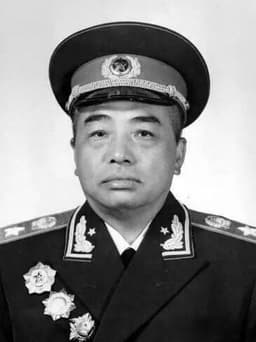
Peng Dehuai
General · Modern
64.9Total

Teodoro Obiang Nguema
General · Modern
51.1Total
Basic Information
Born
1898
1942
Died
1974
—
Era
Modern
Modern
Nationality
China
Equatorial Guinea
Occupation
General
General
Civilization
Eastern
Other
Score Comparison
Military (10%)
80.0
67.2
Political (20%)
62.7
30.8
Influence (20%)
65.0
47.9
Legacy (20%)
55.0
46.7
Leadership (15%)
70.0
70.0
Strategy (15%)
70.0
56.6
TOTAL
64.9
51.1
Peng Dehuai — Complete Timeline
1950 AD
Commander of Chinese Forces in the Korean WarWar
Peng Dehuai was appointed commander of the Chinese People's Volunteer Army in Korea. He led Chinese forces to initial victories against UN forces, pushing them back from the Yalu River and capturing Seoul.
Korean WarMilitary Command
Impact: global
1954 AD
Minister of National Defense of the People's Republic of ChinaPolitical Action◆ Major
Peng Dehuai was appointed Minister of National Defense, overseeing the modernization of the People's Liberation Army. He advocated for professional military reforms and reduced the influence of political commissars.
GovernmentMilitary Reform
Impact: nationalconstructive
1959 AD
Criticized Mao Zedong at the Lushan ConferencePolitical Action
Peng Dehuai wrote a letter to Mao Zedong criticizing the Great Leap Forward's economic policies and their human cost. Mao responded by purging Peng, labeling him a 'right opportunist' and removing him from all posts.
Great Leap ForwardPolitical PurgeCriticism
Impact: nationaldestructive
Teodoro Obiang Nguema — Complete Timeline
1979 AD
Seized Power in a Coup d'ÉtatPolitical Action
Teodoro Obiang Nguema Mbasogo led a coup that overthrew his uncle, President Francisco Mac
CoupPower Seizure
Impact: nationaldestructive
Executed Political RivalsPolitical Action◆ Major
Obiang ordered the execution of his uncle and several former officials, consolidating his power. The executions were part of a broader purge of political opponents and marked the start of his repressive regime.
ExecutionRepression
Impact: nationaldestructive
1996 AD
Re-elected in Controversial ElectionsPolitical Action◆ Major
Obiang won a presidential election with 97.8% of the vote, but the election was widely criticized as fraudulent by international observers. He has since been re-elected multiple times in similarly disputed polls.
Election FraudAuthoritarianism
Impact: nationaldestructive
2004 AD
Survived a Coup AttemptPolitical Action◆ Major
Obiang survived a coup attempt allegedly involving foreign mercenaries, including Mark Thatcher. The plot was foiled, and the perpetrators were tried and imprisoned, further entrenching Obiang's rule.
Coup AttemptSurvival
Impact: national
2022 AD
Became Longest-Serving Current Head of StatePolitical Action◆ Major
Obiang became the longest-serving current head of state in the world, surpassing Paul Biya of Cameroon. His tenure has been marked by authoritarianism, corruption, and human rights abuses.
LongevityAuthoritarianism
Impact: global
Expert Analysis
Origins
Peng Dehuai was born in 1898 into a poor peasant family in Xiangtan, Hunan Province, China. He received little formal education and joined the Hunan Provincial Army at age 18. After participating in the Northern Expedition, he joined the Chinese Communist Party in 1928 and led the Pingjiang Uprising, establishing the Fifth Red Army. His early military experiences shaped his pragmatic and direct approach.
Teodoro Obiang Nguema Mbasogo was born in 1942 in Acoacán, Equatorial Guinea, then a Spanish colony. He attended military academies in Spain and returned to serve in the colonial guard. After independence in 1968, he became a key military figure under his uncle, President Francisco Macías Nguema. Obiang rose through the ranks as governor of Bioko Island and later as deputy minister of defense.
Rise to Power
Peng Dehuai rose to prominence during the Chinese Civil War, commanding the Red Army's First Front Army and later leading the People's Liberation Army in the Korean War. In 1950, he was appointed commander of the Chinese People's Volunteer Army, scoring 80.0 in military leadership. His victories against UN forces pushed them back from the Yalu River, establishing his reputation as a capable commander. He became Minister of National Defense in 1954, advocating for professionalization and modernization of the PLA.
Teodoro Obiang seized power on August 3, 1979, in a bloody coup that overthrew his uncle. He had his uncle executed after a trial that convicted him of genocide, embezzlement, and human rights abuses. Obiang then consolidated control by purging rivals, including executing former officials. He scored 67.2 in military capacity but only 30.8 in political governance. He has since won multiple elections with over 95% of the vote, though these are widely considered fraudulent.
Leadership & Governance
Peng Dehuai's leadership style was direct and principled. As defense minister, he emphasized regular training, modern equipment, and reduced political indoctrination. He clashed with Mao Zedong over the Great Leap Forward, writing a letter in 1959 criticizing the campaign's human cost. This led to his purge at the Lushan Conference. His governance approach favored professionalism over ideology, scoring 62.7 in political influence.
Teodoro Obiang rules through authoritarian control. He has centralized power, suppressed dissent, and enriched his family through oil revenues. Under his rule, Equatorial Guinea has become a major oil exporter, but wealth is concentrated among a small elite. He has survived multiple coup attempts, including one in 2004 allegedly involving Mark Thatcher. His political score of 30.8 reflects severe corruption and human rights abuses, with Transparency International ranking the country among the most corrupt globally.
Triumph & Tragedy
Peng Dehuai's greatest triumph was his military performance in the Korean War, where his strategy halted the UN offensive. His legacy as a military leader earned him a total score of 64.9. However, his tragedy was his political downfall: after criticizing Mao, he was stripped of his posts and persecuted during the Cultural Revolution, dying in 1974 after years of imprisonment and torture.
Teodoro Obiang's triumph is his longevity: he became the longest-serving current head of state in 2016, surpassing Paul Biya. He has maintained power for over 40 years. His tragedy is the nation's stagnation: despite oil wealth, Equatorial Guinea ranks low in human development, with high infant mortality and poverty. His legacy score of 46.7 reflects limited positive impact.
Character & Destiny
Peng Dehuai was known for his bluntness and integrity. He prioritized truth over personal safety, as seen in his Lushan letter. This courage led to his downfall, but posthumous rehabilitation in 1978 restored his reputation. His character, scoring 70.0 in leadership, was both his strength and weakness.
Teodoro Obiang is pragmatic and ruthless. He learned from his uncle's excesses and maintains a veneer of legality while suppressing opposition. His strategy score of 56.6 reflects skillful survival, but his political score of 30.8 shows a failure to build sustainable institutions.
Legacy
Peng Dehuai's legacy is that of a military reformer and a symbol of integrity within the CCP. His advocacy for professional military was later adopted by Deng Xiaoping. He is remembered as a national hero in China, with his reputation fully restored. His influence score of 65.0 reflects his impact on Chinese military modernization.
Teodoro Obiang's legacy is mixed. He brought stability after his uncle's brutal rule but established a corrupt autocracy. His influence score of 47.9 is limited to Equatorial Guinea. Internationally, he is often criticized, and his country remains one of the world's most repressive.
Conclusion
Peng Dehuai had a greater overall impact. His military achievements in Korea and his principled stand against Mao's excesses demonstrate a lasting influence on Chinese history and military thought. With a total score of 64.9 against Obiang's 51.1, Peng's contributions to military professionalism and his moral courage outweigh Obiang's mere longevity. Obiang's rule, while enduring, has not produced comparable strategic or humanitarian advancements. Peng Dehuai's legacy is one of integrity and reform, whereas Obiang's is one of stagnation and repression.
Rankings
🥇
Peng DehuaiLeader
Mil: 80.0Pol: 62.7Inf: 65.0
64.9
🥈
Teodoro Obiang Nguema
Mil: 67.2Pol: 30.8Inf: 47.9
51.1
+13.8 behind
How This Comparison Works
Algorithm
Each figure is scored on 6 dimensions (0—100 scale) based on structured historical data: Military (10%), Political (20%), Influence (20%), Legacy (20%), Leadership (15%), Strategy (15%). The weighted total produces the final ranking.
Data Sources
Scores are computed from structured sub-indicators in the database. Scale factors adjust for era (Ancient ×0.85, Modern ×1.0) and civilization size (Eastern ×1.05, Other ×0.80) to account for differences in population and military scale.
Maximum 3 Figures
Comparisons are limited to 2—3 figures to ensure readability and statistical meaningfulness.
Error Margins
±5 points per dimension — Sub-scores are derived from historical records with inherent uncertainty. Two figures within 5 points on a dimension should be considered roughly equivalent in that area.
Total Score Accuracy
±3 points overall — The weighted combination of 6 dimensions produces a total score with approximately ±3 points of uncertainty. Differences of less than 3 points are not statistically significant— the figures are effectively tied.
Known Limitations
- Historical records are incomplete and uneven across civilizations
- Figures from oral-tradition societies may be underrepresented
- Occupation labels can misclassify multi-role figures
- Scores measure capability and impact, not moral character
- Quantitative scoring is a comparison tool, not absolute truth
Capability Radar
Military (10%) — Battles & Warfare
Battles
85
50
Win Rate
75
54
Expansion
60
60
Political (20%) — Governance & Reform
Reform
55
5
Diplomacy
60
30
Economy
40
10
Influence (20%) — Cultural & Global Reach
Cultural
55
5
Global
65
10
Legacy (20%) — Historical Impact
Historical
70
10
Longevity
60
70
Leadership (15%) — Power & Stability
Tenure
65
95
Stability
50
20
Strategy (15%) — Tactics & Innovation
Strategy
85
61
Tactics
80
67
Reform
70
65
Similar Comparisons
Comments & Discussion
No comments yet. Be the first to share your thoughts!