Loading...
Parakramabahu I vs Wu Zetian
Wu Zetian leads by 3.9 pts · 2 figures compared
…
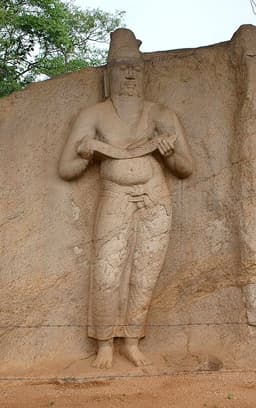
Parakramabahu I
Emperor · Medieval
66.1Total

Wu Zetian
Emperor · Medieval
70.0Total
Basic Information
Born
1123
624
Died
1186
705
Era
Medieval
Medieval
Nationality
Sri Lanka
China
Occupation
Emperor
Emperor
Civilization
Indian
Eastern
Score Comparison
Military (10%)
82.0
60.0
Political (20%)
72.0
62.7
Influence (20%)
61.0
65.0
Legacy (20%)
52.0
80.0
Leadership (15%)
82.0
78.0
Strategy (15%)
65.4
66.3
TOTAL
66.1
70.0
Parakramabahu I — Complete Timeline
1153 AD
Unification of Sri LankaWar
Parakramabahu I unified the entire island of Sri Lanka under his rule after a series of military campaigns. He defeated the rulers of Ruhuna and other regional kingdoms, ending a period of fragmentation.
Impact: national
1160 AD
Construction of Parakrama SamudraOther◆ Major
Parakramabahu I constructed the Parakrama Samudra, a massive man-made sea of interconnected tanks and canals near Polonnaruwa. This irrigation system, covering over 5,000 acres, was a major engineering achievement.
Impact: regionalconstructive
1165 AD
Invasion of BurmaWar◆ Major
Parakramabahu I launched a naval invasion of Burma (Pagan Kingdom) in retaliation for a trade dispute. The Sinhalese fleet captured the port of Kusumiya and sacked the city, demonstrating Sri Lanka's naval power.
Impact: regional
Reform of the Buddhist SanghaReform◆ Major
Parakramabahu I convened a council to purify the Buddhist Sangha. He expelled corrupt monks and re-established discipline, strengthening Theravada Buddhism in Sri Lanka.
Impact: nationalconstructive
1170 AD
Construction of Polonnaruwa VatadageCultural◆ Major
Parakramabahu I built the Polonnaruwa Vatadage, a circular relic house for the Tooth Relic of the Buddha. This structure is considered a masterpiece of Sinhalese architecture.
Impact: nationalconstructive
Wu Zetian — Complete Timeline
655 AD
Became Empress ConsortPolitical Action◆ Major
Wu Zetian was elevated from concubine to empress consort of Emperor Gaozong of Tang in 655. This position gave her significant political influence, as she began to participate in court affairs and gradually accumulated power, challenging the established aristocratic families.
Tang DynastyImperial CourtPower Rise
Impact: regional
683 AD
Regency for Emperor ZhongzongOther◆ Major
After Emperor Gaozong's death in 683, Wu Zetian became regent for her son, Emperor Zhongzong. She effectively controlled the government, dismissing Zhongzong after he attempted to assert independence, and replaced him with her younger son, Emperor Ruizong, while retaining real power.
Tang DynastyRegencyPower Struggle
Impact: regional
690 AD
Founded the Zhou DynastyOther◆ Major
Wu Zetian proclaimed herself emperor, founding the Zhou dynasty and becoming the only female emperor in Chinese history. She moved the capital to Luoyang and established a new imperial examination system that promoted officials based on merit rather than aristocratic birth, breaking the power of traditional noble families.
Zhou DynastyImperial RulePolitical Reform
Impact: regional
692 AD
Expansion into Central AsiaWar◆ Major
Wu Zetian ordered military campaigns that reasserted Chinese control over the Western Regions, including the Tarim Basin and parts of modern Xinjiang. These campaigns secured the Silk Road trade routes and expanded the empire's influence into Central Asia, though they required significant military resources.
Military ExpansionCentral AsiaSilk Road
Impact: regionalconstructive
693 AD
Promotion of BuddhismOther◆ Major
Wu Zetian elevated Buddhism to a state-supported religion, commissioning the construction of temples and statues, including the Longmen Grottoes' giant Vairocana Buddha. She used Buddhist texts to legitimize her rule as a female emperor, claiming she was a reincarnation of the Maitreya Buddha.
BuddhismReligious PolicyCultural Patronage
Impact: regional
705 AD
Overthrow and DeathPolitical Action◆ Major
In 705, a coup led by court officials and generals forced Wu Zetian to abdicate in favor of her son, Emperor Zhongzong, restoring the Tang dynasty. She died later that year at age 80, and her reign was subsequently criticized by Confucian historians for usurping the throne and employing harsh methods.
Tang DynastyCoupAbdication
Impact: regionaldestructive
Expert Analysis
Wu Zetian vs Parakramabahu I
### The Emperor and the King: Two Paths to Power in a Medieval World
In the year 690, in the Forbidden City of Chang’an, a woman of sixty-six donned the imperial yellow robe, a garment no woman had ever worn, and declared herself Emperor of China. Half a world away, in the island kingdom of Sri Lanka, a young prince named Parakramabahu was just beginning to plot his rise. One seized power through a palace of whispers and shadows; the other through the clash of armies on a battlefield. Both would reshape their civilizations. But what drove them? And why did one ascend to a lonely, unprecedented throne, while the other unified an island through sheer martial will?
### Origins
Wu Zetian was born in 624, the daughter of a wealthy timber merchant who had risen to become a minor official. Her world was the Tang dynasty, a golden age of cosmopolitan culture and imperial ambition. Yet for a woman, the path was narrow: she entered the palace at age fourteen as a concubine of Emperor Taizong, a fifth-rank “talented one” among thousands. Her intellect was her only weapon. She read history, poetry, and statecraft, and she learned to read men—their ambitions, their fears, and their weaknesses.
Parakramabahu I, born in 1123, was a prince of the Sinhalese royal house, but his world was fractured. Sri Lanka had fallen into chaos after the decline of the Anuradhapura kingdom, with rival chieftains carving up the land. His father, King Manabharana, ruled only a small principality. Parakramabahu grew up in a world where power was taken, not inherited—a world of constant war, where the sword spoke louder than the scroll. His education was martial: strategy, logistics, and the art of command.
The difference in their origins is stark: Wu Zetian had to navigate a rigid, male-dominated hierarchy where influence was subtle and deadly; Parakramabahu faced a fragmented landscape where victory was literal and immediate.
### Rise to Power
Wu Zetian’s ascent was a masterclass in political survival. After Emperor Taizong’s death in 649, she was sent to a convent—the fate of childless concubines. But she had cultivated a relationship with Taizong’s son, the new Emperor Gaozong. Legend holds she wrote him a poem of longing, and he recalled her to the palace. Once there, she eliminated rivals with chilling precision: she allegedly suffocated her own infant daughter to frame the empress, and had the empress and her rival brutally mutilated and left to die in a vat of wine. By 660, she was effectively ruling China behind Gaozong’s failing health. In 690, she formally ended the Tang dynasty and founded her own Zhou dynasty, the only woman in Chinese history to rule as emperor.
Parakramabahu’s rise was simpler, bloodier, and more straightforward. In 1153, after a decade of civil war, he marched against his uncle, King Gajabahu II, who held the northern capital of Polonnaruwa. The decisive battle was at the fort of Palatha. Parakramabahu’s army, hardened by years of campaigning, broke through the defenses. He captured Gajabahu and forced him into exile. With that victory, he unified the entire island of Sri Lanka under a single rule for the first time in centuries.
Where Wu Zetian used intrigue, Parakramabahu used iron. Both achieved their goal, but the cost was different: one left a trail of corpses in the palace, the other a field of ashes beyond the city walls.
### Leadership & Governance
Wu Zetian’s rule was a paradox of repression and reform. She crushed rebellions, executed thousands of aristocrats who opposed her, and created a secret police to root out dissent. Yet she also broke the monopoly of the old noble families by expanding the imperial examination system, promoting talented commoners to high office. She encouraged Buddhism, commissioning the Longmen Grottoes’ colossal statues, and expanded China’s borders deep into Central Asia. Her military score of 62.0 reflects her mixed record: her generals won campaigns, but she also suffered defeats against the Tibetans and Turks. Her political score of 80.0 captures her genius for statecraft.
Parakramabahu I was a builder-king. His greatest achievement was the Parakrama Samudra, a massive artificial sea of interconnected reservoirs and canals constructed around 1160, which irrigated thousands of acres and transformed Sri Lanka’s agriculture. He also reformed the Buddhist Sangha in 1165, expelling corrupt monks and restoring discipline—a spiritual counterpart to his physical works. His military campaigns were aggressive: in 1165, he launched a naval invasion of Burma’s Pagan Kingdom over a trade dispute, a daring expedition that showed his strategic boldness (strategy score 72.0). But his governance was less about political innovation than about consolidation and construction.
The difference is clear: Wu Zetian reshaped China’s political system; Parakramabahu reshaped its landscape.
### Triumph & Tragedy
Wu Zetian’s triumph was her longevity. She ruled for fifteen years as emperor, and for nearly half a century as the power behind the throne. She died in 705 at age eighty-one, not from rebellion but from old age. Her tragedy was that her dynasty lasted only fifteen years after her death; the Tang was restored, and her name was vilified by later Confucian historians who could not forgive a woman for seizing the throne.
Parakramabahu’s triumph was his unification of Sri Lanka and the construction of the Polonnaruwa Vatadage in 1170, a circular relic house for the Buddha’s Tooth, which became a symbol of his golden age. His tragedy was that his conquests were fleeting. His invasion of Burma, though a tactical success, failed to establish lasting control. And after his death in 1186, his kingdom fragmented once more into warring factions.
### Character & Destiny
Wu Zetian was ruthless, brilliant, and deeply insecure. Her need for legitimacy drove her to purge the nobility, yet she also surrounded herself with talented advisors. She was a woman who had to be twice as capable as any man, and twice as cruel. Her personality was forged in the crucible of the harem, where trust was a liability.
Parakramabahu was a warrior-king in the ancient mold: proud, energetic, and confident. His motto, recorded in the chronicles, was “Not even a drop of water that falls from the sky should be allowed to escape to the sea without being used for the benefit of man.” He saw nature as a resource to be commanded, and his character reflected that ambition.
Their destinies were shaped by their worlds: Wu Zetian’s China was a sophisticated empire where power was a game of chess; Parakramabahu’s Sri Lanka was a fractured island where power was a game of war.
### Legacy
Wu Zetian’s legacy is contested. To some, she is a visionary who broke the ultimate glass ceiling; to others, a tyrannical usurper. Her influence score of 70.9 is modest, but her legacy score of 85.0 reflects her enduring fascination. She remains the only female emperor in Chinese history, a figure of endless debate.
Parakramabahu I is remembered as the greatest king of medieval Sri Lanka. His irrigation works still function today, and the Vatadage is a UNESCO World Heritage site. But his legacy score of 68.6 is lower, partly because his kingdom did not last, and partly because Sri Lanka’s history is less globally known.
### Conclusion
Standing at the edge of the Parakrama Samudra, watching the still water mirror the sky, one feels the weight of a king’s vision. And standing in the shadow of the Longmen Grottoes’ great Buddha, carved by Wu Zetian’s command, one feels the weight of an empress’s ambition. Both sought to shape the world to their will. One succeeded through water and stone; the other through ink and blood. Their differences are the differences of their civilizations, their genders, and their times. Yet both understood the same truth: that power is a river, and only the bold can build a dam.
Rankings
🥇
Wu ZetianLeader
Mil: 60.0Pol: 62.7Inf: 65.0
70.0
🥈
Parakramabahu I
Mil: 82.0Pol: 72.0Inf: 61.0
66.1
+3.9 behind
How This Comparison Works
Algorithm
Each figure is scored on 6 dimensions (0—100 scale) based on structured historical data: Military (10%), Political (20%), Influence (20%), Legacy (20%), Leadership (15%), Strategy (15%). The weighted total produces the final ranking.
Data Sources
Scores are computed from structured sub-indicators in the database. Scale factors adjust for era (Ancient ×0.85, Modern ×1.0) and civilization size (Eastern ×1.05, Other ×0.80) to account for differences in population and military scale.
Maximum 3 Figures
Comparisons are limited to 2—3 figures to ensure readability and statistical meaningfulness.
Error Margins
±5 points per dimension — Sub-scores are derived from historical records with inherent uncertainty. Two figures within 5 points on a dimension should be considered roughly equivalent in that area.
Total Score Accuracy
±3 points overall — The weighted combination of 6 dimensions produces a total score with approximately ±3 points of uncertainty. Differences of less than 3 points are not statistically significant— the figures are effectively tied.
Known Limitations
- Historical records are incomplete and uneven across civilizations
- Figures from oral-tradition societies may be underrepresented
- Occupation labels can misclassify multi-role figures
- Scores measure capability and impact, not moral character
- Quantitative scoring is a comparison tool, not absolute truth
Capability Radar
Military (10%) — Battles & Warfare
Battles
75
65
Win Rate
80
70
Expansion
70
75
Political (20%) — Governance & Reform
Reform
80
85
Diplomacy
70
80
Economy
75
85
Influence (20%) — Cultural & Global Reach
Cultural
65
85
Global
40
70
Legacy (20%) — Historical Impact
Historical
70
90
Longevity
60
85
Leadership (15%) — Power & Stability
Tenure
85
90
Stability
80
75
Strategy (15%) — Tactics & Innovation
Strategy
75
75
Tactics
70
60
Reform
65
80
Similar Comparisons
Comments & Discussion
数据拆解师6/16/2026
拿领土面积说事纯属外行看热闹。吴则天的有效统治半径撑死八百公里,唐朝中央对地方的掌控力在武则天时期实际在萎缩。帕拉卡马巴胡一世统治的波隆纳鲁沃王国面积虽小,但他在1153年实现斯里兰卡全岛统一后,建立了比唐朝更高效的税收体系——碑文显示他甚至精确计算到每棵椰子树年产量。真正的基建狂魔在这边,别拿人口基数耍流氓。
重修史学家6/16/2026
你们都在复制唐朝官方那套“女皇圣明”的叙事。看看《资治通鉴》怎么记载的:武则天为集权,在690年登基时默许来俊臣罗织罪名,四年内杀了至少三千官员。帕拉卡马巴胡统一斯里兰卡后,碑文记载的是修建灌溉系统、给寺庙免税。一个是用人命堆出权力,一个是用建设巩固统一。我选水稻田,不要血染的龙袍。
Historian7176/16/2026
Let the records speak: Wu Zetian’s own Liangzhou Rebellion Memorial admits she “pacified the northwest with silk, not steel.” She bribed the Tibetans while calling it diplomacy. Parakramabahu’s Galpota Slab Inscription boasts of “breaking the bows of the Chola navy and seizing thirty ships.” One destroyed a fleet, the other bought off barbarians. There is no contest in martial legacy. Wu was a master of shadow games, not war.
Historian9036/16/2026
Anyone who pairs Wu Zetian with Parakramabahu is committing category fraud. She ruled the largest empire on Earth through bureaucratic genius and ruthless court intrigue—he conquered a small island with brute force. Give me a break. Wu’s 655 AD purge of the pro-military faction showed she understood civilian supremacy better than most Tang generals. Parakramabahu? His “great victory” at Polonnaruwa in 1165 was against village levies. Comparing them is like pitting a chess grandmaster against a b
Chronicler34936/16/2026
Parakramabahu’s Polonnaruwa victory was against a Chola garrison of perhaps 2,000 men—a skirmish by Tang standards. Wu Zetian’s general Heichi Changzhi crushed the Eastern Turks in 699 with 30,000 cavalry. He wasn’t bribing anyone. And when Wu purged the Li family nobility in 691, she executed 100,000 people in a single year. That’s not political genius—that’s genocide. Don’t romanticize. Both built, both killed. Parakramabahu just aimed smaller.