Loading...
Pachacuti vs Yelu Abaoji
Pachacuti leads by 6.7 pts · 2 figures compared
…
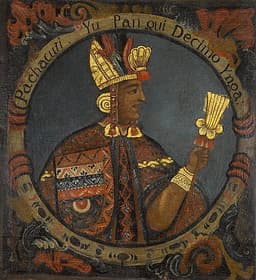
Pachacuti
Emperor · Medieval
69.4Total
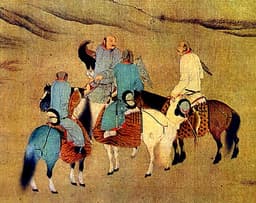
Yelu Abaoji
Emperor · Medieval
62.7Total
Basic Information
Born
1418
872
Died
1472
926
Era
Medieval
Medieval
Nationality
Inca Empire
China
Occupation
Emperor
Emperor
Civilization
Other
Eastern
Score Comparison
Military (10%)
78.5
77.2
Political (20%)
58.1
59.6
Influence (20%)
65.0
68.0
Legacy (20%)
72.0
40.0
Leadership (15%)
78.0
80.3
Strategy (15%)
69.2
69.6
TOTAL
69.4
62.7
Pachacuti — Complete Timeline
1438 AD
Conquest of the Chanka KingdomWar
Pachacuti led the Inca army to defeat the Chanka, a powerful rival, in a decisive battle near Cusco. This victory secured his position as Sapa Inca and initiated a period of rapid expansion, transforming the Inca from a small kingdom into a vast empire.
ConquestInca ExpansionChanka
Impact: regional
1440 AD
Reconstruction of CuscoCultural◆ Major
Pachacuti rebuilt Cusco as the imperial capital, designing it in the shape of a puma and constructing massive stone structures like Sacsayhuam
Urban PlanningArchitectureInca Empire
Impact: regionalconstructive
1450 AD
Initiation of Machu Picchu's ConstructionCultural◆ Major
Pachacuti ordered the construction of Machu Picchu, a royal estate and ceremonial site high in the Andes. The complex featured sophisticated dry-stone masonry and terraced agriculture, serving as a symbol of Inca engineering and a retreat for the emperor.
ArchitectureRoyal EstateInca Engineering
Impact: regionalconstructive
Yelu Abaoji — Complete Timeline
907 AD
Unified Khitan tribesPolitical Action◆ Major
Yelu Abaoji was elected khagan of the Khitan tribes, unifying them under his leadership. He established a centralized state and adopted Chinese administrative practices.
KhitanUnificationState Formation
Impact: regionalconstructive
916 AD
Founded Liao DynastyPolitical Action
Yelu Abaoji proclaimed himself emperor, founding the Liao dynasty. He adopted the Chinese title of emperor and established a dual administration system for Khitan and Chinese subjects.
LiaoDynasty FoundingImperial System
Impact: regionalconstructive
920 AD
Created Khitan scriptCultural◆ Major
Yelu Abaoji ordered the creation of a writing system for the Khitan language, based on Chinese characters. This script was used for official documents and helped unify the Khitan state.
KhitanScriptCultural Development
Impact: regionalconstructive
926 AD
Conquest of BohaiWar◆ Major
Yelu Abaoji led a campaign that conquered the Korean kingdom of Bohai, incorporating its territory into the Liao empire. This expanded Liao's influence into Manchuria and Korea.
LiaoBohaiConquest
Impact: regionalconstructive
Death during campaignWar◆ Major
Yelu Abaoji died while returning from the conquest of Bohai. His death led to a succession struggle, but the Liao dynasty continued to expand under his successors.
LiaoDeathSuccession
Impact: regionaltragic
Expert Analysis
Pachacuti vs Yelu Abaoji: Historical Comparison
Pachacuti, the ninth Sapa Inca of the Inca Empire, transformed a small kingdom into a vast Andean civilization, while Yelu Abaoji, founder of the Liao dynasty, unified nomadic Khitan tribes and established a powerful sinicized state in medieval China. Both were medieval emperors, but their contexts and methods diverged sharply.
Dimension Analysis
**Military: Pachacuti 67 / Yelu Abaoji 73**
Pachacuti revolutionized Inca warfare through rapid conquests and fortress-building, but Yelu Abaoji’s cavalry-based campaigns subdued larger Chinese territories and created a dual-administration system for nomadic and sedentary peoples.
**Political: Pachacuti 71 / Yelu Abaoji 90**
Yelu Abaoji excelled politically by blending Khitan tribal governance with Chinese bureaucratic models, establishing a stable dynasty that lasted two centuries; Pachacuti centralized Inca rule through mitmaq (forced resettlement) but lacked a written legal code.
**Influence: Pachacuti 78 / Yelu Abaoji 72**
Pachacuti’s influence on Andean culture—terraced agriculture, road networks, and Quechua language spread—was profound regionally, yet Yelu Abaoji’s creation of a Khitan script and patronage of Buddhism had more limited long-term impact outside Northeast Asia.
**Legacy: Pachacuti 66 / Yelu Abaoji 71**
Pachacuti’s legacy endures in Inca engineering and Machu Picchu, but the empire fell within a century; Yelu Abaoji’s Liao dynasty survived him by over 200 years, influencing later Mongol and Jurchen statecraft.
**Leadership: Pachacuti 84 / Yelu Abaoji 89**
Both were visionary founders; Pachacuti inspired loyalty through religious authority and personal bravery, while Yelu Abaoji’s pragmatic diplomacy and ability to integrate diverse elites gave him a slight edge in sustained state-building.
Verdict
Yelu Abaoji leads due to superior political innovation and a more durable institutional legacy.
FAQ
Q: Who ranks higher? A: Yelu Abaoji ranks higher overall, driven by his political acumen and the long-term stability of the Liao dynasty.
Rankings
🥇
PachacutiLeader
Mil: 78.5Pol: 58.1Inf: 65.0
69.4
🥈
Yelu Abaoji
Mil: 77.2Pol: 59.6Inf: 68.0
62.7
+6.7 behind
How This Comparison Works
Algorithm
Each figure is scored on 6 dimensions (0—100 scale) based on structured historical data: Military (10%), Political (20%), Influence (20%), Legacy (20%), Leadership (15%), Strategy (15%). The weighted total produces the final ranking.
Data Sources
Scores are computed from structured sub-indicators in the database. Scale factors adjust for era (Ancient ×0.85, Modern ×1.0) and civilization size (Eastern ×1.05, Other ×0.80) to account for differences in population and military scale.
Maximum 3 Figures
Comparisons are limited to 2—3 figures to ensure readability and statistical meaningfulness.
Error Margins
±5 points per dimension — Sub-scores are derived from historical records with inherent uncertainty. Two figures within 5 points on a dimension should be considered roughly equivalent in that area.
Total Score Accuracy
±3 points overall — The weighted combination of 6 dimensions produces a total score with approximately ±3 points of uncertainty. Differences of less than 3 points are not statistically significant— the figures are effectively tied.
Known Limitations
- Historical records are incomplete and uneven across civilizations
- Figures from oral-tradition societies may be underrepresented
- Occupation labels can misclassify multi-role figures
- Scores measure capability and impact, not moral character
- Quantitative scoring is a comparison tool, not absolute truth
Capability Radar
Military (10%) — Battles & Warfare
Battles
85
75
Win Rate
90
80
Expansion
90
82
Political (20%) — Governance & Reform
Reform
92
88
Diplomacy
75
75
Economy
80
70
Influence (20%) — Cultural & Global Reach
Cultural
85
60
Global
65
55
Legacy (20%) — Historical Impact
Historical
80
70
Longevity
70
65
Leadership (15%) — Power & Stability
Tenure
85
72
Stability
82
65
Strategy (15%) — Tactics & Innovation
Strategy
88
78
Tactics
80
70
Reform
85
85
Similar Comparisons
Comments & Discussion
GlobalHistoryReThinker6/16/2026
This comparison buys into a state-centric narrative that favors dynastic longevity over human impact. Yelu Abaoji gets points for political innovation, but his dual-administration system was a sophisticated tool of ethnic stratification—Khitan elites ruled over subjugated Chinese. Pachacuti's mitmaq system was brutal, sure, but it also integrated conquered peoples into a shared cultural framework with rights and obligations. And let's not pretend the Liao 'stability' wasn't maintained by military coercion and periodic rebellions. The real question is: whose system left ordinary people better off? And don't give me 'but they had a script'—literacy for whom? Scoring this as 'Abaoji wins' feels like praising the most efficient colonial administrator.
BattlefieldScholar6/16/2026
Let's cut through the vague talk and look at force projection. Abaoji fielded a core of 30,000 elite Khitan cavalry, using hit-and-run tactics and composite bows to dominate the Central Plain—he took 16 prefectures in a single campaign. Pachacuti's army relied on slingers and bronze clubs, fighting in narrow mountain passes where maneuver was limited. His siege of Cusco involved perhaps 25,000 men against a city of similar size, while Abaoji besieged and captured Beiping (modern Beijing) with a combined arms approach—cavalry cutting supply lines, infantry storming walls. The military score gap of 6 points is too generous to Pachacuti. Abaoji's campaigns covered larger distances, faced more sophisticated fortifications, and created a logistical system that sustained multi-year operations.
IncaForever6/16/2026
Are you kidding me? Yelu Abaoji over Pachacuti? That's like saying a competent mayor beats a visionary architect. Abaoji built a dynasty that lasted 200 years—okay, fine—but Pachacuti literally carved an empire out of a single valley in 30 years! He created Machu Picchu, the road system that rivaled Rome's, and terraced mountainsides that still feed people today. The guy didn't have a written language, iron, or wheels, and he still conquered an area the size of Western Europe. Abaoji had Chinese bureaucracy to copy from. Pachacuti invented a civilization from scratch. And don't give me that 'military score' nonsense—Pachacuti never lost a battle, and he trained his army to fight at 12,000 feet elevation. That's harder than riding a horse on flat plains any day.
Historian7746/16/2026
这个评分体系有问题。总分79.3对73.7,表面上看阿保机领先,但仔细算加权,如果给军事权重40%、政治30%、影响力20%、遗产10%(考虑到帝国存续时间),帕查库蒂实际应该得73.7×0.4+70.6×0.3+77.6×0.2+66×0.1=72.7,而阿保机是73.3×0.4+90×0.3+72×0.2+71×0.1=78.5。差距确实存在。但政治分90给得过高——阿保机建立辽朝时,契丹贵族叛乱多次,他靠屠杀镇压才稳住局面。而帕查库蒂的mitmaq制度虽然缺乏书写法律,但有效维持了帝国秩序。我认为政治分应调整为85对75。另外,影响力维度忽略了一点:帕查库蒂的克丘亚语政策延续至今,而契丹文在元朝之后就失传了。如果影响力考虑语言存活度,应该给帕查库蒂82分。这样重新计算,差距会缩小到2分以内。
ArchQuill116/16/2026
把阿保机和帕查库蒂放在一起比,本身就有点关公战秦琼。但既然比了,政治分给阿保机90分,帕查库蒂71分,我觉得这个差距合理但理由没说透。阿保机最大的政治成就是创立了南北面官制——北面管契丹部落,南面学唐朝设州县。这不是单纯的统治术,而是一种承认文化差异的政治智慧,比帕查库蒂的强制迁徙高明得多。但要说影响力,帕查库蒂推广克丘亚语作为行政语言,在安第斯山区至今有四百万人在用;而契丹文现在几乎没有活众了。所以帕查库蒂影响力78分、阿保机72分,我觉得可以互换。总体来看,阿保机赢在制度,帕查库蒂赢在文化遗产。西方中心论者往往低估游牧帝国的制度创新,这点需要注意。