Loading...
Pachacuti vs Wu Zetian
Wu Zetian leads by 0.6 pts · 2 figures compared
…
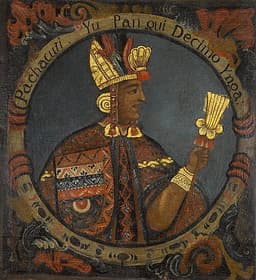
Pachacuti
Emperor · Medieval
69.4Total

Wu Zetian
Emperor · Medieval
70.0Total
Basic Information
Born
1418
624
Died
1472
705
Era
Medieval
Medieval
Nationality
Inca Empire
China
Occupation
Emperor
Emperor
Civilization
Other
Eastern
Score Comparison
Military (10%)
78.5
60.0
Political (20%)
58.1
62.7
Influence (20%)
65.0
65.0
Legacy (20%)
72.0
80.0
Leadership (15%)
78.0
78.0
Strategy (15%)
69.2
66.3
TOTAL
69.4
70.0
Pachacuti — Complete Timeline
1438 AD
Conquest of the Chanka KingdomWar
Pachacuti led the Inca army to defeat the Chanka, a powerful rival, in a decisive battle near Cusco. This victory secured his position as Sapa Inca and initiated a period of rapid expansion, transforming the Inca from a small kingdom into a vast empire.
ConquestInca ExpansionChanka
Impact: regional
1440 AD
Reconstruction of CuscoCultural◆ Major
Pachacuti rebuilt Cusco as the imperial capital, designing it in the shape of a puma and constructing massive stone structures like Sacsayhuam
Urban PlanningArchitectureInca Empire
Impact: regionalconstructive
1450 AD
Initiation of Machu Picchu's ConstructionCultural◆ Major
Pachacuti ordered the construction of Machu Picchu, a royal estate and ceremonial site high in the Andes. The complex featured sophisticated dry-stone masonry and terraced agriculture, serving as a symbol of Inca engineering and a retreat for the emperor.
ArchitectureRoyal EstateInca Engineering
Impact: regionalconstructive
Wu Zetian — Complete Timeline
655 AD
Became Empress ConsortPolitical Action◆ Major
Wu Zetian was elevated from concubine to empress consort of Emperor Gaozong of Tang in 655. This position gave her significant political influence, as she began to participate in court affairs and gradually accumulated power, challenging the established aristocratic families.
Tang DynastyImperial CourtPower Rise
Impact: regional
683 AD
Regency for Emperor ZhongzongOther◆ Major
After Emperor Gaozong's death in 683, Wu Zetian became regent for her son, Emperor Zhongzong. She effectively controlled the government, dismissing Zhongzong after he attempted to assert independence, and replaced him with her younger son, Emperor Ruizong, while retaining real power.
Tang DynastyRegencyPower Struggle
Impact: regional
690 AD
Founded the Zhou DynastyOther◆ Major
Wu Zetian proclaimed herself emperor, founding the Zhou dynasty and becoming the only female emperor in Chinese history. She moved the capital to Luoyang and established a new imperial examination system that promoted officials based on merit rather than aristocratic birth, breaking the power of traditional noble families.
Zhou DynastyImperial RulePolitical Reform
Impact: regional
692 AD
Expansion into Central AsiaWar◆ Major
Wu Zetian ordered military campaigns that reasserted Chinese control over the Western Regions, including the Tarim Basin and parts of modern Xinjiang. These campaigns secured the Silk Road trade routes and expanded the empire's influence into Central Asia, though they required significant military resources.
Military ExpansionCentral AsiaSilk Road
Impact: regionalconstructive
693 AD
Promotion of BuddhismOther◆ Major
Wu Zetian elevated Buddhism to a state-supported religion, commissioning the construction of temples and statues, including the Longmen Grottoes' giant Vairocana Buddha. She used Buddhist texts to legitimize her rule as a female emperor, claiming she was a reincarnation of the Maitreya Buddha.
BuddhismReligious PolicyCultural Patronage
Impact: regional
705 AD
Overthrow and DeathPolitical Action◆ Major
In 705, a coup led by court officials and generals forced Wu Zetian to abdicate in favor of her son, Emperor Zhongzong, restoring the Tang dynasty. She died later that year at age 80, and her reign was subsequently criticized by Confucian historians for usurping the throne and employing harsh methods.
Tang DynastyCoupAbdication
Impact: regionaldestructive
Expert Analysis
Pachacuti vs Wu Zetian
# The Throne and the Mountain
In the winter of 690, a sixty-six-year-old woman climbed the steps of the imperial palace in Luoyang, China, and declared herself emperor—the only woman in four thousand years of Chinese history to do so. Half a world away and seven centuries earlier, a young prince named Pachacuti stood on a hillside overlooking the sacred valley of Cusco, watching his father flee before the advancing Chanka army, then turned to face the enemy alone. Two figures, separated by time and geography, each carved an empire from the raw material of ambition. Yet their paths, their methods, and their legacies could not have diverged more sharply.
Origins
Wu Zetian was born in 624, the daughter of a wealthy timber merchant who had risen to minor official rank. In Tang China, where Confucian tradition bound women to the inner quarters, a girl of her station had few prospects beyond marriage. When she was fourteen, her beauty caught the eye of Emperor Taizong, who brought her into the palace as a low-ranking concubine. For twelve years she served him, learning the brutal calculus of court politics—every glance a weapon, every word a gambit. Taizong’s death in 649 should have sealed her fate: by custom, childless concubines were sent to Buddhist convents. But she had already seduced his son, the future Emperor Gaozong. Within a year, she was back in the palace, pregnant with his child.
Pachacuti’s beginnings were more auspicious. Born in 1418 to the Sapa Inca Viracocha, he was a prince of the ruling dynasty, raised in Cusco’s stone palaces amid the priests and generals who governed a kingdom still modest in scale. The Incas then controlled only the valley of Cusco and its immediate surroundings, surrounded by more powerful neighbors like the Chanka. Pachacuti’s name at birth was Cusi Yupanqui, meaning “happy and honored.” He would earn his later name, which means “he who remakes the world.”
Rise to Power
The turning point came in 1438, when the Chanka kingdom launched a massive assault on Cusco. Viracocha, believing the city doomed, fled with his chosen heir. But the young prince refused to retreat. Gathering what warriors remained, he led a desperate counterattack that drove the Chanka back and shattered their army. The victory was so complete that Viracocha abdicated in shame, and Pachacuti seized the throne. He did not wait for destiny—he took it.
Wu Zetian’s rise was more patient, more serpentine. After Gaozong suffered a stroke in 660, she began ruling through him, reading memorials and issuing decrees under his seal. When he died in 683, she maneuvered her sons onto the throne and then deposed them, eliminating rivals with a ruthlessness that became legend. She executed officials, exiled princes, and crushed a rebellion led by her own son. In 690, she finally cast aside the pretense: she founded the Zhou dynasty and took the title of emperor.
Leadership & Governance
Pachacuti governed as a conqueror-architect. After securing Cusco, he launched a series of campaigns that expanded Inca dominion from a small kingdom into an empire stretching from modern Ecuador to Chile. He reorganized the army into disciplined units, built a network of roads and storehouses to supply them, and imposed the Inca religion and Quechua language on conquered peoples. But he also practiced a form of strategic integration: defeated leaders were brought to Cusco, taught Inca customs, and given positions in the imperial bureaucracy. His greatest administrative innovation was the *mit’a* system of rotational labor, which mobilized millions of subjects for public works—roads, terraces, temples—without the use of money or writing.
Wu Zetian ruled through intellect and terror. She expanded the civil service examination system, opening government positions to talented commoners and breaking the monopoly of aristocratic clans. She promoted scholars, poets, and Buddhists, commissioning the translation of sutras and building temples. Yet her court was a theater of suspicion: secret police monitored officials, informants whispered accusations, and torture was routine. She executed or exiled thousands, including her own children. Her political genius lay in her ability to balance factions—Buddhist clergy against Confucian bureaucrats, northern generals against southern scholars—while keeping absolute power in her own hands.
Triumph & Tragedy
Pachacuti’s greatest triumph was the transformation of Cusco itself. In 1440, he rebuilt the city in the shape of a puma, with massive stone walls that fit together without mortar—a feat of engineering that still puzzles modern observers. Around 1450, he ordered the construction of Machu Picchu, a royal estate perched on a mountain ridge above the Urubamba River. It was a place of beauty and power, designed to awe both gods and men. His tragedy came in the form of succession: he chose his son Topa Inca as heir, but the transition was fraught with intrigue, and the empire he built would fall to Spanish conquistadors within a century of his death.
Wu Zetian’s triumph was her very existence: she ruled for fifteen years as emperor, a feat unprecedented and unrepeated in Chinese history. She expanded the empire into Central Asia, secured the Silk Road, and left a treasury so full that her successors had no need to raise taxes for decades. Her tragedy was the collapse of her dynasty upon her death in 705. A coup forced her to abdicate, and the Tang dynasty was restored. Her seven sons and grandsons were killed or exiled. The Zhou dynasty vanished as if it had never been.
Character & Destiny
Pachacuti was a builder. His personality was that of a man who believed the world could be reshaped—mountains terraced, rivers channeled, cities carved from stone. He was ruthless when necessary but not cruel for its own sake; his conquests were followed by integration, not annihilation. He saw empire as a sacred duty, a cosmic order to be imposed on chaos.
Wu Zetian was a survivor. Every decision she made was shaped by the knowledge that she was a woman in a world that hated female power. She could trust no one, not even her children, because her position depended on constant vigilance. Her cruelty was calculated, her patronage strategic. She ruled not to build a new world but to prove she could master the old one.
Legacy
Today, Pachacuti is remembered as the father of the Inca Empire, a figure of national pride in Peru. Machu Picchu draws millions of visitors who marvel at his vision. Wu Zetian remains a figure of fascination and controversy—admired for her political acumen, reviled for her brutality. A blank stone tablet stands at her tomb, inscribed with no words, as if she knew that history would never agree on what to say about her.
Conclusion
One built a mountain palace that still stands; the other built a dynasty that vanished. One conquered with armies; the other with intelligence and terror. Pachacuti remade the world in stone; Wu Zetian remade it in flesh and blood. Both achieved what seemed impossible—a prince who saved his kingdom, a woman who became emperor. But their different fates remind us that power is never merely personal. It is shaped by the tools available, the enemies at hand, and the stories a culture tells about who is allowed to rule. In the end, the mountain endures; the throne does not.
Rankings
🥇
Wu ZetianLeader
Mil: 60.0Pol: 62.7Inf: 65.0
70.0
🥈
Pachacuti
Mil: 78.5Pol: 58.1Inf: 65.0
69.4
+0.6 behind
How This Comparison Works
Algorithm
Each figure is scored on 6 dimensions (0—100 scale) based on structured historical data: Military (10%), Political (20%), Influence (20%), Legacy (20%), Leadership (15%), Strategy (15%). The weighted total produces the final ranking.
Data Sources
Scores are computed from structured sub-indicators in the database. Scale factors adjust for era (Ancient ×0.85, Modern ×1.0) and civilization size (Eastern ×1.05, Other ×0.80) to account for differences in population and military scale.
Maximum 3 Figures
Comparisons are limited to 2—3 figures to ensure readability and statistical meaningfulness.
Error Margins
±5 points per dimension — Sub-scores are derived from historical records with inherent uncertainty. Two figures within 5 points on a dimension should be considered roughly equivalent in that area.
Total Score Accuracy
±3 points overall — The weighted combination of 6 dimensions produces a total score with approximately ±3 points of uncertainty. Differences of less than 3 points are not statistically significant— the figures are effectively tied.
Known Limitations
- Historical records are incomplete and uneven across civilizations
- Figures from oral-tradition societies may be underrepresented
- Occupation labels can misclassify multi-role figures
- Scores measure capability and impact, not moral character
- Quantitative scoring is a comparison tool, not absolute truth
Capability Radar
Military (10%) — Battles & Warfare
Battles
85
65
Win Rate
90
70
Expansion
90
75
Political (20%) — Governance & Reform
Reform
92
85
Diplomacy
75
80
Economy
80
85
Influence (20%) — Cultural & Global Reach
Cultural
85
85
Global
65
70
Legacy (20%) — Historical Impact
Historical
80
90
Longevity
70
85
Leadership (15%) — Power & Stability
Tenure
85
90
Stability
82
75
Strategy (15%) — Tactics & Innovation
Strategy
88
75
Tactics
80
60
Reform
85
80
Similar Comparisons
Comments & Discussion
MountainMaker6/16/2026
Pachacuti wins this hands down. Wu Zetian manipulated court intrigue and slept her way to power—clever, sure, but she inherited a functioning Tang bureaucracy. Pachacuti literally invented an empire from scratch while his dad ran away. The guy single-handedly turned Cusco from a village into the capital of the largest pre-Columbian empire in the Americas. That's not politics; that's god-tier state-building.
碑文侦探6/16/2026
说武则天靠美色上位,典型是史记读太少。她十四岁入宫,服侍两代皇帝二十六年,中间还在感业寺出家三年,六十岁才称帝。你们只看见她睡男人,没看见她废太子、改科举、设北门学士、迁都洛阳。军事上打下半朝鲜,经济上人口翻倍。这些政绩哪个男人做不到?你们就说她是睡的。
DataSkepticDan6/16/2026
Let's look at numbers, not romantic narratives. Wu Zetian ruled ~15 years as emperor over 60 million people in a literate, monetized economy. Pachacuti ruled ~30 years over maybe 5-10 million in an oral, non-literate society. Wu's reign saw tax records, census data, and codified law—things that actually measure governance. Pachacuti? All we have is oral tradition recorded 200 years later by Spanish priests. That's not history; it's fan fiction.
墨家弟子6/16/2026
你们都说因卡无敌,我却看出结构崩塌之因。帕查库提建的“米塔”徭役制,表面是国有经济,实则是用宗教恐惧压榨百姓。每次征服都要百姓搬去外地种地,文化错位。武则天至少搞了武举,打通底层上升通道。帕查库提?他只修路不修心,没有政治现代化。等西班牙人来,民心早散。军事强不等于治理强。
IncaFanboy6/16/2026
You data nerds miss the point entirely. Pachacuti didn't just conquer—he engineered. Moray's agricultural terraces are still used today. Sacsayhuamán's stones fit so perfectly you can't slide a knife between them. He created an empire that fed itself, communicated by runners who could relay messages 150 miles in a day, and had no writing system—yet managed tax collection, census, and resettlement without it. That's not primitive; that's a different kind of genius.