Loading...
Pachacuti vs Timur
Pachacuti leads by 3.8 pts · 2 figures compared
…
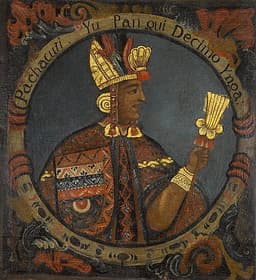
Pachacuti
Emperor · Medieval
69.4Total
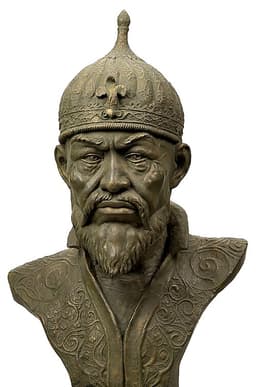
Timur
Emperor · Medieval
65.6Total
Basic Information
Born
1418
1336
Died
1472
1405
Era
Medieval
Medieval
Nationality
Inca Empire
Timurid Empire
Occupation
Emperor
Emperor
Civilization
Other
Middle Eastern
Score Comparison
Military (10%)
78.5
79.0
Political (20%)
58.1
70.0
Influence (20%)
65.0
70.0
Legacy (20%)
72.0
40.0
Leadership (15%)
78.0
79.8
Strategy (15%)
69.2
77.6
TOTAL
69.4
65.6
Pachacuti — Complete Timeline
1438 AD
Conquest of the Chanka KingdomWar
Pachacuti led the Inca army to defeat the Chanka, a powerful rival, in a decisive battle near Cusco. This victory secured his position as Sapa Inca and initiated a period of rapid expansion, transforming the Inca from a small kingdom into a vast empire.
ConquestInca ExpansionChanka
Impact: regional
1440 AD
Reconstruction of CuscoCultural◆ Major
Pachacuti rebuilt Cusco as the imperial capital, designing it in the shape of a puma and constructing massive stone structures like Sacsayhuam
Urban PlanningArchitectureInca Empire
Impact: regionalconstructive
1450 AD
Initiation of Machu Picchu's ConstructionCultural◆ Major
Pachacuti ordered the construction of Machu Picchu, a royal estate and ceremonial site high in the Andes. The complex featured sophisticated dry-stone masonry and terraced agriculture, serving as a symbol of Inca engineering and a retreat for the emperor.
ArchitectureRoyal EstateInca Engineering
Impact: regionalconstructive
Timur — Complete Timeline
1362 AD
Battle of the Terek RiverWar
Timur defeated the Mongol ruler of the Chagatai Khanate, establishing his control over Transoxiana. This victory marked the beginning of his rise to power, as he captured Samarkand and declared himself emir.
Rise to PowerBattleCentral Asia
Impact: regional
1387 AD
Conquest of PersiaWar◆ Major
Timur launched a campaign into Persia, capturing Isfahan and Shiraz. He suppressed a revolt in Isfahan by massacring tens of thousands of inhabitants, establishing his reputation for extreme brutality and consolidating control over the region.
ConquestMassacrePersia
Impact: regionaldestructive
1395 AD
Campaign against the Golden HordeWar◆ Major
Timur defeated the Golden Horde under Tokhtamysh at the Battle of the Terek River. He sacked Sarai, the Horde's capital, and destroyed its trade networks, permanently weakening the Mongol state and securing his northern frontier.
ConquestGolden HordeBattle
Impact: regionaldestructive
1398 AD
Sack of DelhiWar◆ Major
Timur invaded the Delhi Sultanate, defeating Sultan Nasir-ud-Din Mahmud Shah Tughluq. His army sacked Delhi, massacring tens of thousands of civilians and destroying the city's infrastructure, then withdrew with immense plunder.
ConquestMassacreIndia
Impact: regionaldestructive
1402 AD
Battle of AnkaraWar
Timur defeated the Ottoman Sultan Bayezid I at Ankara, capturing him. The victory shattered Ottoman power, leading to a civil war among Bayezid's sons and delaying Ottoman expansion into Europe for a decade.
BattleOttoman EmpireDecisive Victory
Impact: global
1404 AD
Construction of SamarkandCultural◆ Major
Timur invested heavily in transforming Samarkand into a cultural and architectural center. He brought artisans from conquered lands to build mosques, madrasas, and the Bibi-Khanym Mosque, making the city a showcase of Timurid art and learning.
ArchitecturePatronageCultural Center
Impact: regionalconstructive
1405 AD
Death during campaign against Ming ChinaWar◆ Major
Timur died of illness while leading a massive army toward the Ming dynasty's borders. His death ended the planned invasion of China and led to the fragmentation of his empire among his sons and grandsons.
DeathCampaignMing Dynasty
Impact: regional
Expert Analysis
Pachacuti vs Timur
# The Builder and the Destroyer
In the high Andes, a sovereign reshaped mountains into the silhouette of a sacred beast, commanding stone to rise in perfect, seamless walls that still defy explanation. On the steppes of Central Asia, another ruler piled human skulls into towers, leaving cities in ashes and rivers running red, yet ordering the most exquisite tiles and gardens the world had ever seen. How did two men, both born into the turbulence of the fourteenth and fifteenth centuries, follow such divergent paths—one remembered as the father of an empire, the other as its devourer? The answer lies not merely in their deeds, but in the worlds that shaped them.
Origins
Pachacuti was born in 1418 into a small kingdom among the Cusco valley’s competing tribes. His father, the Sapa Inca Viracocha, ruled a modest domain overshadowed by the powerful Chanka confederation to the south. Young Yupanqui—his birth name—grew up watching a people clinging to steep slopes, their survival dependent on terraced fields and mountain passes. The Inca world was one of scarcity and vigilance; every harvest, every alliance, every skirmish mattered. There was no grand imperial tradition to inherit, only the daily struggle to hold what little they had.
Timur, born eighty-two years earlier in 1336 near Samarkand, came from a world already vast and broken. The Mongol Empire, which had once stretched from China to Hungary, was fracturing into warring khanates. Timur’s tribe, the Barlas, were Turco-Mongols, heirs to Genghis Khan’s legacy but impoverished by its collapse. As a young man, Timur tended sheep and led small raids; an arrow wound to his leg and hand in a cattle theft left him lame and with a permanently stiffened hand—hence his Persian nickname, *Timur-e Lang*, “Timur the Lame.” Where Pachacuti inherited a fragile kingdom, Timur inherited a broken dream of world dominion.
Rise to Power
The turning point for Pachacuti came in 1438, when the Chanka army marched on Cusco. His father fled the city, leaving the twenty-year-old prince to defend the capital with a handful of warriors. Against all odds, Pachacuti rallied the terrified populace, ambushed the Chanka in a narrow valley, and routed them. The victory was so complete that the Chanka never recovered. Pachacuti did not merely survive; he transformed survival into legitimacy. He deposed his fleeing father, took the title Sapa Inca, and began the work of conquest.
Timur’s rise was more gradual and treacherous. In 1362, at the Battle of the Terek River, he defeated the Mongol ruler of the Chagatai Khanate, seizing control of Transoxiana. But unlike Pachacuti’s decisive single battle, Timur spent decades maneuvering among shifting alliances, betraying former allies, and crushing rivals. He never claimed the title of khan—he was not a direct descendant of Genghis—but ruled through puppet khans, content to be the power behind the throne. His legitimacy came not from blood, but from victory after bloody victory.
Leadership & Governance
Pachacuti’s genius lay in integration. After conquest, he did not humiliate the defeated; he incorporated their elites into the Inca administration, demanded loyalty rituals, and redistributed land to ensure every subject had enough to eat. He rebuilt Cusco in the shape of a puma, a sacred animal, with streets of precisely fitted stone that survived earthquakes for centuries. He initiated Machu Picchu around 1450, not as a fortress but as a royal estate, a place of peace and ceremony. The Inca Empire became a vast network of roads, storehouses, and *mitmaq*—relocated loyal populations—that bound diverse peoples into a single, sustainable whole. Pachacuti governed like a gardener, grafting new branches onto an ancient trunk.
Timur governed like a storm. He conquered Persia in 1387, capturing Isfahan and Shiraz, but when Isfahan revolted, he ordered the massacre of tens of thousands, building towers of severed heads as a warning. In 1398, he sacked Delhi, slaughtering perhaps 100,000 civilians. In 1402, he defeated the Ottoman Sultan Bayezid I at Ankara, shattering Ottoman power for a generation. Yet Timur also invested heavily in his capital, Samarkand, beginning around 1404. He brought artisans from every conquered city—Persian tile-makers, Indian stone-cutters, Chinese painters—to create a city of dazzling mosques, gardens, and observatories. He was a patron of learning and architecture, but his cultural projects were built on a foundation of terror. Where Pachacuti created a system that outlasted him, Timur created a spectacle that depended on his presence.
Triumph & Tragedy
Pachacuti’s greatest triumph was the transformation of a mountain kingdom into an empire stretching from modern Colombia to Chile. His tragedy was that the system he built required absolute centralization; after his death in 1472, later Incas struggled to maintain the machinery of conquest, and when the Spanish arrived, the empire’s rigidity became its weakness.
Timur’s triumph was his defeat of the Ottoman Empire at Ankara in 1402, a victory that saved Christian Constantinople for another half-century and reshaped the balance of power across Eurasia. His tragedy was his insatiable ambition. In 1405, while marching toward the Ming dynasty’s borders with a massive army, he died of illness. The invasion collapsed, and his empire fragmented within decades. He had built no lasting institutions, only a reputation.
Character & Destiny
Pachacuti’s name itself means “cataclysm” or “world-changer” in Quechua. He was patient, strategic, and deeply religious, believing the sun god Inti had chosen him. His decisions were calculated to build permanence: he married conquered princesses, adopted their gods, and even composed sacred hymns. He saw himself as a civilizer.
Timur was a pragmatist of destruction. He was literate, intellectually curious, and could discuss history and theology with scholars, but he never hesitated to annihilate entire cities. He saw himself as a restorer of the Mongol Empire, a sword of God against the faithless. His lameness and scarred hand may have driven a need to prove himself through terror. His personality was a paradox: the refined patron of arts and the architect of mass graves.
Legacy
Today, Pachacuti is revered as the father of the Inca nation, his face on Peruvian currency, his name synonymous with indigenous pride. Machu Picchu draws millions of visitors, a testament to his vision of harmony between human and mountain. His administrative innovations—the *mita* labor system, the quipu record-keeping, the road network—influenced Andean society for centuries after the Spanish conquest.
Timur’s legacy is more ambiguous. In Uzbekistan, he is a national hero, his statue in Samarkand, his mausoleum a pilgrimage site. But in Persia, India, and Anatolia, he is remembered as a monster. His descendants, the Mughals, would build the Taj Mahal, but Timur himself left no monument more enduring than the memory of his cruelty. His empire vanished, but his name lives on as a warning.
Conclusion
Pachacuti and Timur both remade their worlds, but they did so with opposite tools. One built with stone and law, the other with blood and fire. The Inca emperor understood that power is sustained not by fear alone, but by the consent of the conquered. The Turco-Mongol conqueror believed that fear was enough. Their lives ask a question that history never tires of posing: what endures—the empire of the builder, or the legend of the destroyer? The answer lies in the ruins of Cusco and the empty streets of Samarkand, in the faces of the living and the silence of the dead.
Rankings
🥇
PachacutiLeader
Mil: 78.5Pol: 58.1Inf: 65.0
69.4
🥈
Timur
Mil: 79.0Pol: 70.0Inf: 70.0
65.6
+3.8 behind
How This Comparison Works
Algorithm
Each figure is scored on 6 dimensions (0—100 scale) based on structured historical data: Military (10%), Political (20%), Influence (20%), Legacy (20%), Leadership (15%), Strategy (15%). The weighted total produces the final ranking.
Data Sources
Scores are computed from structured sub-indicators in the database. Scale factors adjust for era (Ancient ×0.85, Modern ×1.0) and civilization size (Eastern ×1.05, Other ×0.80) to account for differences in population and military scale.
Maximum 3 Figures
Comparisons are limited to 2—3 figures to ensure readability and statistical meaningfulness.
Error Margins
±5 points per dimension — Sub-scores are derived from historical records with inherent uncertainty. Two figures within 5 points on a dimension should be considered roughly equivalent in that area.
Total Score Accuracy
±3 points overall — The weighted combination of 6 dimensions produces a total score with approximately ±3 points of uncertainty. Differences of less than 3 points are not statistically significant— the figures are effectively tied.
Known Limitations
- Historical records are incomplete and uneven across civilizations
- Figures from oral-tradition societies may be underrepresented
- Occupation labels can misclassify multi-role figures
- Scores measure capability and impact, not moral character
- Quantitative scoring is a comparison tool, not absolute truth
Capability Radar
Military (10%) — Battles & Warfare
Battles
85
95
Win Rate
90
92
Expansion
90
96
Political (20%) — Governance & Reform
Reform
92
78
Diplomacy
75
70
Economy
80
82
Influence (20%) — Cultural & Global Reach
Cultural
85
88
Global
65
85
Legacy (20%) — Historical Impact
Historical
80
90
Longevity
70
75
Leadership (15%) — Power & Stability
Tenure
85
85
Stability
82
65
Strategy (15%) — Tactics & Innovation
Strategy
88
93
Tactics
80
94
Reform
85
80
Similar Comparisons
Comments & Discussion
MountainShaper6/16/2026
Pachacuti wasn't just building walls—he was literally engineering an empire from scratch. The Chanka almost wiped out Cusco in 1438, and Pachacuti turned that near-death into a genesis myth. Meanwhile, Timur inherited a fractured Mongol world and chose skull pyramids over statecraft. Give me the Andean terraformer who thought in centuries over the steppe pyromaniac who left ash heaps. One created Machu Picchu; the other made headcounts.
焦土棋手6/16/2026
别被帖木儿的瓷砖迷惑了。他在撒马尔罕堆花园,但他在伊斯法罕堆了七万颗人头。中国史料记载他活到六十九还想着远征大明,结果死半路上——典型的赌徒心态。帕查库蒂十四岁就敢带兵抗昌卡人,后来搞梯田、驿站、太阳祭,一套制度玩得明明白白。建者是安第斯的牛顿,毁者是草原的丁丁历险记。
SteppeDebunker6/16/2026
Let's be honest: Pachacuti's "empire" was a walking logistics crisis. No wheel, no writing, no cavalry—he conquered with llama trains and knotted strings. Timur fielded armored horsemen and moved siege engineers across half of Asia. Yes, he sacked Delhi, but he also brought Persian scholars to Samarkand. If we're judging impact, Timur broke the Delhi Sultanate and reshaped Eurasian trade routes. Pachacuti built pretty terraces that lasted three generations before the Spanish showed up.
碳十四杠精6/16/2026
数据呢?帕查库蒂的年代是靠西班牙编年史倒推的,误差能划一个世纪。帖木儿至少有自己的铸币和波斯传记,时间线清楚。你说他“晚年转向建设”?他1398年还在印度屠城,1400年烧大马士革,1402年抓了奥斯曼苏丹当脚凳。直到死前两年才动工修清真寺。这叫转型?这叫PR危机。帕查库蒂至少把库斯科从山村盘成帝国心脏,这才叫长期主义。
SinologistGhost6/16/2026
You're both ignoring the elephant in the steppe: Timur's obsession with Genghisid legitimacy. He married into the lineage, never took the khagan title, ruled through puppets. That's not brutality—that's political theater. Pachacuti didn't need proxies; he declared himself son of Inti and rewrote history. Which is scarier to a conquered people: a warlord who claims your gods or one who admits he's just a usurper with good taste in tiles? Timur's honesty is his only redeeming flaw.