Loading...
Ota Minoru vs Saigo Takamori
Saigo Takamori leads by 11.4 pts · 2 figures compared
…
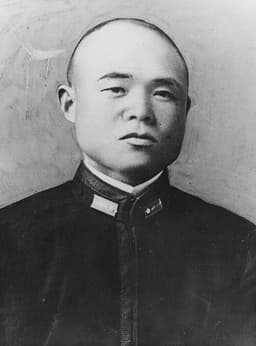
Ota Minoru
General · Modern
42.0Total

Saigo Takamori
General · Modern
53.4Total
Basic Information
Born
1891
1828
Died
1945
1877
Era
Modern
Modern
Nationality
Japan
Japan
Occupation
General
General
Civilization
Eastern
Eastern
Score Comparison
Military (10%)
50.0
25.0
Political (20%)
26.4
43.7
Influence (20%)
50.2
72.0
Legacy (20%)
41.7
52.0
Leadership (15%)
36.9
50.7
Strategy (15%)
45.0
57.5
TOTAL
42.0
53.4
Ota Minoru — Complete Timeline
1945 AD
Assumed command of the Okinawa Naval BaseWar◆ Major
In early 1945, Rear Admiral Ota Minoru was placed in command of the Imperial Japanese Navy's forces on Okinawa. He was responsible for defending the island against the impending American invasion, leading a mixed force of naval personnel and base troops.
World War IIPacific WarOkinawa
Impact: regional
Led the defense of the Oroku PeninsulaWar◆ Major
During the Battle of Okinawa, Ota commanded the defense of the Oroku Peninsula from May to June 1945. His forces, numbering about 10,000 men, held out against the U.S. 6th Marine Division for ten days of intense fighting before being overwhelmed.
World War IIBattle of OkinawaLast Stand
Impact: regionaltragic
Committed suicide with staff officersOther◆ Major
On June 13, 1945, with his position overrun and defeat imminent, Rear Admiral Ota Minoru committed suicide by pistol along with his senior staff officers in his command cave on the Oroku Peninsula. This act followed the Japanese military code of honor.
World War IISuicideBushido
tragic
Saigo Takamori — Complete Timeline
1868 AD
Role in the Meiji RestorationPolitical Action◆ Major
Saigo Takamori was a key leader in the Meiji Restoration, commanding Satsuma forces in the Boshin War against the Tokugawa shogunate. He led the capture of Edo Castle and was instrumental in establishing the new imperial government. His actions helped end the shogunate and restore imperial rule.
Meiji RestorationBoshin WarImperial Rule
Impact: nationalconstructive
1873 AD
Resignation from the Meiji GovernmentPolitical Action◆ Major
Saigo Takamori resigned from his government posts over the Seikanron debate, opposing the majority's decision not to invade Korea. He returned to Kagoshima, disillusioned with the government's direction. This resignation set the stage for his later rebellion and highlighted his disagreement with modernization policies.
ResignationSeikanronMeiji Government
Impact: national
1877 AD
Satsuma RebellionWar
Saigo Takamori led a rebellion of Satsuma samurai against the Meiji government's modernizing reforms. The rebellion began with the seizure of Kagoshima and escalated into a full-scale war. Saigo's forces were defeated at the Battle of Shiroyama, and Saigo was killed. This was the last major samurai uprising.
RebellionSamuraiMeiji Restoration
Impact: nationaltragic
Battle of ShiroyamaWar◆ Major
The final battle of the Satsuma Rebellion, where government forces surrounded Saigo Takamori's outnumbered samurai on Mount Shiroyama in Kagoshima. After a fierce fight, Saigo was wounded and committed seppuku. The battle ended the rebellion and marked the end of the samurai class as a military force.
BattleSamuraiEnd of an Era
Impact: nationaltragic
Expert Analysis
Origins
Ota Minoru was born in 1891 in Yamaguchi Prefecture, Japan, into a family with a samurai lineage. He graduated from the Imperial Japanese Naval Academy in 1913, receiving training in modern naval warfare. His early career included service on cruisers and battleships, and he specialized in naval aviation, commanding air groups and serving as a staff officer. In contrast, Saigo Takamori was born on January 23, 1828, in Kagoshima, the son of a low-ranking samurai. He studied under the scholar Zusho Shosuke and was influenced by the Mito school of thought, which emphasized imperial loyalty. Saigo's early life was marked by service to the Satsuma domain, where he became a key figure in the domain's political and military affairs.
Rise to Power
Ota Minoru rose through the ranks of the Imperial Japanese Navy, commanding the seaplane tender *Kamoi* and later serving as chief of staff of the 11th Air Fleet. His appointment as commander of the Okinawa Naval Base in early 1945 placed him at the forefront of Japan's desperate defense against the American invasion. Saigo Takamori's rise to prominence came through his involvement in the Meiji Restoration. He commanded Satsuma forces in the Boshin War (1868-1869), leading to the capture of Edo Castle. He became a key figure in the new Meiji government, serving as a field marshal and councilor. However, his influence waned after the Seikanron debate in 1873, where he advocated for invading Korea but was overruled, leading to his resignation.
Leadership & Governance
Ota Minoru's leadership in the Battle of Okinawa was characterized by steadfast defense and adherence to the samurai code of bushido. He commanded 10,000 men on the Oroku Peninsula, organizing a tenacious defense against overwhelming American forces from May to June 1945. His governance style was rigid, prioritizing honor over surrender. Saigo Takamori's leadership was more political and charismatic. He was a key architect of the Meiji Restoration, but his governance was rooted in the samurai tradition. After resigning from government, he established private schools in Kagoshima that became centers of samurai discontent. His leadership during the Satsuma Rebellion (1877) was marked by tactical skill but flawed strategy, as he failed to secure popular support outside Satsuma.
Triumph & Tragedy
Ota Minoru's greatest triumph was the prolonged defense of the Oroku Peninsula, which tied down American forces and inflicted casualties. However, his tragedy was the inevitable defeat and his decision to commit suicide with his staff on June 13, 1945, rather than surrender. His military score of 50.0 reflects competent but not exceptional performance. Saigo Takamori's triumph was his role in overthrowing the Tokugawa shogunate and establishing the Meiji government. His tragedy was the Satsuma Rebellion, which ended in his defeat and death at the Battle of Shiroyama on September 24, 1877. His political score of 43.7 and leadership score of 50.7 show a stronger political acumen than Ota.
Character & Destiny
Ota Minoru was a product of the Imperial Navy, disciplined and fatalistic. His character was shaped by the samurai ethos of his upbringing, leading him to choose death over dishonor. Saigo Takamori was known for his personal integrity, humility, and deep loyalty to the samurai class. His decision to rebel against the government he helped create was driven by a sense of injustice. Historical assessments often portray Saigo as a tragic figure, out of step with the modernization of Japan. Ota's destiny was sealed by the futility of Japan's defensive strategy in 1945, while Saigo's fate was determined by his refusal to compromise his principles.
Legacy
Ota Minoru is remembered primarily as a symbol of Japanese resistance in Okinawa. His legacy is localized, with memorials on the island and recognition in Japanese war history. His influence score of 50.2 reflects limited impact beyond the battle. Saigo Takamori's legacy is far broader. He is celebrated as the "Last Samurai," a folk hero who resisted modernization. Statues and museums commemorate him, and his story has been romanticized in films and literature. His legacy score of 52.0 and influence score of 72.0 indicate a lasting cultural impact. Saigo's rebellion accelerated the Meiji government's consolidation of power and the end of the samurai class.
Conclusion
Saigo Takamori had greater impact than Ota Minoru. Saigo's total score of 53.4 surpasses Ota's 42.0 by 11.4 points. Saigo's influence (72.0 vs 50.2) and legacy (52.0 vs 41.7) are significantly higher. While Ota Minoru's defense of Okinawa demonstrated courage, it did not alter the course of history. Saigo Takamori's actions helped shape modern Japan, and his rebellion marked the end of the samurai era. His story continues to resonate as a symbol of resistance to change. Therefore, Saigo Takamori is the more significant historical figure.
Rankings
🥇
Saigo TakamoriLeader
Mil: 25.0Pol: 43.7Inf: 72.0
53.4
🥈
Ota Minoru
Mil: 50.0Pol: 26.4Inf: 50.2
42.0
+11.4 behind
How This Comparison Works
Algorithm
Each figure is scored on 6 dimensions (0—100 scale) based on structured historical data: Military (10%), Political (20%), Influence (20%), Legacy (20%), Leadership (15%), Strategy (15%). The weighted total produces the final ranking.
Data Sources
Scores are computed from structured sub-indicators in the database. Scale factors adjust for era (Ancient ×0.85, Modern ×1.0) and civilization size (Eastern ×1.05, Other ×0.80) to account for differences in population and military scale.
Maximum 3 Figures
Comparisons are limited to 2—3 figures to ensure readability and statistical meaningfulness.
Error Margins
±5 points per dimension — Sub-scores are derived from historical records with inherent uncertainty. Two figures within 5 points on a dimension should be considered roughly equivalent in that area.
Total Score Accuracy
±3 points overall — The weighted combination of 6 dimensions produces a total score with approximately ±3 points of uncertainty. Differences of less than 3 points are not statistically significant— the figures are effectively tied.
Known Limitations
- Historical records are incomplete and uneven across civilizations
- Figures from oral-tradition societies may be underrepresented
- Occupation labels can misclassify multi-role figures
- Scores measure capability and impact, not moral character
- Quantitative scoring is a comparison tool, not absolute truth
Capability Radar
Military (10%) — Battles & Warfare
Battles
30
45
Win Rate
10
40
Expansion
10
20
Political (20%) — Governance & Reform
Reform
10
40
Diplomacy
10
30
Economy
10
20
Influence (20%) — Cultural & Global Reach
Cultural
20
70
Global
10
55
Legacy (20%) — Historical Impact
Historical
25
65
Longevity
15
60
Leadership (15%) — Power & Stability
Tenure
20
35
Stability
10
15
Strategy (15%) — Tactics & Innovation
Strategy
35
55
Tactics
40
60
Reform
10
30
Similar Comparisons
Comments & Discussion
No comments yet. Be the first to share your thoughts!