Loading...
This comparison has not been analyzed yet.
One-time AI generation (~1 minute). Scores and timeline are already available below.
Oscar I vs Sahin Giray
Oscar I leads by 4.3 pts · 2 figures compared
…
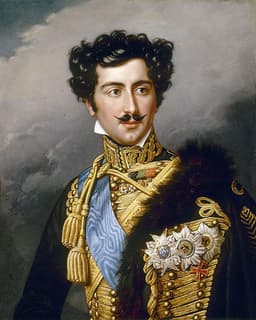
Oscar I
Emperor · Modern
49.7Total

Sahin Giray
Emperor · Modern
45.4Total
Basic Information
Born
1799
1745
Died
1859
1787
Era
Modern
Modern
Nationality
Sweden
Crimean Khanate
Occupation
Emperor
Emperor
Civilization
Western
Eastern
Score Comparison
Military (10%)
21.2
50.0
Political (20%)
72.0
46.6
Influence (20%)
51.8
48.6
Legacy (20%)
40.0
38.3
Leadership (15%)
72.0
51.9
Strategy (15%)
30.3
38.6
TOTAL
49.7
45.4
Oscar I — Complete Timeline
1840 AD
Liberal reforms of the penal codeReform◆ Major
Oscar I oversaw a major reform of the Swedish penal code, abolishing the death penalty for most crimes and reducing the use of corporal punishment. This was part of a broader liberalization of Swedish law, influenced by Enlightenment principles and aimed at modernizing the justice system.
SwedenLawReformPenal Code
Impact: nationalprogressive
Introduction of freedom of the pressReform◆ Major
Oscar I introduced a new press law that significantly expanded freedom of the press in Sweden. This allowed for greater public debate and criticism of the government, marking a shift towards a more open and liberal society, though it was still subject to some restrictions.
SwedenPress FreedomLiberalismReform
Impact: nationalprogressive
1854 AD
First Swedish railway concessionOther◆ Major
Oscar I granted the first concession for the construction of a railway in Sweden, connecting Stockholm to Gothenburg. This initiated the development of Sweden's railway network, which was crucial for economic integration and industrial growth in the following decades.
SwedenRailwayInfrastructureIndustrialization
Impact: nationalconstructive
1858 AD
Repeal of the Conventicle ActReform◆ Major
Oscar I repealed the Conventicle Act, which had prohibited religious gatherings outside the state church. This allowed for greater religious freedom and the establishment of free churches, a significant step towards religious toleration in Sweden.
SwedenReligionFreedomReform
Impact: nationalprogressive
Sahin Giray — Complete Timeline
1774 AD
Treaty of Küçük KaynarcaPolitical Action
Sahin Giray was appointed khan of Crimea under the terms of the Treaty of K
TreatyCrimeaRussian Empire
Impact: regional
1775 AD
Westernization ReformsReform◆ Major
Sahin Giray implemented Western-style reforms in Crimea, including military reorganization, tax reforms, and the introduction of a new legal code. These reforms alienated the traditional Tatar nobility and clergy, leading to widespread opposition.
ReformWesternizationModernization
Impact: nationalconstructive
1783 AD
Russian Annexation of CrimeaPolitical Action
Sahin Giray abdicated after Catherine the Great annexed Crimea into the Russian Empire. He was granted a pension and exile in Russia, but his rule ended the centuries-old Crimean Khanate.
AnnexationCrimeaRussian Empire
Impact: regionaltragic
1787 AD
Execution by the Ottoman EmpirePolitical Action◆ Major
Sahin Giray was executed by the Ottoman Empire after being extradited from Russia. The Ottomans viewed him as a traitor for collaborating with Russia, and his death eliminated the last Crimean khan.
ExecutionOttoman EmpireDeath
Impact: regionaltragic
This comparison has not been analyzed yet.
One-time AI generation (~1 minute). Scores and timeline are already available below.
Rankings
🥇
Oscar ILeader
Mil: 21.2Pol: 72.0Inf: 51.8
49.7
🥈
Sahin Giray
Mil: 50.0Pol: 46.6Inf: 48.6
45.4
+4.3 behind
How This Comparison Works
Algorithm
Each figure is scored on 6 dimensions (0—100 scale) based on structured historical data: Military (10%), Political (20%), Influence (20%), Legacy (20%), Leadership (15%), Strategy (15%). The weighted total produces the final ranking.
Data Sources
Scores are computed from structured sub-indicators in the database. Scale factors adjust for era (Ancient ×0.85, Modern ×1.0) and civilization size (Eastern ×1.05, Other ×0.80) to account for differences in population and military scale.
Maximum 3 Figures
Comparisons are limited to 2—3 figures to ensure readability and statistical meaningfulness.
Error Margins
±5 points per dimension — Sub-scores are derived from historical records with inherent uncertainty. Two figures within 5 points on a dimension should be considered roughly equivalent in that area.
Total Score Accuracy
±3 points overall — The weighted combination of 6 dimensions produces a total score with approximately ±3 points of uncertainty. Differences of less than 3 points are not statistically significant— the figures are effectively tied.
Known Limitations
- Historical records are incomplete and uneven across civilizations
- Figures from oral-tradition societies may be underrepresented
- Occupation labels can misclassify multi-role figures
- Scores measure capability and impact, not moral character
- Quantitative scoring is a comparison tool, not absolute truth
Capability Radar
Military (10%) — Battles & Warfare
Battles
10
20
Win Rate
10
15
Expansion
10
10
Political (20%) — Governance & Reform
Reform
70
40
Diplomacy
60
35
Economy
60
25
Influence (20%) — Cultural & Global Reach
Cultural
30
20
Global
20
10
Legacy (20%) — Historical Impact
Historical
30
25
Longevity
20
15
Leadership (15%) — Power & Stability
Tenure
60
30
Stability
65
15
Strategy (15%) — Tactics & Innovation
Strategy
10
20
Tactics
10
25
Reform
20
30
Similar Comparisons
Comments & Discussion
No comments yet. Be the first to share your thoughts!