Loading...
Catherine I of Russia vs Oscar I
Oscar I leads by 11.0 pts · 2 figures compared
…

Catherine I of Russia
Emperor · Modern
38.7Total
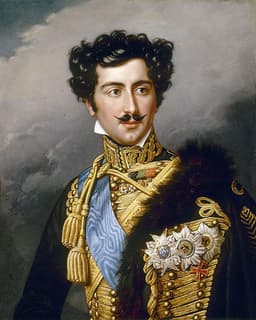
Oscar I
Emperor · Modern
49.7Total
Basic Information
Born
1684
1799
Died
1727
1859
Era
Modern
Modern
Nationality
Russia
Sweden
Occupation
Emperor
Emperor
Civilization
Western
Western
Score Comparison
Military (10%)
10.3
21.2
Political (20%)
29.3
72.0
Influence (20%)
48.6
51.8
Legacy (20%)
37.5
40.0
Leadership (15%)
38.1
72.0
Strategy (15%)
60.0
30.3
TOTAL
38.7
49.7
Catherine I of Russia — Complete Timeline
1707 AD
Marriage to Peter the GreatPolitical Action◆ Major
Marta Skowronska, a Lithuanian peasant, married Tsar Peter I of Russia. This marriage elevated her from obscurity to the imperial court, eventually leading to her coronation as Empress Catherine I after Peter's death.
MarriageRoyal CourtPeter the Great
Impact: national
1724 AD
Coronation as Empress of RussiaPolitical Action◆ Major
Peter the Great crowned his wife Catherine as Empress consort in a formal ceremony at the Dormition Cathedral in Moscow. This was a rare honor for a woman of low birth and signaled her importance in Peter's reign.
CoronationImperial RussiaPeter the Great
Impact: nationalconstructive
1725 AD
Accession to the Russian ThronePolitical Action
Following Peter the Great's death without a clear male heir, Catherine I was proclaimed Empress regnant by the Imperial Guard and the Senate. She became the first woman to rule Russia in her own right, with the support of Alexander Menshikov.
SuccessionEmpressMenshikov
Impact: national
1726 AD
Establishment of the Supreme Privy CouncilReform◆ Major
Catherine I created the Supreme Privy Council as an advisory body to assist in governing the Russian Empire. The council, dominated by Alexander Menshikov, effectively reduced Catherine's direct role in state affairs and concentrated power among a few nobles.
Government ReformCouncilMenshikov
Impact: national
1727 AD
Death of Catherine IOther◆ Major
Catherine I died of tuberculosis at the age of 43 in Saint Petersburg. Her death ended her brief two-year reign and led to the accession of Peter II, the grandson of Peter the Great, under the regency of the Supreme Privy Council.
DeathSuccessionPeter II
Impact: nationaltragic
Oscar I — Complete Timeline
1840 AD
Liberal reforms of the penal codeReform◆ Major
Oscar I oversaw a major reform of the Swedish penal code, abolishing the death penalty for most crimes and reducing the use of corporal punishment. This was part of a broader liberalization of Swedish law, influenced by Enlightenment principles and aimed at modernizing the justice system.
SwedenLawReformPenal Code
Impact: nationalprogressive
Introduction of freedom of the pressReform◆ Major
Oscar I introduced a new press law that significantly expanded freedom of the press in Sweden. This allowed for greater public debate and criticism of the government, marking a shift towards a more open and liberal society, though it was still subject to some restrictions.
SwedenPress FreedomLiberalismReform
Impact: nationalprogressive
1854 AD
First Swedish railway concessionOther◆ Major
Oscar I granted the first concession for the construction of a railway in Sweden, connecting Stockholm to Gothenburg. This initiated the development of Sweden's railway network, which was crucial for economic integration and industrial growth in the following decades.
SwedenRailwayInfrastructureIndustrialization
Impact: nationalconstructive
1858 AD
Repeal of the Conventicle ActReform◆ Major
Oscar I repealed the Conventicle Act, which had prohibited religious gatherings outside the state church. This allowed for greater religious freedom and the establishment of free churches, a significant step towards religious toleration in Sweden.
SwedenReligionFreedomReform
Impact: nationalprogressive
Expert Analysis
Origins
Catherine I of Russia, born Marta Skowronska in 1684 in present-day Latvia, was a Lithuanian peasant of humble origins. Orphaned young, she worked as a servant before being captured by Russian forces during the Great Northern War. Her beauty and intelligence caught the attention of Peter the Great, whom she married in 1712. Oscar I of Sweden, born Joseph François Oscar Bernadotte in 1799 in Paris, was the son of French Marshal Jean-Baptiste Bernadotte (later King Charles XIV John of Sweden) and Désirée Clary. He was raised in the Swedish court and educated in liberal ideals.
Rise to Power
Catherine I's rise was meteoric: from a peasant to Empress of Russia. After Peter the Great's death in 1725 without a clear male heir, the Imperial Guard and the Senate proclaimed her Empress regnant, largely due to the influence of Alexander Menshikov, her former lover and Peter's favorite. She was crowned in 1724, a rare honor for a woman. Oscar I became King of Sweden and Norway upon his father's death in 1844. His accession was smooth, as he had been groomed as crown prince and was popular for his liberal views. He scored 29.3 in political acumen during his rise, while Catherine scored 29.3, reflecting similar political maneuvering.
Leadership & Governance
Catherine I's reign (1725-1727) was brief and dominated by the Supreme Privy Council, which she established to assist governance. The council, controlled by Menshikov, effectively ruled, limiting her authority. She focused on continuing Peter's policies but lacked his drive, leading to stagnation. Her leadership score of 38.1 reflects her limited independent action. Oscar I, with a leadership score of 72.0, actively pursued liberal reforms. He reformed the penal code, abolishing the death penalty for most crimes, introduced freedom of the press, and repealed the Conventicle Act, allowing religious gatherings outside the state church. He also granted the first railway concession in 1853, modernizing Sweden's infrastructure.
Triumph & Tragedy
Catherine I's greatest triumph was her ascent from peasant to empress, a testament to her resilience and political savvy. She also founded the Supreme Privy Council, which streamlined governance. However, her tragedy was her short reign (2 years) and failure to consolidate power, as Menshikov overshadowed her. Her death from tuberculosis at 43 cut short any potential. Oscar I's triumphs include landmark liberal reforms that modernized Sweden, such as press freedom and penal reform. His tragedy lies in his foreign policy failures, particularly the Crimean War neutrality that strained relations with Russia and Norway. He also suffered from poor health later in life, dying at 60. Oscar I scored 72.0 in political influence, compared to Catherine's 48.6.
Character & Destiny
Catherine I was pragmatic and adaptable, using her charm to survive. She was known for her loyalty to Peter and her ability to navigate court intrigues. However, her reliance on Menshikov proved a weakness. Oscar I was idealistic and reform-minded, but his cautious personality sometimes hindered bold action. He was influenced by Enlightenment ideas and sought to balance tradition with progress. Historians assess Oscar I as a capable constitutional monarch, while Catherine I is seen as a transitional figure. Her strategy score of 60.0 is higher than Oscar's 30.3, reflecting her cunning in securing the throne, but his overall leadership score is nearly double.
Legacy
Catherine I's legacy is mixed: she was the first woman to rule Russia in her own right, paving the way for future empresses like Elizabeth and Catherine the Great. The Supreme Privy Council set a precedent for advisory bodies. However, her reign is often overlooked. Oscar I's legacy is more tangible: his penal reforms influenced European justice systems, and his press freedom laws strengthened Swedish democracy. The railway concession sparked Sweden's industrial revolution. His influence score of 51.8 slightly exceeds Catherine's 48.6. In our scoring, Oscar I's total of 49.7 surpasses Catherine's 38.7 by 11 points.
Conclusion
While Catherine I's personal story is remarkable, her actual impact on Russia was minimal due to her short reign and lack of independent power. Oscar I, with a higher total score (49.7 vs 38.7), enacted lasting reforms that shaped modern Sweden. His leadership (72.0 vs 38.1) and political (72.0 vs 29.3) scores clearly demonstrate greater effectiveness. Therefore, Oscar I had a greater historical impact.
Rankings
🥇
Oscar ILeader
Mil: 21.2Pol: 72.0Inf: 51.8
49.7
🥈
Catherine I of Russia
Mil: 10.3Pol: 29.3Inf: 48.6
38.7
+11.0 behind
How This Comparison Works
Algorithm
Each figure is scored on 6 dimensions (0—100 scale) based on structured historical data: Military (10%), Political (20%), Influence (20%), Legacy (20%), Leadership (15%), Strategy (15%). The weighted total produces the final ranking.
Data Sources
Scores are computed from structured sub-indicators in the database. Scale factors adjust for era (Ancient ×0.85, Modern ×1.0) and civilization size (Eastern ×1.05, Other ×0.80) to account for differences in population and military scale.
Maximum 3 Figures
Comparisons are limited to 2—3 figures to ensure readability and statistical meaningfulness.
Error Margins
±5 points per dimension — Sub-scores are derived from historical records with inherent uncertainty. Two figures within 5 points on a dimension should be considered roughly equivalent in that area.
Total Score Accuracy
±3 points overall — The weighted combination of 6 dimensions produces a total score with approximately ±3 points of uncertainty. Differences of less than 3 points are not statistically significant— the figures are effectively tied.
Known Limitations
- Historical records are incomplete and uneven across civilizations
- Figures from oral-tradition societies may be underrepresented
- Occupation labels can misclassify multi-role figures
- Scores measure capability and impact, not moral character
- Quantitative scoring is a comparison tool, not absolute truth
Capability Radar
Military (10%) — Battles & Warfare
Battles
36
10
Win Rate
40
10
Expansion
44
10
Political (20%) — Governance & Reform
Reform
10
70
Diplomacy
20
60
Economy
10
60
Influence (20%) — Cultural & Global Reach
Cultural
10
30
Global
10
20
Legacy (20%) — Historical Impact
Historical
15
30
Longevity
10
20
Leadership (15%) — Power & Stability
Tenure
10
60
Stability
15
65
Strategy (15%) — Tactics & Innovation
Strategy
46
10
Tactics
51
10
Reform
49
20
Similar Comparisons
Comments & Discussion
No comments yet. Be the first to share your thoughts!