Loading...
Francis II vs Oscar I
Oscar I leads by 2.4 pts · 2 figures compared
…

Francis II
Emperor · Modern
47.3Total
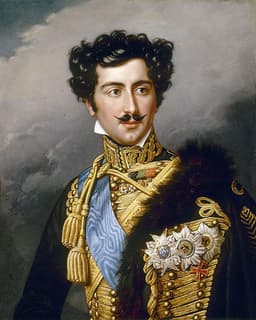
Oscar I
Emperor · Modern
49.7Total
Basic Information
Born
1768
1799
Died
1835
1859
Era
Modern
Modern
Nationality
Holy Roman Empire
Sweden
Occupation
Emperor
Emperor
Civilization
Western
Western
Score Comparison
Military (10%)
10.2
21.2
Political (20%)
46.6
72.0
Influence (20%)
53.3
51.8
Legacy (20%)
46.7
40.0
Leadership (15%)
65.0
72.0
Strategy (15%)
45.0
30.3
TOTAL
47.3
49.7
Francis II — Complete Timeline
1805 AD
Battle of AusterlitzWar◆ Major
Francis II's Russian and Austrian armies were decisively defeated by Napoleon at Austerlitz. The defeat forced Austria to sign the Treaty of Pressburg, ceding territory to France and Bavaria and ending the Third Coalition. It led directly to the dissolution of the Holy Roman Empire.
Napoleonic WarsBattleThird Coalition
Impact: globaldestructive
1806 AD
Dissolved the Holy Roman EmpirePolitical Action
Francis II, facing Napoleon's creation of the Confederation of the Rhine and the threat of French invasion, abdicated as Holy Roman Emperor and dissolved the empire. This ended the thousand-year-old institution, and Francis continued as Emperor of Austria (Francis I).
Holy Roman EmpireNapoleonDissolution
Impact: global
1810 AD
Married Marie Louise of AustriaPolitical Action
Francis II arranged the marriage of his daughter Marie Louise to Napoleon Bonaparte, sealing the Treaty of Sch
NapoleonMarriageAlliance
Impact: regional
1814 AD
Congress of ViennaPolitical Action
Francis II (as Emperor Francis I of Austria) hosted the Congress of Vienna, which redrew the map of Europe after Napoleon's defeat. Austria gained territory in Italy and Germany, and the congress established a conservative order that lasted until the revolutions of 1848.
Congress of ViennaPost-NapoleonicDiplomacy
Impact: global
Oscar I — Complete Timeline
1840 AD
Liberal reforms of the penal codeReform◆ Major
Oscar I oversaw a major reform of the Swedish penal code, abolishing the death penalty for most crimes and reducing the use of corporal punishment. This was part of a broader liberalization of Swedish law, influenced by Enlightenment principles and aimed at modernizing the justice system.
SwedenLawReformPenal Code
Impact: nationalprogressive
Introduction of freedom of the pressReform◆ Major
Oscar I introduced a new press law that significantly expanded freedom of the press in Sweden. This allowed for greater public debate and criticism of the government, marking a shift towards a more open and liberal society, though it was still subject to some restrictions.
SwedenPress FreedomLiberalismReform
Impact: nationalprogressive
1854 AD
First Swedish railway concessionOther◆ Major
Oscar I granted the first concession for the construction of a railway in Sweden, connecting Stockholm to Gothenburg. This initiated the development of Sweden's railway network, which was crucial for economic integration and industrial growth in the following decades.
SwedenRailwayInfrastructureIndustrialization
Impact: nationalconstructive
1858 AD
Repeal of the Conventicle ActReform◆ Major
Oscar I repealed the Conventicle Act, which had prohibited religious gatherings outside the state church. This allowed for greater religious freedom and the establishment of free churches, a significant step towards religious toleration in Sweden.
SwedenReligionFreedomReform
Impact: nationalprogressive
Expert Analysis
Origins
Francis II was born on February 12, 1768 in Florence, the eldest son of Grand Duke Peter Leopold of Tuscany (later Emperor Leopold II) and Maria Luisa of Spain. He was educated in a strict, traditional Habsburg manner, emphasizing piety and obedience. His early exposure to court politics came in the shadow of the French Revolution, which deeply influenced his conservative worldview. Oscar I was born on July 4, 1799 in Paris, the son of Jean-Baptiste Bernadotte (later King Charles XIV John of Sweden) and Désirée Clary. His father was a French Marshal who was elected Crown Prince of Sweden in 1810. Oscar grew up in Sweden, educated in liberal ideals by tutors such as the historian Erik Gustaf Geijer. He was fluent in French, Swedish, and German, and developed an interest in the arts and sciences.
Rise to Power
Francis II became Holy Roman Emperor in 1792 after the death of his father Leopold II. He was only 24 and inherited a declining empire threatened by revolutionary France. His early reign was marked by the War of the First Coalition (1792-1797), where Austria suffered defeats. In 1804, he proclaimed himself Emperor of Austria as Francis I to maintain imperial rank after Napoleon's coronation. The turning point came in 1806 when Napoleon created the Confederation of the Rhine, prompting Francis to dissolve the Holy Roman Empire on August 6, 1806, ending a millennium of tradition. Oscar I became king of Sweden and Norway in 1844 upon the death of his father Charles XIV John. His rise was smoother, as he had been groomed for succession. He served as regent during his father's illnesses and introduced reforms even before becoming king. His accession marked a shift from his father's conservative autocracy to a more liberal regime.
Leadership & Governance
Francis II's leadership was characterized by cautious conservatism and reliance on his ministers, such as Metternich. He opposed liberal and nationalist movements, maintaining a police state with censorship and espionage. His governance score of 65.0 reflects his ability to preserve the Austrian Empire but with rigid control. For example, he refused to grant a constitution and upheld the Carlsbad Decrees of 1819 to suppress liberal ideas. In contrast, Oscar I was a reformer. He introduced a new penal code in 1864 that abolished the death penalty for most crimes and reduced corporal punishment. He expanded freedom of the press with a new press law in 1845, allowing public criticism. He repealed the Conventicle Act in 1858, granting religious freedom. His leadership score of 72.0 reflects his progressive policies. However, his reforms were moderate and often faced opposition from the nobility.
Triumph & Tragedy
Francis II's greatest triumph was hosting the Congress of Vienna in 1814-1815, which restored European stability and expanded Austrian territory. He also arranged the marriage of his daughter Marie Louise to Napoleon in 1810, temporarily securing peace. His greatest failure was the dissolution of the Holy Roman Empire, a humiliating end to a centuries-old institution. He also suffered a major defeat at Austerlitz in 1805, which forced Austria to pay heavy reparations. Oscar I's triumphs include the liberal reforms that modernized Sweden: the penal code, press freedom, and religious tolerance. He also granted the first railway concession in 1855, initiating infrastructure development. His failures include an inability to fully implement his reforms due to opposition from the Riksdag and his father's legacy. His foreign policy, such as the support for Denmark in the Schleswig-Holstein crisis, was indecisive and led to no gains.
Character & Destiny
Francis II was devout, methodical, and deeply conservative. He believed in divine right and resisted change, which made him ill-suited to the revolutionary era. His character led to a defensive posture that preserved the Austrian Empire but at the cost of modernization. Historians like A.J.P. Taylor have described him as 'the dullest of the Habsburgs.' Oscar I was intelligent, cultured, and open to new ideas. He was influenced by the Enlightenment and sought to reconcile monarchy with liberal progress. His destiny was to be a reformer in a time of rising nationalism, but his moderate approach prevented radical change. He scored 72.0 in political skill, higher than Francis's 46.6, indicating greater adaptability.
Legacy
Francis II's legacy is mixed. He is remembered as the last Holy Roman Emperor, and his dissolution of the empire marked the end of the medieval political order. As Emperor of Austria, he established the Habsburg monarchy that lasted until 1918. His score of 46.7 in legacy reflects the negative association with the empire's demise. Oscar I's legacy is more positive but limited. His reforms laid the groundwork for Sweden's modern social democracy, but many were later expanded by his successors. He is often overshadowed by his father and son. His legacy score of 40.0 is lower than Francis's, partly because his changes were incremental. However, in terms of impact on daily life, Oscar I's reforms had a direct effect on Swedish society.
Conclusion
Oscar I scores higher overall (49.7 vs 47.3) and had a more positive impact through liberal reforms that modernized Sweden. While Francis II faced larger geopolitical challenges, his rigid conservatism and the dissolution of the Holy Roman Empire mark a negative legacy. Oscar I's reforms in penal code, press freedom, and railways had lasting effects on Swedish society. Therefore, Oscar I had greater impact in terms of progressive change, while Francis II's impact was more about preserving an empire that ultimately failed.
Rankings
🥇
Oscar ILeader
Mil: 21.2Pol: 72.0Inf: 51.8
49.7
🥈
Francis II
Mil: 10.2Pol: 46.6Inf: 53.3
47.3
+2.4 behind
How This Comparison Works
Algorithm
Each figure is scored on 6 dimensions (0—100 scale) based on structured historical data: Military (10%), Political (20%), Influence (20%), Legacy (20%), Leadership (15%), Strategy (15%). The weighted total produces the final ranking.
Data Sources
Scores are computed from structured sub-indicators in the database. Scale factors adjust for era (Ancient ×0.85, Modern ×1.0) and civilization size (Eastern ×1.05, Other ×0.80) to account for differences in population and military scale.
Maximum 3 Figures
Comparisons are limited to 2—3 figures to ensure readability and statistical meaningfulness.
Error Margins
±5 points per dimension — Sub-scores are derived from historical records with inherent uncertainty. Two figures within 5 points on a dimension should be considered roughly equivalent in that area.
Total Score Accuracy
±3 points overall — The weighted combination of 6 dimensions produces a total score with approximately ±3 points of uncertainty. Differences of less than 3 points are not statistically significant— the figures are effectively tied.
Known Limitations
- Historical records are incomplete and uneven across civilizations
- Figures from oral-tradition societies may be underrepresented
- Occupation labels can misclassify multi-role figures
- Scores measure capability and impact, not moral character
- Quantitative scoring is a comparison tool, not absolute truth
Capability Radar
Military (10%) — Battles & Warfare
Battles
10
10
Win Rate
10
10
Expansion
5
10
Political (20%) — Governance & Reform
Reform
30
70
Diplomacy
40
60
Economy
30
60
Influence (20%) — Cultural & Global Reach
Cultural
20
30
Global
30
20
Legacy (20%) — Historical Impact
Historical
50
30
Longevity
30
20
Leadership (15%) — Power & Stability
Tenure
60
60
Stability
20
65
Strategy (15%) — Tactics & Innovation
Strategy
5
10
Tactics
5
10
Reform
5
20
Similar Comparisons
Comments & Discussion
No comments yet. Be the first to share your thoughts!