Loading...
This comparison has not been analyzed yet.
One-time AI generation (~1 minute). Scores and timeline are already available below.
Norman Schwarzkopf vs Yamamoto Gonnohyoe
Norman Schwarzkopf leads by 4.5 pts · 2 figures compared
…
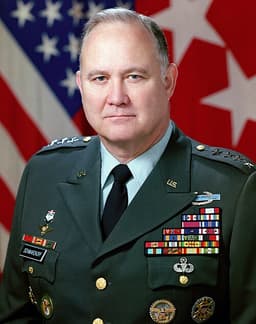
Norman Schwarzkopf
General · Modern
58.9Total

Yamamoto Gonnohyoe
General · Modern
54.4Total
Basic Information
Born
1934
1852
Died
—
1933
Era
Modern
Modern
Nationality
United States
Japan
Occupation
General
General
Civilization
Western
Eastern
Score Comparison
Military (10%)
78.0
50.0
Political (20%)
45.0
72.0
Influence (20%)
55.0
55.0
Legacy (20%)
58.0
50.0
Leadership (15%)
62.0
48.8
Strategy (15%)
68.1
50.0
TOTAL
58.9
54.4
Norman Schwarzkopf — Complete Timeline
1990 AD
Appointed Commander of Coalition Forces for Operation Desert ShieldOther◆ Major
In August 1990, Schwarzkopf was appointed Commander-in-Chief of U.S. Central Command and overall commander of coalition forces in the Persian Gulf. He oversaw the buildup of over 500,000 troops in Saudi Arabia to deter Iraqi aggression after the invasion of Kuwait.
Gulf WarMilitary BuildupCoalition Command
Impact: global
1991 AD
Executed Operation Desert Storm Ground CampaignWar◆ Major
Schwarzkopf planned and executed the 100-hour ground offensive that began on February 24, 1991. Using a left-hook maneuver through the Iraqi desert, coalition forces outflanked Iraqi defenses, liberating Kuwait and destroying much of the Iraqi Republican Guard with minimal coalition casualties.
Gulf WarMilitary VictoryOperational Planning
Impact: global
Negotiated Ceasefire at SafwanOther◆ Major
On March 3, 1991, Schwarzkopf met with Iraqi military commanders at Safwan airfield to negotiate the terms of the ceasefire ending the Gulf War. He secured Iraqi agreement to return prisoners, provide minefield maps, and cease military operations, though he allowed Iraqi helicopters to fly, later criticized as enabling suppression of uprisings.
Gulf WarCeasefirePost-War Settlement
Impact: regional
1992 AD
Published Autobiography 'It Doesn't Take a Hero'Other
Schwarzkopf published his autobiography 'It Doesn't Take a Hero' in September 1992. The book detailed his military career from Vietnam through the Gulf War, becoming a bestseller and providing his personal account of the decision-making process during Operation Desert Storm.
AutobiographyMilitary MemoirPublic Figure
Impact: national
Yamamoto Gonnohyoe — Complete Timeline
1904 AD
Naval Career and Russo-Japanese WarWar◆ Major
Yamamoto served as a naval commander during the Russo-Japanese War. He was involved in the Battle of Tsushima, where the Japanese fleet under Admiral Togo destroyed the Russian Baltic Fleet. Yamamoto's contributions to naval strategy were significant.
Russo-Japanese WarNavyBattle
Impact: globalconstructive
1913 AD
Served as Prime MinisterPolitical Action◆ Major
Yamamoto Gonnohyoe served as the 16th Prime Minister of Japan from 1913 to 1914. His first term was marked by the Taisho Political Crisis and the Siemens scandal, which led to his resignation. He was a naval admiral and a key figure in the Imperial Japanese Navy.
Prime MinisterGovernmentNavy
Impact: national
1914 AD
Siemens ScandalPolitical Action◆ Major
The Siemens scandal broke during Yamamoto's first term as Prime Minister, involving bribery and corruption in the Imperial Japanese Navy. The scandal implicated high-ranking officials and led to widespread public outrage. Yamamoto resigned to take responsibility.
ScandalCorruptionResignation
Impact: nationaldestructive
1923 AD
Second Term as Prime MinisterPolitical Action◆ Major
Yamamoto served a second term as Prime Minister from 1923 to 1924, following the Great Kanto Earthquake. He oversaw the reconstruction of Tokyo and the implementation of martial law. His government also passed the Peace Preservation Law to suppress leftist movements.
Prime MinisterEarthquakeReconstruction
Impact: national
This comparison has not been analyzed yet.
One-time AI generation (~1 minute). Scores and timeline are already available below.
Rankings
🥇
Norman SchwarzkopfLeader
Mil: 78.0Pol: 45.0Inf: 55.0
58.9
🥈
Yamamoto Gonnohyoe
Mil: 50.0Pol: 72.0Inf: 55.0
54.4
+4.5 behind
How This Comparison Works
Algorithm
Each figure is scored on 6 dimensions (0—100 scale) based on structured historical data: Military (10%), Political (20%), Influence (20%), Legacy (20%), Leadership (15%), Strategy (15%). The weighted total produces the final ranking.
Data Sources
Scores are computed from structured sub-indicators in the database. Scale factors adjust for era (Ancient ×0.85, Modern ×1.0) and civilization size (Eastern ×1.05, Other ×0.80) to account for differences in population and military scale.
Maximum 3 Figures
Comparisons are limited to 2—3 figures to ensure readability and statistical meaningfulness.
Error Margins
±5 points per dimension — Sub-scores are derived from historical records with inherent uncertainty. Two figures within 5 points on a dimension should be considered roughly equivalent in that area.
Total Score Accuracy
±3 points overall — The weighted combination of 6 dimensions produces a total score with approximately ±3 points of uncertainty. Differences of less than 3 points are not statistically significant— the figures are effectively tied.
Known Limitations
- Historical records are incomplete and uneven across civilizations
- Figures from oral-tradition societies may be underrepresented
- Occupation labels can misclassify multi-role figures
- Scores measure capability and impact, not moral character
- Quantitative scoring is a comparison tool, not absolute truth
Capability Radar
Military (10%) — Battles & Warfare
Battles
85
35
Win Rate
95
40
Expansion
70
55
Political (20%) — Governance & Reform
Reform
40
55
Diplomacy
75
65
Economy
50
50
Influence (20%) — Cultural & Global Reach
Cultural
55
40
Global
65
45
Legacy (20%) — Historical Impact
Historical
65
50
Longevity
50
45
Leadership (15%) — Power & Stability
Tenure
55
60
Stability
70
45
Strategy (15%) — Tactics & Innovation
Strategy
85
50
Tactics
80
45
Reform
60
70
Similar Comparisons
Comments & Discussion
No comments yet. Be the first to share your thoughts!