Loading...
Nikol Pashinyan vs Pedro Pablo Kuczynski
Nikol Pashinyan leads by 6.4 pts · 2 figures compared
…
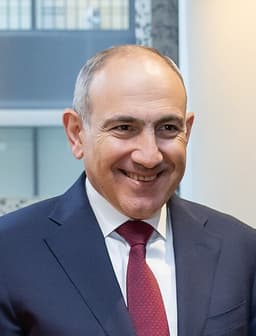
Nikol Pashinyan
Politician · Modern
55.8Total

Pedro Pablo Kuczynski
Politician · Modern
49.4Total
Basic Information
Born
1975
1938
Died
—
—
Era
Modern
Modern
Nationality
Armenia
Peru
Occupation
Politician
Politician
Civilization
Western
Western
Score Comparison
Military (10%)
49.3
49.4
Political (20%)
68.0
68.0
Influence (20%)
56.4
48.6
Legacy (20%)
45.0
38.3
Leadership (15%)
74.0
55.3
Strategy (15%)
42.0
42.1
TOTAL
55.8
49.4
Nikol Pashinyan — Complete Timeline
2018 AD
Velvet RevolutionPolitical Action
Pashinyan led a series of peaceful protests against the long-serving Prime Minister Serzh Sargsyan, who was accused of clinging to power. The protests, known as the Velvet Revolution, forced Sargsyan to resign, and Pashinyan was elected Prime Minister by parliament.
RevolutionArmeniaDemocracy
Impact: nationalconstructive
Elected Prime MinisterPolitical Action◆ Major
Following the Velvet Revolution, Pashinyan was elected Prime Minister of Armenia by a parliamentary vote. His election marked a shift towards a more democratic and reformist government, with promises to tackle corruption and strengthen the rule of law.
ElectionArmeniaLeadership
Impact: nationalconstructive
2020 AD
Nagorno-Karabakh WarWar
Pashinyan's government faced a full-scale war with Azerbaijan over the disputed Nagorno-Karabakh region. The 44-day war ended with a Russian-brokered ceasefire that saw Armenia cede significant territories it had controlled since the 1990s. The defeat triggered a political crisis in Armenia.
WarNagorno-KarabakhArmeniaAzerbaijan
Impact: regionaltragic
2021 AD
Survived Coup AttemptPolitical Action◆ Major
Following the Nagorno-Karabakh war, the Armenian military issued a statement demanding Pashinyan's resignation, which he denounced as a coup attempt. He dismissed the chief of the general staff and mobilized supporters, ultimately retaining power amid mass protests.
Coup AttemptArmeniaPolitical Crisis
Impact: national
Pedro Pablo Kuczynski — Complete Timeline
2001 AD
Appointed Minister of Economy and FinancePolitical Action◆ Major
Pedro Pablo Kuczynski was appointed Minister of Economy and Finance under President Alejandro Toledo. He implemented free-market economic policies, including privatization and trade liberalization, which contributed to Peru's economic growth.
Economic PolicyMinisterReform
Impact: nationalconstructive
2016 AD
Elected President of PeruPolitical Action
Pedro Pablo Kuczynski won the 2016 presidential election, defeating Keiko Fujimori in a narrow runoff. His victory was seen as a continuation of pro-business policies, but his government was plagued by political instability and corruption scandals.
ElectionPro-Business
Impact: nationalconstructive
2018 AD
Resigned amid corruption scandalPolitical Action
Facing imminent impeachment over corruption allegations linked to the Odebrecht scandal, Kuczynski resigned the presidency. His resignation was a major political crisis, leading to the succession of Vice President Mart
ResignationCorruptionOdebrecht
Impact: nationaldestructive
Expert Analysis
Origins
Nikol Pashinyan was born on June 1, 1975, in Ijevan, Armenia, then part of the Soviet Union. He studied journalism at Yerevan State University but was expelled for political activities. His early career as a journalist and editor of the opposition newspaper *Haykakan Zhamanak* shaped his role as a vocal critic of the ruling elite. Pashinyan was imprisoned from 2008 to 2011 for his role in post-election protests, gaining him credibility as a political prisoner.
Pedro Pablo Kuczynski was born on October 3, 1938, in Lima, Peru, into a well-connected family of Polish and French descent. He studied at Oxford and Princeton, earning a master's in public affairs. Kuczynski worked as an economist at the World Bank and later as a Wall Street investment banker, serving as CEO of a financial firm. His technocratic background contrasted sharply with Pashinyan's grassroots activism.
Rise to Power
Pashinyan rose to prominence as the leader of the 2018 Velvet Revolution. In March 2018, after Serzh Sargsyan moved to extend his rule as prime minister, Pashinyan led a protest march from Gyumri to Yerevan, gathering tens of thousands. The protests forced Sargsyan to resign on April 23, 2018. On May 8, 2018, Pashinyan was elected prime minister by a 59–42 vote in parliament, marking a peaceful transfer of power.
Kuczynski entered politics later in life. He served as Minister of Energy and Mines (1980-1982) and Minister of Economy and Finance (2001-2002) under President Alejandro Toledo, where he implemented free-market policies. He ran for president in 2011 but lost to Ollanta Humala. In 2016, he narrowly defeated Keiko Fujimori in a runoff, winning 50.1% of the vote. His presidency began on July 28, 2016, but he lacked a parliamentary majority.
Leadership & Governance
Pashinyan's governance was characterized by anti-corruption drives and democratic reforms. He launched investigations into former officials and sought to reduce oligarchic influence. However, his leadership was tested by the Nagorno-Karabakh conflict. During the 44-day war in 2020, his government faced criticism for military unpreparedness. He scored 74.0 in leadership but only 42.0 in strategy, reflecting his reactive approach.
Kuczynski governed as a centrist technocrat, promoting foreign investment and fiscal discipline. He signed a peace deal with the Shining Path remnants and prioritized infrastructure. But his leadership was weak: he scored 55.3 in leadership. He faced constant opposition from Fujimori's party, which controlled Congress. His reliance on executive decrees and inability to build coalitions undermined his agenda.
Triumph & Tragedy
Pashinyan's greatest triumph was the Velvet Revolution, a peaceful uprising that ended Sargsyan's rule and restored faith in democratic processes. His tragedy came with the Nagorno-Karabakh War (September 27–November 10, 2020), which resulted in Armenia losing control of territories. A Russian-brokered ceasefire led to the deployment of Russian peacekeepers. Pashinyan's popularity plummeted, and he survived a coup attempt in February 2021 when the military demanded his resignation.
Kuczynski's triumph was stabilizing Peru's economy; GDP growth averaged 4% during his tenure. He also secured the release of journalist Gustavo Gorriti from Venezuelan custody. His tragedy was the Odebrecht scandal. In 2017, it emerged that his consulting firm had received payments from Odebrecht. Facing impeachment, he resigned on March 21, 2018, less than two years into his term. He was later sentenced to 36 months of probation for money laundering.
Character & Destiny
Pashinyan is a charismatic populist with a confrontational style. His willingness to challenge elites fueled his rise but also isolated him. His decision-making during the war was criticized as erratic; he initially refused to declare martial law. Historians note his inability to balance domestic reform with national security.
Kuczynski was a reserved technocrat, often seen as aloof. His background in finance made him effective in economic policy but poor at political negotiation. He underestimated the Fujimori opposition and failed to build alliances. His resignation highlighted the fragility of a presidency built on narrow electoral margins.
Legacy
Pashinyan's legacy is mixed. He is credited with ending authoritarian rule but blamed for the war loss. Armenia's democratic institutions remain fragile. His overall score of 55.8 reflects his political impact (68.0) but low legacy (45.0) due to the war's aftermath. He remains a divisive figure.
Kuczynski's legacy is overshadowed by corruption. His economic reforms were positive but short-lived; his successor Pedro Castillo reversed many policies. He scored 38.3 in legacy, the lowest among comparable leaders. His resignation damaged Peru's institutional trust.
Conclusion
Nikol Pashinyan had a greater impact on his nation's trajectory. Despite his failures in the Nagorno-Karabakh War, his role in the Velvet Revolution permanently altered Armenia's political landscape, shifting it toward democracy. Kuczynski's presidency, while economically competent, was too brief and tainted by scandal to leave a lasting mark. Pashinyan's total score of 55.8 vs. Kuczynski's 49.4 underscores his higher political influence and leadership. The Armenian revolutionary changed his country's political culture, while the Peruvian banker merely managed it.
Rankings
🥇
Nikol PashinyanLeader
Mil: 49.3Pol: 68.0Inf: 56.4
55.8
🥈
Pedro Pablo Kuczynski
Mil: 49.4Pol: 68.0Inf: 48.6
49.4
+6.4 behind
How This Comparison Works
Algorithm
Each figure is scored on 6 dimensions (0—100 scale) based on structured historical data: Military (10%), Political (20%), Influence (20%), Legacy (20%), Leadership (15%), Strategy (15%). The weighted total produces the final ranking.
Data Sources
Scores are computed from structured sub-indicators in the database. Scale factors adjust for era (Ancient ×0.85, Modern ×1.0) and civilization size (Eastern ×1.05, Other ×0.80) to account for differences in population and military scale.
Maximum 3 Figures
Comparisons are limited to 2—3 figures to ensure readability and statistical meaningfulness.
Error Margins
±5 points per dimension — Sub-scores are derived from historical records with inherent uncertainty. Two figures within 5 points on a dimension should be considered roughly equivalent in that area.
Total Score Accuracy
±3 points overall — The weighted combination of 6 dimensions produces a total score with approximately ±3 points of uncertainty. Differences of less than 3 points are not statistically significant— the figures are effectively tied.
Known Limitations
- Historical records are incomplete and uneven across civilizations
- Figures from oral-tradition societies may be underrepresented
- Occupation labels can misclassify multi-role figures
- Scores measure capability and impact, not moral character
- Quantitative scoring is a comparison tool, not absolute truth
Capability Radar
Military (10%) — Battles & Warfare
Battles
27
27
Win Rate
33
35
Expansion
36
35
Political (20%) — Governance & Reform
Reform
60
40
Diplomacy
50
50
Economy
40
60
Influence (20%) — Cultural & Global Reach
Cultural
45
10
Global
35
20
Legacy (20%) — Historical Impact
Historical
40
20
Longevity
30
10
Leadership (15%) — Power & Stability
Tenure
55
30
Stability
35
20
Strategy (15%) — Tactics & Innovation
Strategy
36
41
Tactics
44
39
Reform
42
42
Similar Comparisons
Comments & Discussion
No comments yet. Be the first to share your thoughts!