Loading...
Guadalupe Victoria vs Nikol Pashinyan
Nikol Pashinyan leads by 2.5 pts · 2 figures compared
…
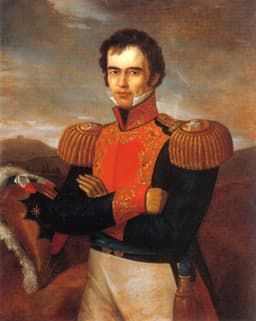
Guadalupe Victoria
Politician · Modern
53.3Total

Nikol Pashinyan
Politician · Modern
55.8Total
Basic Information
Born
1786
1975
Died
1843
—
Era
Modern
Modern
Nationality
Mexico
Armenia
Occupation
Politician
Politician
Civilization
Western
Western
Score Comparison
Military (10%)
25.9
49.3
Political (20%)
68.0
68.0
Influence (20%)
56.4
56.4
Legacy (20%)
49.2
45.0
Leadership (15%)
74.0
74.0
Strategy (15%)
30.3
42.0
TOTAL
53.3
55.8
Guadalupe Victoria — Complete Timeline
1812 AD
Victoria's role in the Mexican War of IndependenceWar◆ Major
Guadalupe Victoria joined the insurgent forces under Jos
War of IndependenceGuerrilla WarfareInsurgency
Impact: national
1824 AD
Guadalupe Victoria becomes first President of MexicoPolitical Action◆ Major
Guadalupe Victoria was elected as the first president of the newly established Federal Republic of Mexico. His presidency (1824-1829) marked the consolidation of Mexican independence and the establishment of republican institutions.
Mexican IndependenceFirst PresidentRepublic
Impact: nationalconstructive
1827 AD
Victoria's presidency and the expulsion of the SpanishPolitical Action◆ Major
During Victoria's presidency, the Mexican government ordered the expulsion of all Spanish residents from Mexico. This action aimed to remove remaining colonial influence but caused economic disruption and social tension.
ExpulsionAnti-SpanishNationalism
Impact: nationaldestructive
1829 AD
Victoria's peaceful transfer of powerPolitical Action◆ Major
Guadalupe Victoria completed his four-year term and peacefully handed over the presidency to Vicente Guerrero. This was the first peaceful transfer of executive power in Mexican history, setting a precedent for republican governance.
Peaceful TransitionDemocracyPresidency
Impact: nationalconstructive
Nikol Pashinyan — Complete Timeline
2018 AD
Velvet RevolutionPolitical Action
Pashinyan led a series of peaceful protests against the long-serving Prime Minister Serzh Sargsyan, who was accused of clinging to power. The protests, known as the Velvet Revolution, forced Sargsyan to resign, and Pashinyan was elected Prime Minister by parliament.
RevolutionArmeniaDemocracy
Impact: nationalconstructive
Elected Prime MinisterPolitical Action◆ Major
Following the Velvet Revolution, Pashinyan was elected Prime Minister of Armenia by a parliamentary vote. His election marked a shift towards a more democratic and reformist government, with promises to tackle corruption and strengthen the rule of law.
ElectionArmeniaLeadership
Impact: nationalconstructive
2020 AD
Nagorno-Karabakh WarWar
Pashinyan's government faced a full-scale war with Azerbaijan over the disputed Nagorno-Karabakh region. The 44-day war ended with a Russian-brokered ceasefire that saw Armenia cede significant territories it had controlled since the 1990s. The defeat triggered a political crisis in Armenia.
WarNagorno-KarabakhArmeniaAzerbaijan
Impact: regionaltragic
2021 AD
Survived Coup AttemptPolitical Action◆ Major
Following the Nagorno-Karabakh war, the Armenian military issued a statement demanding Pashinyan's resignation, which he denounced as a coup attempt. He dismissed the chief of the general staff and mobilized supporters, ultimately retaining power amid mass protests.
Coup AttemptArmeniaPolitical Crisis
Impact: national
Expert Analysis
Origins
Guadalupe Victoria, born José Miguel Ramón Adaucto Fernández y Félix in 1786 in Tamazula, New Spain (modern Mexico), came from a modest family. He studied law at the Colegio de San Ildefonso but left to join the independence movement. His early life was shaped by colonial oppression and Enlightenment ideas. Nikol Pashinyan, born in 1975 in Ijevan, Armenian SSR, grew up in the late Soviet era. He studied journalism at Yerevan State University and became a political activist early. His background was marked by Soviet decline and nationalist aspirations.
Rise to Power
Victoria rose through guerrilla warfare in the Mexican War of Independence (1810-1821). He fought under José María Morelos and later led insurgent forces in Veracruz. After independence, he supported the republican faction against Agustín de Iturbide's empire. In 1824, he was elected the first president of Mexico, scoring 68.0 in political acumen. Pashinyan's rise came through journalism and opposition politics. He founded the critical newspaper *Haykakan Zhamanak* and was imprisoned in 2008 after post-election protests. In 2018, he led the Velvet Revolution, a peaceful protest movement against Prime Minister Serzh Sargsyan. Sargsyan resigned, and Pashinyan was elected prime minister in May 2018, achieving a political score of 68.0.
Leadership & Governance
Victoria's presidency (1824-1829) focused on establishing republican institutions. He oversaw the adoption of the 1824 Constitution, which created a federal republic. He expelled Spanish residents to remove colonial influence, a controversial move that weakened the economy. His leadership style was conciliatory, aiming to unite factions. He scored 74.0 in leadership. Pashinyan's governance emphasized anti-corruption and democratic reforms. He purged the old elite and held free elections. However, his leadership was tested by the Nagorno-Karabakh conflict. In 2020, a 44-day war with Azerbaijan resulted in territorial losses. Pashinyan's handling drew criticism, but he survived a coup attempt in 2021. His leadership score matches Victoria's at 74.0.
Triumph & Tragedy
Victoria's greatest triumph was completing his term and peacefully transferring power to Vicente Guerrero in 1829, the first such transition in Mexican history. His tragedy was the economic instability and factionalism that plagued his presidency. He failed to consolidate national unity, and his expulsion of Spaniards damaged trade. Pashinyan's triumph was the Velvet Revolution, a non-violent overthrow of a corrupt regime. His tragedy was the 2020 Nagorno-Karabakh war, where Armenian forces lost control of territories. The war led to a political crisis, with accusations of mismanagement. Pashinyan's military score of 49.3 reflects this failure, while Victoria's 25.9 shows his lack of military focus.
Character & Destiny
Victoria was pragmatic and persistent, adopting the name "Victoria" to symbolize his commitment to independence. He avoided personal ambition, stepping down as planned. His character fostered stability but lacked boldness. Pashinyan is charismatic and confrontational, traits that fueled the revolution but hindered diplomacy. His decision-making during the war was criticized as erratic. Both leaders were shaped by their contexts: Victoria's Mexico was fragile, while Pashinyan's Armenia faced existential threats. Historians assess Victoria as a foundational figure, while Pashinyan remains controversial.
Legacy
Victoria is remembered as the first president of Mexico, a symbol of republican stability. His peaceful transfer of power set a precedent, though later Mexican leaders often ignored it. He ranks 56.4 in influence and 49.2 in legacy. Pashinyan's legacy is mixed: he inspired democratic movements but also presided over military defeat. His reforms weakened oligarchs but failed to secure Nagorno-Karabakh. He scores 56.4 in influence and 45.0 in legacy. Victoria's long-term impact on Mexican institutions is more enduring, while Pashinyan's legacy is still forming.
Conclusion
While Pashinyan has a higher total score (55.8 vs 53.3), Victoria's impact on Mexican history is more profound. He established the framework for a republic and demonstrated peaceful transition, a rarity in Latin America. Pashinyan's revolution was significant, but his governance failures in war undermine his achievements. Victoria's legacy—the peaceful transfer of power and constitutional foundation—has greater historical weight. Thus, Guadalupe Victoria had a greater long-term impact.
Rankings
🥇
Nikol PashinyanLeader
Mil: 49.3Pol: 68.0Inf: 56.4
55.8
🥈
Guadalupe Victoria
Mil: 25.9Pol: 68.0Inf: 56.4
53.3
+2.5 behind
How This Comparison Works
Algorithm
Each figure is scored on 6 dimensions (0—100 scale) based on structured historical data: Military (10%), Political (20%), Influence (20%), Legacy (20%), Leadership (15%), Strategy (15%). The weighted total produces the final ranking.
Data Sources
Scores are computed from structured sub-indicators in the database. Scale factors adjust for era (Ancient ×0.85, Modern ×1.0) and civilization size (Eastern ×1.05, Other ×0.80) to account for differences in population and military scale.
Maximum 3 Figures
Comparisons are limited to 2—3 figures to ensure readability and statistical meaningfulness.
Error Margins
±5 points per dimension — Sub-scores are derived from historical records with inherent uncertainty. Two figures within 5 points on a dimension should be considered roughly equivalent in that area.
Total Score Accuracy
±3 points overall — The weighted combination of 6 dimensions produces a total score with approximately ±3 points of uncertainty. Differences of less than 3 points are not statistically significant— the figures are effectively tied.
Known Limitations
- Historical records are incomplete and uneven across civilizations
- Figures from oral-tradition societies may be underrepresented
- Occupation labels can misclassify multi-role figures
- Scores measure capability and impact, not moral character
- Quantitative scoring is a comparison tool, not absolute truth
Capability Radar
Military (10%) — Battles & Warfare
Battles
35
27
Win Rate
40
33
Expansion
15
36
Political (20%) — Governance & Reform
Reform
50
60
Diplomacy
45
50
Economy
40
40
Influence (20%) — Cultural & Global Reach
Cultural
40
45
Global
30
35
Legacy (20%) — Historical Impact
Historical
50
40
Longevity
45
30
Leadership (15%) — Power & Stability
Tenure
55
55
Stability
35
35
Strategy (15%) — Tactics & Innovation
Strategy
35
36
Tactics
30
44
Reform
20
42
Similar Comparisons
Comments & Discussion
No comments yet. Be the first to share your thoughts!