Loading...
Nikita Khrushchev vs Sao Shwe Thaik
Nikita Khrushchev leads by 19.8 pts · 2 figures compared
…
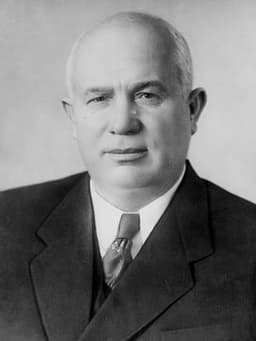
Nikita Khrushchev
Politician · Modern
64.6Total

Sao Shwe Thaik
Politician · Modern
44.8Total
Basic Information
Born
1894
1894
Died
1971
1962
Era
Modern
Modern
Nationality
Russia
Burma
Occupation
Politician
Politician
Civilization
Western
Eastern
Score Comparison
Military (10%)
43.3
11.8
Political (20%)
70.0
48.0
Influence (20%)
82.0
51.8
Legacy (20%)
52.0
42.5
Leadership (15%)
72.0
65.0
Strategy (15%)
54.8
30.6
TOTAL
64.6
44.8
Nikita Khrushchev — Complete Timeline
1956 AD
Secret Speech on the Cult of PersonalityPolitical Action
Khrushchev delivered a closed-session speech to the 20th Congress of the Communist Party, denouncing Stalin's cult of personality and crimes. This speech initiated de-Stalinization, leading to political reforms and the release of political prisoners.
De-StalinizationSpeechCommunist Party
Impact: globalconstructive
1957 AD
Launch of Sputnik 1Invention◆ Major
Under Khrushchev's leadership, the Soviet Union launched Sputnik 1, the first artificial satellite to orbit Earth. This achievement sparked the Space Race and demonstrated Soviet technological superiority at the time.
Space RaceSatelliteTechnology
Impact: globalconstructive
1958 AD
Berlin UltimatumPolitical Action◆ Major
Khrushchev issued an ultimatum demanding the withdrawal of Western forces from West Berlin within six months. The ultimatum escalated Cold War tensions but was eventually dropped after negotiations, leading to the Berlin Crisis of 1961.
Cold WarBerlinUltimatum
Impact: global
1962 AD
Cuban Missile CrisisWar
Khrushchev authorized the placement of Soviet nuclear missiles in Cuba, leading to a 13-day confrontation with the United States. The crisis ended with a negotiated withdrawal of missiles from both Cuba and Turkey, averting nuclear war.
Cold WarNuclear CrisisCuba
Impact: global
1964 AD
Ouster from PowerPolitical Action◆ Major
Khrushchev was removed from his positions as First Secretary and Premier by the Communist Party leadership, led by Leonid Brezhnev. The ouster was due to his erratic policies, the Cuban Missile Crisis fallout, and agricultural failures.
CoupBrezhnevSoviet Union
Impact: nationaltragic
Sao Shwe Thaik — Complete Timeline
1947 AD
Signed the Panglong AgreementPolitical Action◆ Major
Sao Shwe Thaik, as a Shan leader, signed the Panglong Agreement with Aung San and other ethnic representatives. The agreement promised autonomy for ethnic states within a federal Burma, laying the foundation for the post-independence constitution.
Panglong AgreementEthnic unityFederalism
Impact: nationalconstructive
1948 AD
Elected first president of independent BurmaPolitical Action◆ Major
Sao Shwe Thaik was elected as the first President of the Union of Burma after independence from Britain. As a Shan saopha (traditional ruler), his presidency symbolized the unity of Burma's diverse ethnic groups under the new federal constitution.
PresidencyIndependenceFederalism
Impact: nationalconstructive
1962 AD
Resigned presidency after military coupPolitical Action◆ Major
General Ne Win staged a military coup, overthrowing the civilian government. Sao Shwe Thaik resigned as president and was placed under house arrest. The coup ended Burma's democratic experiment and began decades of military rule.
CoupMilitary ruleEnd of democracy
Impact: nationaltragic
Died in custodyPolitical Action◆ Major
Sao Shwe Thaik died while under house arrest following the 1962 coup. His death was officially attributed to a heart attack, but rumors of foul play persist. He became a symbol of the lost democratic and federal aspirations of Burma.
Death in custodyMartyrMilitary repression
Impact: nationaltragic
Expert Analysis
Origins
Nikita Khrushchev (1894-1971) was born into a poor peasant family in Kalinovka, Russia. He received minimal formal education, working as a metal fitter in his youth. His early political involvement began after the Russian Revolution, joining the Bolsheviks in 1918. He rose through party ranks during the 1920s and 1930s, studying at the Stalin Industrial Academy in Moscow. He survived the Great Purges, serving as First Secretary of the Ukrainian Communist Party from 1938.
Sao Shwe Thaik (1895-1962) was born in Yawnghwe, a Shan state in British Burma. He was a saopha (traditional prince) of Yawnghwe, inheriting the title in 1929. Educated at a British missionary school, he gained administrative experience under colonial rule. He became involved in the anti-colonial movement, joining the Anti-Fascist People's Freedom League. His background as a hereditary ruler shaped his moderate, federalist approach.
Rise to Power
Khrushchev's rise accelerated after World War II. He led the reconstruction of Ukraine, then became a key figure in Moscow. In 1953, after Stalin's death, he outmaneuvered rivals like Lavrentiy Beria and Georgy Malenkov to become First Secretary. By 1956, his Secret Speech denouncing Stalin consolidated his power, scoring 70.0 in political acumen. He became Premier in 1958, controlling both party and state.
Sao Shwe Thaik's rise was tied to Burma's independence. As a Shan leader, he signed the 1947 Panglong Agreement with Aung San, promising ethnic autonomy. After Aung San's assassination, he was elected first President of the Union of Burma in 1948, a largely ceremonial role. His prestige as a saopha helped unify the new nation, but his political score of 48.0 reflects limited executive power.
Leadership & Governance
Khrushchev's leadership was bold and erratic. He de-Stalinized the USSR, releasing political prisoners and reforming the secret police. His agricultural policies, like the Virgin Lands Campaign, initially increased grain production but later failed due to soil erosion and mismanagement. He pushed for peaceful coexistence with the West but also triggered crises. His governance score of 72.0 reflects his dynamic but inconsistent style.
Sao Shwe Thaik's governance was symbolic and unifying. As president, he represented the federal union, respecting parliamentary democracy. He supported Prime Minister U Nu's policies, including Buddhist socialism and neutrality. However, his influence was limited; the military under General Ne Win held real power. His leadership score of 65.0 reflects his dignified but passive role.
Triumph & Tragedy
Khrushchev's greatest triumph was navigating the Cuban Missile Crisis (1962), avoiding nuclear war by agreeing to remove missiles from Cuba in exchange for a US pledge not to invade. He also launched Sputnik (1957), scoring 82.0 in influence. His tragedies include the Berlin Ultimatum (1958-61), which failed to force Western withdrawal, and the construction of the Berlin Wall. The disastrous collapse of his agricultural reforms and his ouster in 1964 by Leonid Brezhnev marked his decline.
Sao Shwe Thaik's triumph was signing the Panglong Agreement, which promised autonomy for ethnic states. His presidency from 1948-1952 symbolized national unity. His tragedy was the 1962 military coup by General Ne Win, which ended democracy. He resigned and was placed under house arrest, dying in custody under suspicious circumstances. His legacy score of 42.5 reflects his tragic end and the failure of federalism.
Character & Destiny
Khrushchev was impulsive, outspoken, and risk-taking. His decision to place missiles in Cuba showed audacity, but his withdrawal was pragmatic. His Secret Speech was a bold gamble that reshaped Soviet politics. However, his erratic decisions, like the Berlin Ultimatum and agricultural reforms, alienated allies. His character—combining peasant cunning with ideological fervor—led to both his rise and fall. He scored 54.8 in strategy, reflecting mixed outcomes.
Sao Shwe Thaik was cautious, diplomatic, and traditional. He believed in federalism and democratic processes, but lacked the ruthlessness to confront the military. His acceptance of house arrest without resistance illustrated his non-confrontational nature. His destiny was tied to Burma's fragile democracy; when the army struck, he had no power to resist. His strategy score of 30.6 indicates limited political maneuvering.
Legacy
Khrushchev's legacy is mixed. He is remembered for de-Stalinization, the Space Race, and the Cuban Missile Crisis. His reforms opened Soviet society but were incomplete. He influenced later leaders like Gorbachev. His impact on the Cold War is measured by his score of 52.0 in legacy, as he both escalated and de-escalated tensions. The Sputnik launch spurred US science education. His ouster showed the limits of reform within the Soviet system.
Sao Shwe Thaik's legacy is as a symbol of Burma's failed federalism. The Panglong Agreement remains a reference point for ethnic rights. His death in custody represents the military's suppression of democracy. He is honored in Myanmar as a founding father, but his vision of ethnic autonomy was never realized. His legacy score of 42.5 underscores his overshadowing by stronger forces.
Conclusion
Nikita Khrushchev had a greater impact on world history than Sao Shwe Thaik. With a total score of 64.6 against 44.8, Khrushchev's decisions during the Cold War affected global nuclear strategy, space exploration, and Soviet politics. His actions, though flawed, shaped the trajectory of the 20th century. Sao Shwe Thaik's influence was confined to Burma's brief democratic period and ethnic politics, which ended with the 1962 coup. While both faced tragic ends, Khrushchev's role in defining the Cold War gives him a wider and more enduring significance.
Rankings
🥇
Nikita KhrushchevLeader
Mil: 43.3Pol: 70.0Inf: 82.0
64.6
🥈
Sao Shwe Thaik
Mil: 11.8Pol: 48.0Inf: 51.8
44.8
+19.8 behind
How This Comparison Works
Algorithm
Each figure is scored on 6 dimensions (0—100 scale) based on structured historical data: Military (10%), Political (20%), Influence (20%), Legacy (20%), Leadership (15%), Strategy (15%). The weighted total produces the final ranking.
Data Sources
Scores are computed from structured sub-indicators in the database. Scale factors adjust for era (Ancient ×0.85, Modern ×1.0) and civilization size (Eastern ×1.05, Other ×0.80) to account for differences in population and military scale.
Maximum 3 Figures
Comparisons are limited to 2—3 figures to ensure readability and statistical meaningfulness.
Error Margins
±5 points per dimension — Sub-scores are derived from historical records with inherent uncertainty. Two figures within 5 points on a dimension should be considered roughly equivalent in that area.
Total Score Accuracy
±3 points overall — The weighted combination of 6 dimensions produces a total score with approximately ±3 points of uncertainty. Differences of less than 3 points are not statistically significant— the figures are effectively tied.
Known Limitations
- Historical records are incomplete and uneven across civilizations
- Figures from oral-tradition societies may be underrepresented
- Occupation labels can misclassify multi-role figures
- Scores measure capability and impact, not moral character
- Quantitative scoring is a comparison tool, not absolute truth
Capability Radar
Military (10%) — Battles & Warfare
Battles
5
16
Win Rate
10
17
Expansion
20
21
Political (20%) — Governance & Reform
Reform
80
40
Diplomacy
70
50
Economy
55
30
Influence (20%) — Cultural & Global Reach
Cultural
60
30
Global
70
20
Legacy (20%) — Historical Impact
Historical
75
35
Longevity
55
20
Leadership (15%) — Power & Stability
Tenure
75
55
Stability
50
25
Strategy (15%) — Tactics & Innovation
Strategy
15
24
Tactics
10
25
Reform
30
30
Similar Comparisons
Comments & Discussion
No comments yet. Be the first to share your thoughts!