Loading...
This comparison has not been analyzed yet.
One-time AI generation (~1 minute). Scores and timeline are already available below.
Ng Eng Hen vs Pakalitha Mosisili
Ng Eng Hen leads by 2.5 pts · 2 figures compared
…
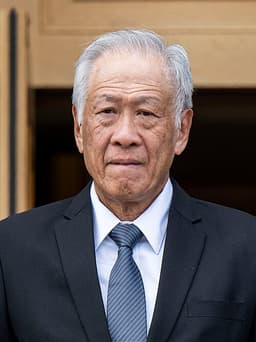
Ng Eng Hen
Politician · Modern
52.2Total

Pakalitha Mosisili
Politician · Modern
49.7Total
Basic Information
Born
1958
1945
Died
—
—
Era
Modern
Modern
Nationality
Singapore
Lesotho
Occupation
Politician
Politician
Civilization
Eastern
Other
Score Comparison
Military (10%)
10.0
50.0
Political (20%)
72.0
54.7
Influence (20%)
51.8
51.0
Legacy (20%)
45.0
45.0
Leadership (15%)
78.0
53.2
Strategy (15%)
45.0
44.7
TOTAL
52.2
49.7
Ng Eng Hen — Complete Timeline
2001 AD
Elected to Parliament for Bishan-Toa Payoh GRCPolitical Action
Ng Eng Hen was first elected to Parliament as a Member of Parliament for Bishan-Toa Payoh GRC. This marked the start of his political career in the People's Action Party.
ElectionParliamentPAP
constructive
2003 AD
Appointed Minister for EducationPolitical Action◆ Major
Ng was appointed Minister for Education, overseeing reforms in Singapore's education system. He introduced changes to the curriculum and promoted holistic education.
EducationReformSingapore
Impact: nationalconstructive
2008 AD
Appointed Minister for ManpowerPolitical Action◆ Major
Ng Eng Hen was appointed Minister for Manpower, overseeing labor policies and foreign worker management. He implemented measures to address labor shortages and improve productivity.
LabourManpowerSingapore
Impact: nationalconstructive
2011 AD
Appointed Minister for DefencePolitical Action◆ Major
Ng Eng Hen was appointed Minister for Defence, becoming Singapore's longest-serving defence minister. He oversaw the modernization of the Singapore Armed Forces, including the development of the SAF's cyber and unmanned systems capabilities.
DefenceMilitarySingapore
Impact: nationalconstructive
Pakalitha Mosisili — Complete Timeline
1998 AD
First elected Prime Minister of LesothoPolitical Action◆ Major
Mosisili became Prime Minister after the 1998 general election, which was disputed and led to political instability. His Lesotho Congress for Democracy party won a majority, but allegations of fraud prompted intervention by Southern African Development Community forces.
ElectionPolitical CrisisSADC Intervention
Impact: national
Signed the Lesotho Highlands Water Project TreatyPolitical Action◆ Major
Mosisili signed the treaty with South Africa to implement the Lesotho Highlands Water Project, a major infrastructure scheme transferring water to South Africa and generating hydroelectric power for Lesotho. The project became a key economic driver but faced corruption allegations.
InfrastructureWater ProjectCorruption
Impact: regionalconstructive
2012 AD
Lost 2012 election and peacefully transferred powerPolitical Action◆ Major
After 14 years in power, Mosisili's party lost the 2012 general election to a coalition led by Tom Thabane. He accepted defeat and stepped down, marking a rare peaceful transfer of power in Lesotho's history.
ElectionPeaceful TransitionDemocracy
Impact: nationalconstructive
2015 AD
Returned to power in 2015 snap electionPolitical Action◆ Major
Mosisili returned as Prime Minister after winning the 2015 snap election, forming a coalition government. His return followed the collapse of Thabane's government amid political infighting and instability.
ElectionCoalitionPolitical Instability
Impact: national
2017 AD
Resigned amid no-confidence votePolitical Action◆ Major
Mosisili resigned as Prime Minister after losing a no-confidence vote in parliament. His coalition government collapsed due to internal divisions, leading to another snap election which he lost to Tom Thabane.
No-ConfidenceGovernment CollapseResignation
Impact: nationaldestructive
This comparison has not been analyzed yet.
One-time AI generation (~1 minute). Scores and timeline are already available below.
Rankings
🥇
Ng Eng HenLeader
Mil: 10.0Pol: 72.0Inf: 51.8
52.2
🥈
Pakalitha Mosisili
Mil: 50.0Pol: 54.7Inf: 51.0
49.7
+2.5 behind
How This Comparison Works
Algorithm
Each figure is scored on 6 dimensions (0—100 scale) based on structured historical data: Military (10%), Political (20%), Influence (20%), Legacy (20%), Leadership (15%), Strategy (15%). The weighted total produces the final ranking.
Data Sources
Scores are computed from structured sub-indicators in the database. Scale factors adjust for era (Ancient ×0.85, Modern ×1.0) and civilization size (Eastern ×1.05, Other ×0.80) to account for differences in population and military scale.
Maximum 3 Figures
Comparisons are limited to 2—3 figures to ensure readability and statistical meaningfulness.
Error Margins
±5 points per dimension — Sub-scores are derived from historical records with inherent uncertainty. Two figures within 5 points on a dimension should be considered roughly equivalent in that area.
Total Score Accuracy
±3 points overall — The weighted combination of 6 dimensions produces a total score with approximately ±3 points of uncertainty. Differences of less than 3 points are not statistically significant— the figures are effectively tied.
Known Limitations
- Historical records are incomplete and uneven across civilizations
- Figures from oral-tradition societies may be underrepresented
- Occupation labels can misclassify multi-role figures
- Scores measure capability and impact, not moral character
- Quantitative scoring is a comparison tool, not absolute truth
Capability Radar
Military (10%) — Battles & Warfare
Battles
0
20
Win Rate
0
27
Expansion
0
28
Political (20%) — Governance & Reform
Reform
60
40
Diplomacy
65
50
Economy
60
35
Influence (20%) — Cultural & Global Reach
Cultural
20
20
Global
30
25
Legacy (20%) — Historical Impact
Historical
30
30
Longevity
40
40
Leadership (15%) — Power & Stability
Tenure
75
70
Stability
70
30
Strategy (15%) — Tactics & Innovation
Strategy
0
29
Tactics
0
32
Reform
30
38
Similar Comparisons
Comments & Discussion
No comments yet. Be the first to share your thoughts!