Loading...
Ng Eng Hen vs Urho Kekkonen
Urho Kekkonen leads by 9.5 pts · 2 figures compared
…
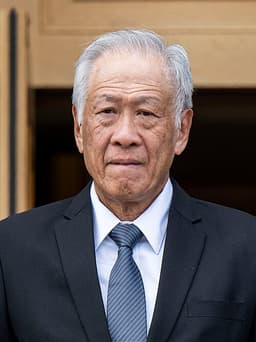
Ng Eng Hen
Politician · Modern
52.2Total

Urho Kekkonen
Politician · Modern
61.7Total
Basic Information
Born
1958
1900
Died
—
1986
Era
Modern
Modern
Nationality
Singapore
Finland
Occupation
Politician
Politician
Civilization
Eastern
Western
Score Comparison
Military (10%)
10.0
49.0
Political (20%)
72.0
62.7
Influence (20%)
51.8
72.0
Legacy (20%)
45.0
52.0
Leadership (15%)
78.0
80.7
Strategy (15%)
45.0
42.7
TOTAL
52.2
61.7
Ng Eng Hen — Complete Timeline
2001 AD
Elected to Parliament for Bishan-Toa Payoh GRCPolitical Action
Ng Eng Hen was first elected to Parliament as a Member of Parliament for Bishan-Toa Payoh GRC. This marked the start of his political career in the People's Action Party.
ElectionParliamentPAP
constructive
2003 AD
Appointed Minister for EducationPolitical Action◆ Major
Ng was appointed Minister for Education, overseeing reforms in Singapore's education system. He introduced changes to the curriculum and promoted holistic education.
EducationReformSingapore
Impact: nationalconstructive
2008 AD
Appointed Minister for ManpowerPolitical Action◆ Major
Ng Eng Hen was appointed Minister for Manpower, overseeing labor policies and foreign worker management. He implemented measures to address labor shortages and improve productivity.
LabourManpowerSingapore
Impact: nationalconstructive
2011 AD
Appointed Minister for DefencePolitical Action◆ Major
Ng Eng Hen was appointed Minister for Defence, becoming Singapore's longest-serving defence minister. He oversaw the modernization of the Singapore Armed Forces, including the development of the SAF's cyber and unmanned systems capabilities.
DefenceMilitarySingapore
Impact: nationalconstructive
Urho Kekkonen — Complete Timeline
1956 AD
Presidency of Finland (1956-1982)Political Action
Urho Kekkonen was elected President of Finland in 1956 and served for 26 years until 1982, the longest tenure in Finnish history. His presidency was marked by a policy of active neutrality, maintaining friendly relations with the Soviet Union while preserving Finland's independence and democratic system.
PresidencyFinlandLongevity
Impact: national
The 'Kekkonen Doctrine' of NeutralityPolitical Action◆ Major
Kekkonen developed a foreign policy doctrine that emphasized Finland's neutrality in the Cold War, balancing relations with the Soviet Union and the West. He maintained close ties with Moscow through the 1948 Treaty of Friendship, Cooperation, and Mutual Assistance, while also pursuing economic integration with Western Europe.
Foreign PolicyNeutralityCold War
Impact: regionalconstructive
1960 AD
Domestic Political Dominance and the 'Kekkonen System'Political Action◆ Major
Kekkonen consolidated his power through a system of personal influence and coalition-building, often dissolving parliament and calling new elections to achieve his goals. His dominance led to a period of political stability but also criticism of authoritarian tendencies, as he marginalized opponents and controlled foreign policy.
Political SystemFinlandPower
Impact: national
1975 AD
Hosting the Conference on Security and Co-operation in Europe (CSCE)Political Action
Kekkonen hosted the final summit of the Conference on Security and Co-operation in Europe (CSCE) in Helsinki in 1975, which produced the Helsinki Accords. The accords recognized post-war borders in Europe and committed signatories to human rights principles, a landmark achievement in Cold War diplomacy.
DiplomacyCold WarHuman Rights
Impact: globalconstructive
Expert Analysis
Origins
Ng Eng Hen was born in 1958 in Singapore, then a British colony. He studied medicine at the National University of Singapore and became a doctor. His early career was in the public service, but he quickly moved into politics, being elected to Parliament in 2001 for the Bishan-Toa Payoh Group Representation Constituency. His background in medicine and lack of military experience shaped his later approach to defense.
Urho Kekkonen was born in 1900 in Pielavesi, Finland, then part of the Russian Empire. He studied law at the University of Helsinki and became a lawyer. He entered politics in the 1930s, serving as Prime Minister multiple times before becoming President. His early life in a rural, nationalist environment influenced his commitment to Finnish independence and neutrality.
Rise to Power
Ng Eng Hen rose quickly within the People's Action Party (PAP). After his election in 2001, he was appointed Minister of State for Education in 2002, then full Minister for Education in 2003. In 2005, he became Minister for Manpower, and in 2008, he was appointed Minister for Defence, a position he held until 2023. His rise was steady, without major turning points, reflecting the PAP's structured succession.
Urho Kekkonen's rise was more dramatic. He became Prime Minister in 1950 and 1954, but his major turning point was the 1956 presidential election, which he won narrowly against K.-A. Fagerholm. He consolidated power through the so-called "Kekkonen system," using his relationship with the Soviet Union to outmaneuver opponents. He dissolved parliament multiple times and called new elections to maintain his majority, a tactic unusual in a democracy.
Leadership & Governance
Ng Eng Hen's leadership style was technocratic and managerial. As Defence Minister, he oversaw the modernization of the Singapore Armed Forces, focusing on technology and cyber defense. He scored 78.0 in leadership, but his military score of 10.0 reflects his civilian background. He implemented the "Total Defence" concept, involving economic, civil, and social defense. His governance was efficient but lacked the transformative impact of Kekkonen.
Kekkonen's leadership was more political and strategic. He scored 80.7 in leadership and 49.0 in military. He maintained Finland's neutrality through the "Kekkonen Doctrine," balancing between the Soviet Union and the West. Domestically, he dominated politics, often bypassing parliament. His governance was effective but also criticized as authoritarian, with a score of 42.7 in strategy, reflecting his reactive rather than proactive approach.
Triumph & Tragedy
Ng Eng Hen's greatest success was overseeing the SAF's transformation into a modern, high-tech force. His score of 51.8 in influence reflects his role in regional security dialogues. However, his failure was the lack of a major strategic vision; Singapore's defense remained dependent on conscription and external alliances. His legacy score of 45.0 is moderate.
Kekkonen's triumph was hosting the 1975 Conference on Security and Co-operation in Europe (CSCE), which produced the Helsinki Accords. This boosted his influence score to 72.0. His tragedy was the erosion of democratic norms; his dominance created a "Kekkonen system" that stifled political competition. His legacy score of 52.0 reflects mixed views.
Character & Destiny
Ng Eng Hen was methodical and cautious, a product of Singapore's meritocratic system. His character suited a stable, predictable environment, but he lacked the boldness to shape history. His destiny was to be a competent manager, not a visionary.
Kekkonen was pragmatic and cunning, using his personal relationships with Soviet leaders to secure Finland's position. His character was both a strength and a weakness; his ability to navigate Cold War politics was unparalleled, but his autocratic tendencies damaged Finland's democracy. His destiny was to be a controversial figure who saved Finland's independence at the cost of its democratic ideals.
Legacy
Ng Eng Hen's legacy is the modernization of Singapore's defense establishment, but his impact is limited to Singapore. His scores: military 10.0, political 72.0, influence 51.8, legacy 45.0, leadership 78.0, strategy 45.0, total 52.2.
Kekkonen's legacy is more significant. He shaped Finland's foreign policy for decades, and the Helsinki Accords influenced human rights globally. His scores: military 49.0, political 62.7, influence 72.0, legacy 52.0, leadership 80.7, strategy 42.7, total 61.7.
Conclusion
Urho Kekkonen had greater impact. His total score of 61.7 surpasses Ng Eng Hen's 52.2 by 9.5 points. Kekkonen navigated a perilous Cold War, maintained Finnish independence, and left a mark on international diplomacy. Ng Eng Hen, while effective, operated in a stable, prosperous Singapore without existential threats. Kekkonen's decisions had global consequences; Ng Eng Hen's were regional. Thus, Kekkonen is the more historically significant figure.
Rankings
🥇
Urho KekkonenLeader
Mil: 49.0Pol: 62.7Inf: 72.0
61.7
🥈
Ng Eng Hen
Mil: 10.0Pol: 72.0Inf: 51.8
52.2
+9.5 behind
How This Comparison Works
Algorithm
Each figure is scored on 6 dimensions (0—100 scale) based on structured historical data: Military (10%), Political (20%), Influence (20%), Legacy (20%), Leadership (15%), Strategy (15%). The weighted total produces the final ranking.
Data Sources
Scores are computed from structured sub-indicators in the database. Scale factors adjust for era (Ancient ×0.85, Modern ×1.0) and civilization size (Eastern ×1.05, Other ×0.80) to account for differences in population and military scale.
Maximum 3 Figures
Comparisons are limited to 2—3 figures to ensure readability and statistical meaningfulness.
Error Margins
±5 points per dimension — Sub-scores are derived from historical records with inherent uncertainty. Two figures within 5 points on a dimension should be considered roughly equivalent in that area.
Total Score Accuracy
±3 points overall — The weighted combination of 6 dimensions produces a total score with approximately ±3 points of uncertainty. Differences of less than 3 points are not statistically significant— the figures are effectively tied.
Known Limitations
- Historical records are incomplete and uneven across civilizations
- Figures from oral-tradition societies may be underrepresented
- Occupation labels can misclassify multi-role figures
- Scores measure capability and impact, not moral character
- Quantitative scoring is a comparison tool, not absolute truth
Capability Radar
Military (10%) — Battles & Warfare
Battles
0
29
Win Rate
0
33
Expansion
0
35
Political (20%) — Governance & Reform
Reform
60
75
Diplomacy
65
90
Economy
60
70
Influence (20%) — Cultural & Global Reach
Cultural
20
60
Global
30
65
Legacy (20%) — Historical Impact
Historical
30
70
Longevity
40
65
Leadership (15%) — Power & Stability
Tenure
75
85
Stability
70
85
Strategy (15%) — Tactics & Innovation
Strategy
0
40
Tactics
0
42
Reform
30
42
Similar Comparisons
Comments & Discussion
No comments yet. Be the first to share your thoughts!