Loading...
Nana Olomu vs Taksin
Taksin leads by 20.9 pts · 2 figures compared
…

Nana Olomu
Emperor · Modern
46.9Total
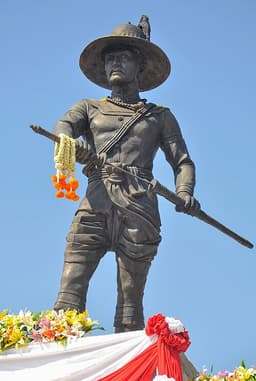
Taksin
Emperor · Modern
67.8Total
Basic Information
Born
1852
1734
Died
1916
1782
Era
Modern
Modern
Nationality
Nigeria
Thailand
Occupation
Emperor
Emperor
Civilization
Other
Eastern
Score Comparison
Military (10%)
50.0
81.2
Political (20%)
39.4
70.0
Influence (20%)
51.8
62.0
Legacy (20%)
41.7
56.0
Leadership (15%)
55.3
85.0
Strategy (15%)
43.7
69.1
TOTAL
46.9
67.8
Nana Olomu — Complete Timeline
1875 AD
Rise as Itsekiri merchant princePolitical Action◆ Major
Nana Olomu emerged as the leading Itsekiri trader in the Niger Delta, controlling palm oil exports from the Benin River. He built a fleet of canoes and established a network of trading posts, becoming the wealthiest African in the region.
TradeWealthItsekiri
Impact: regionalconstructive
1890 AD
Conflict with British over trade controlPolitical Action◆ Major
Nana resisted British attempts to impose direct control over the palm oil trade, refusing to pay new duties and challenging the authority of British consuls. He armed his followers and fortified his base at Ebrohimi.
ResistanceTradeBritish
Impact: regional
1894 AD
Battle of EbrohimiWar◆ Major
British naval forces attacked Nana's fortified town of Ebrohimi, destroying his fleet and fortifications. Nana escaped but his power was broken, ending Itsekiri resistance to British control of the Niger Delta.
BattleBritish NavyDestruction
Impact: regionaltragic
Exile to AccraPolitical Action◆ Major
After his defeat, Nana surrendered to British authorities and was exiled to Accra in the Gold Coast (modern Ghana). His exile removed the last major Itsekiri obstacle to British colonial rule in the Niger Delta.
ExileColonialismItsekiri
Impact: regionaltragic
Taksin — Complete Timeline
1767 AD
Fall of AyutthayaWar
Burmese forces sacked and destroyed the city of Ayutthaya, ending the 417-year-old Ayutthaya kingdom. General Taksin escaped the fall and began organizing resistance against the Burmese occupation.
Burmese WarAyutthaya FallThai History
Impact: regionaltragic
Battle of Bang KungWar◆ Major
Taksin led a naval and land force to defeat a Burmese garrison at Bang Kung. This victory allowed him to establish a base at Chanthaburi and begin the reconquest of Siam.
Burmese WarResistanceThai Independence
Impact: national
1768 AD
Founding of the Thonburi KingdomPolitical Action
Taksin established Thonburi as the new capital of Siam, founding the Thonburi kingdom. He was crowned king and began the process of reunifying the country after the fall of Ayutthaya.
Thonburi KingdomThai HistoryReunification
Impact: nationalconstructive
1770 AD
Reunification of SiamWar◆ Major
King Taksin defeated rival warlords and regional powers, reunifying Siam under his rule. He also repelled Burmese invasions and expanded Thai influence into Laos and Cambodia.
ReunificationBurmese WarThai Expansion
Impact: regionalconstructive
1782 AD
Deposition and ExecutionPolitical Action◆ Major
King Taksin was deposed in a coup led by General Chao Phraya Chakri (later Rama I). He was executed shortly after, ending the Thonburi kingdom. The Chakri dynasty then established the Rattanakosin kingdom with Bangkok as its capital.
CoupChakri DynastyThonburi End
Impact: nationaltragic
Expert Analysis
Origins
Nana Olomu was born around 1852 in the Itsekiri region of the Niger Delta, part of present-day Nigeria. He was the son of Chief Olomu, a prominent trader and leader of the Itsekiri. Nana was raised within the complex trading networks of the Delta, learning the business of palm oil export. He received education in local customs and trade, but also had some exposure to Western influences through European traders. His early life was marked by the rising power of the British Empire in the region, which increasingly interfered with local trade.
King Taksin was born in 1734 in Ayutthaya, Siam (modern Thailand). His father was a Chinese immigrant who served as a tax collector, and his mother was Thai. Taksin was adopted by a high-ranking nobleman and received a traditional education in Buddhist scriptures and military arts. He entered the royal service and rose through the ranks, becoming the governor of Tak province. His early experiences included military campaigns against the Burmese, which shaped his strategic thinking.
Rise to Power
Nana Olomu rose to prominence in the 1870s and 1880s as the leading Itsekiri merchant prince. He controlled the palm oil trade from the Benin River, amassing wealth and influence. He built a fleet of war canoes and a fortified base at Ebrohimi. His rise was facilitated by the decline of the old trading states and the increasing demand for palm oil in Europe. However, the British, seeking direct control, imposed new duties and sought to undermine his authority. In 1894, tensions escalated into armed conflict.
Taksin's rise began after the fall of Ayutthaya in 1767. Burmese forces sacked the capital, and the kingdom collapsed. Taksin escaped with a small force and established a base at Chanthaburi. He rebuilt his army and navy, and in 1768, he defeated a Burmese garrison at Bang Kung. This victory allowed him to move to Thonburi, which he made his capital. He was crowned king and began the reunification of Siam, defeating rival warlords and repelling Burmese invasions. By 1776, he had reunified the kingdom.
Leadership & Governance
Nana Olomu's leadership was traditional and commercial. He ruled through a network of alliances with local chiefs and traders. His governance focused on maintaining the Itsekiri monopoly over the palm oil trade. He resisted British demands for free trade and taxation. His military strategy was defensive, relying on the fortified town of Ebrohimi and his fleet. However, he lacked the political structure to mobilize widespread support beyond his immediate followers.
Taksin's leadership was autocratic and militaristic. He centralized power, reorganized the administration, and promoted trade. He built a strong army and navy, and his governance was focused on rapid reunification and defense. He implemented reforms to strengthen the economy, including encouraging Chinese immigration and trade. However, his later years were marked by paranoia and harsh rule, leading to his deposition.
Triumph & Tragedy
Nana Olomu's greatest success was building a powerful trading empire that challenged British dominance. He successfully controlled the palm oil trade for years, amassing wealth and influence. His tragedy was the destruction of Ebrohimi in 1894. British naval forces bombarded his town, destroying his fleet and fortifications. He escaped but was forced to surrender and was exiled to Accra, where he died in 1916. His defeat marked the end of Itsekiri independence.
Taksin's greatest triumph was reunifying Siam after the catastrophic fall of Ayutthaya. He defeated multiple enemies and restored Thai sovereignty. He also expanded Thai influence into Laos and Cambodia. His tragedy was his mental decline and execution. In 1782, he was deposed by General Chao Phraya Chakri (later Rama I) and executed. His death ended the Thonburi kingdom, but his legacy continued through the Chakri dynasty.
Character & Destiny
Nana Olomu was a pragmatic and determined leader. He understood the balance of power but underestimated British resolve. His character was shaped by his commercial background; he negotiated and resisted but ultimately lacked the military capacity to withstand a modern naval power. His destiny was sealed by the technological and organizational superiority of the British Empire. He scored 50.0 in military and 43.7 in strategy, reflecting his limited resources.
Taksin was a charismatic and decisive military leader. His strategic acumen is reflected in his high scores: 81.2 military, 69.1 strategy, and 85.0 leadership. He was ruthless and ambitious, but his later paranoia alienated his supporters. His character led to both his success and his downfall. He could not transition from wartime to peacetime governance, and his mental instability precipitated his overthrow.
Legacy
Nana Olomu is remembered as a symbol of resistance against colonialism in Nigeria. His struggle highlights the impact of British imperialism on African trade systems. However, his legacy is limited; he did not establish a lasting political entity. His scores: influence 51.8, legacy 41.7. He is a regional figure, known primarily in Itsekiri history.
Taksin's legacy is profound. He founded the Thonburi kingdom, which restored Siamese independence and paved the way for the modern Thai state. The Chakri dynasty, which succeeded him, traces its legitimacy partly through him. He is revered as a national hero in Thailand, with monuments and holidays. His scores: influence 62.0, legacy 56.0. His impact on Thai history is significant.
Conclusion
Taksin had greater impact than Nana Olomu. His military and political achievements were more substantial: he reunified a kingdom, defeated foreign invaders, and established a new capital. His scores total 67.8 compared to Nana's 46.9, a gap of 20.9 points. While Nana's resistance was notable, it was ultimately unsuccessful and limited in scope. Taksin's legacy endures in modern Thailand, while Nana's is confined to a specific region. Thus, Taksin is the more historically significant figure.
Rankings
🥇
TaksinLeader
Mil: 81.2Pol: 70.0Inf: 62.0
67.8
🥈
Nana Olomu
Mil: 50.0Pol: 39.4Inf: 51.8
46.9
+20.9 behind
How This Comparison Works
Algorithm
Each figure is scored on 6 dimensions (0—100 scale) based on structured historical data: Military (10%), Political (20%), Influence (20%), Legacy (20%), Leadership (15%), Strategy (15%). The weighted total produces the final ranking.
Data Sources
Scores are computed from structured sub-indicators in the database. Scale factors adjust for era (Ancient ×0.85, Modern ×1.0) and civilization size (Eastern ×1.05, Other ×0.80) to account for differences in population and military scale.
Maximum 3 Figures
Comparisons are limited to 2—3 figures to ensure readability and statistical meaningfulness.
Error Margins
±5 points per dimension — Sub-scores are derived from historical records with inherent uncertainty. Two figures within 5 points on a dimension should be considered roughly equivalent in that area.
Total Score Accuracy
±3 points overall — The weighted combination of 6 dimensions produces a total score with approximately ±3 points of uncertainty. Differences of less than 3 points are not statistically significant— the figures are effectively tied.
Known Limitations
- Historical records are incomplete and uneven across civilizations
- Figures from oral-tradition societies may be underrepresented
- Occupation labels can misclassify multi-role figures
- Scores measure capability and impact, not moral character
- Quantitative scoring is a comparison tool, not absolute truth
Capability Radar
Military (10%) — Battles & Warfare
Battles
25
75
Win Rate
20
80
Expansion
20
72
Political (20%) — Governance & Reform
Reform
20
68
Diplomacy
25
60
Economy
30
62
Influence (20%) — Cultural & Global Reach
Cultural
25
60
Global
15
50
Legacy (20%) — Historical Impact
Historical
30
65
Longevity
20
55
Leadership (15%) — Power & Stability
Tenure
30
65
Stability
20
55
Strategy (15%) — Tactics & Innovation
Strategy
25
82
Tactics
30
78
Reform
15
70
Similar Comparisons
Comments & Discussion
No comments yet. Be the first to share your thoughts!