Loading...
Idris of Libya vs Taksin
Taksin leads by 15.2 pts · 2 figures compared
…

Idris of Libya
Emperor · Modern
52.6Total
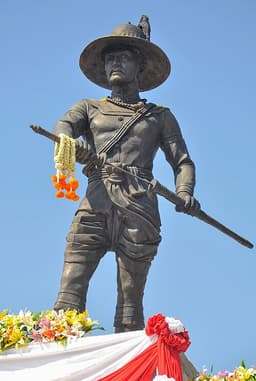
Taksin
Emperor · Modern
67.8Total
Basic Information
Born
1889
1734
Died
1983
1782
Era
Modern
Modern
Nationality
Libya
Thailand
Occupation
Emperor
Emperor
Civilization
Middle Eastern
Eastern
Score Comparison
Military (10%)
43.3
81.2
Political (20%)
61.3
70.0
Influence (20%)
50.2
62.0
Legacy (20%)
40.0
56.0
Leadership (15%)
74.0
85.0
Strategy (15%)
54.3
69.1
TOTAL
52.6
67.8
Idris of Libya — Complete Timeline
1951 AD
Became King of LibyaPolitical Action◆ Major
Idris was proclaimed King of the newly independent United Kingdom of Libya. His reign established a constitutional monarchy and aligned Libya with the West, granting military bases to the United States and Britain.
IndependenceMonarchyLibyan State
Impact: national
1969 AD
Ousted by Muammar Gaddafi's CoupPolitical Action
While undergoing medical treatment in Turkey, King Idris was overthrown in a bloodless military coup led by Muammar Gaddafi. The coup ended the Libyan monarchy and ushered in decades of Gaddafi's rule.
Coup d'étatGaddafiEnd of Monarchy
Impact: nationaltragic
1983 AD
Died in Exile in EgyptPolitical Action
Idris died in Cairo, Egypt, where he had lived in exile since his overthrow. His death marked the end of the Senussi dynasty's political influence in Libya, though the family remained a symbol of the pre-Gaddafi era.
ExileDeathSenussi Dynasty
Impact: nationaltragic
Taksin — Complete Timeline
1767 AD
Fall of AyutthayaWar
Burmese forces sacked and destroyed the city of Ayutthaya, ending the 417-year-old Ayutthaya kingdom. General Taksin escaped the fall and began organizing resistance against the Burmese occupation.
Burmese WarAyutthaya FallThai History
Impact: regionaltragic
Battle of Bang KungWar◆ Major
Taksin led a naval and land force to defeat a Burmese garrison at Bang Kung. This victory allowed him to establish a base at Chanthaburi and begin the reconquest of Siam.
Burmese WarResistanceThai Independence
Impact: national
1768 AD
Founding of the Thonburi KingdomPolitical Action
Taksin established Thonburi as the new capital of Siam, founding the Thonburi kingdom. He was crowned king and began the process of reunifying the country after the fall of Ayutthaya.
Thonburi KingdomThai HistoryReunification
Impact: nationalconstructive
1770 AD
Reunification of SiamWar◆ Major
King Taksin defeated rival warlords and regional powers, reunifying Siam under his rule. He also repelled Burmese invasions and expanded Thai influence into Laos and Cambodia.
ReunificationBurmese WarThai Expansion
Impact: regionalconstructive
1782 AD
Deposition and ExecutionPolitical Action◆ Major
King Taksin was deposed in a coup led by General Chao Phraya Chakri (later Rama I). He was executed shortly after, ending the Thonburi kingdom. The Chakri dynasty then established the Rattanakosin kingdom with Bangkok as its capital.
CoupChakri DynastyThonburi End
Impact: nationaltragic
Expert Analysis
Origins
King Idris I of Libya was born Sayyid Muhammad Idris al-Mahdi al-Senussi in 1889 at Al-Jaghbub, a desert oasis in Cyrenaica. He was the grandson of Muhammad ibn Ali al-Senussi, founder of the Senussi Sufi order, a religious brotherhood that wielded significant influence across North Africa. Idris was raised in a deeply religious environment and became the leader of the Senussi order in 1916 after his cousin's death. His early life was marked by resistance against Italian colonization, but he spent much of his youth in exile in Egypt, where he cultivated ties with the British.
King Taksin was born in 1734 in Ayutthaya, Siam (modern Thailand), as Sin, the son of a Chinese immigrant tax farmer and a Siamese mother. He entered the royal court as a page and became a trusted official under King Ekkathat. Rising through the ranks, he was appointed governor of Tak province, earning the title Phraya Taksin. His early career was shaped by military service and administrative experience within the declining Ayutthaya kingdom, which faced constant Burmese threats.
Rise to Power
Idris's rise was gradual and diplomatic. During World War I, he led the Senussi in a campaign against the British in Egypt but later negotiated a truce. In 1920, Italy recognized him as Emir of Cyrenaica, but the Fascist regime revoked this, forcing him into exile. After World War II, the Senussi supported the Allies, and in 1951, with UN backing, Idris became King of the newly independent United Kingdom of Libya, a federation of Cyrenaica, Tripolitania, and Fezzan. His coronation on December 24, 1951, was a product of international diplomacy and tribal alliances.
Taksin's rise was forged in war. After the Burmese sacked Ayutthaya in April 1767, he escaped with 500 followers to the eastern coast. Gathering forces at Chanthaburi, he launched a counterattack. In November 1767, he recaptured Ayutthaya but found it ruined. He then established Thonburi as the new capital in 1768, crowning himself king. He spent the next decade reunifying Siam by defeating rival warlords in Phitsanulok, Nakhon Si Thammarat, and the Chao Phraya basin, and repelling Burmese invasions. His military scores of 81.2 reflect his battlefield successes, far above Idris's 43.3.
Leadership & Governance
Idris ruled as a constitutional monarch but maintained significant personal authority. He fostered a decentralized government, balancing tribal and regional interests. He aligned Libya with the West, granting military bases to the US and UK in exchange for aid. His governance was conservative and cautious, focusing on stability rather than modernization. He avoided radical reforms, and his political score of 61.3 reflects a moderate but unambitious approach.
Taksin was an autocratic and hands-on ruler. He centralized power in Thonburi, appointed loyalists to key posts, and vigorously suppressed dissent. He promoted trade, especially with China, and revived the economy after war. He also patronized Buddhism, commissioning the compilation of the Tripitaka. However, his mental state deteriorated; he became paranoid and religiously delusional, claiming to be a future Buddha. This led to harsh punishments and alienation of the nobility. His political score of 70.0 is higher than Idris's, but his governance was volatile.
Triumph & Tragedy
Idris's greatest triumph was peacefully leading Libya to independence and maintaining stability for 18 years. He also oversaw the discovery of oil in 1959, which transformed Libya's economy. However, his tragedy was his failure to build a strong national identity or military. He relied on tribal support and foreign protection, leaving Libya vulnerable. In 1969, while abroad for medical treatment, a young Muammar Gaddafi overthrew him in a bloodless coup. Idris died in exile in Egypt in 1983, his dynasty ended.
Taksin's triumph was reunifying Siam after near-total collapse. His military campaigns were spectacular; he scored 81.2 in military, reflecting victories like the Battle of Bang Kung in 1768. He also expanded Thai influence into Laos and Cambodia. But his tragedy was his downfall: in 1782, facing rebellion and his own increasing instability, he was deposed by General Chao Phraya Chakri (later Rama I) and executed. The Thonburi kingdom lasted only 15 years, and Taksin's legacy was overshadowed by the subsequent Chakri dynasty.
Character & Destiny
Idris was reserved, pious, and cautious. He avoided confrontation and preferred diplomacy. His leadership score of 74.0 indicates competence but not dynamism. His character led him to rely on British protection and tribal loyalty, but when the army turned against him, he had no means to resist. His destiny was to be a transitional figure, bridging Libya from colony to independence, but unable to secure its future.
Taksin was bold, ambitious, and charismatic. His leadership score of 85.0 reflects his ability to inspire loyalty and lead from the front. However, his later paranoia and religious extremism alienated his supporters. His strategy score of 69.1 shows effective military planning, but his political miscalculations led to his execution. His destiny was to be a heroic restorer who fell from grace.
Legacy
Idris's legacy is mixed. He is remembered as the father of Libyan independence but also as a monarch who failed to build lasting institutions. His reign's legacy score of 40.0 is low because Gaddafi's coup erased his achievements. Today, his name is rarely invoked in Libya, and the Senussi dynasty has no political role.
Taksin's legacy is more enduring. He is revered as a national hero in Thailand, credited with saving Siam from extinction. His total score of 67.8 is higher than Idris's 52.6, reflecting greater impact. The Thonburi kingdom's brief existence was a precursor to the Chakri dynasty, which continues today. Taksin's military campaigns set the stage for modern Thailand's borders. However, his execution and the dynasty change complicate his legacy.
Conclusion
Taksin had a greater impact on history than Idris of Libya. His military reunification of Siam scored 81.2, dwarfing Idris's 43.3. Taksin's leadership score of 85.0 versus Idris's 74.0 further underscores his decisiveness. While Idris achieved independence peacefully, his legacy was ephemeral—his total score of 52.6 reflects a reign that ended in oblivion. Taksin, despite his tragic end, established the foundation for modern Thailand, with a legacy score of 56.0 against Idris's 40.0. The 15.2-point gap in total scores confirms Taksin's superior historical significance. He was a restorer of a civilization; Idris was a caretaker of a fragile state.
Rankings
🥇
TaksinLeader
Mil: 81.2Pol: 70.0Inf: 62.0
67.8
🥈
Idris of Libya
Mil: 43.3Pol: 61.3Inf: 50.2
52.6
+15.2 behind
How This Comparison Works
Algorithm
Each figure is scored on 6 dimensions (0—100 scale) based on structured historical data: Military (10%), Political (20%), Influence (20%), Legacy (20%), Leadership (15%), Strategy (15%). The weighted total produces the final ranking.
Data Sources
Scores are computed from structured sub-indicators in the database. Scale factors adjust for era (Ancient ×0.85, Modern ×1.0) and civilization size (Eastern ×1.05, Other ×0.80) to account for differences in population and military scale.
Maximum 3 Figures
Comparisons are limited to 2—3 figures to ensure readability and statistical meaningfulness.
Error Margins
±5 points per dimension — Sub-scores are derived from historical records with inherent uncertainty. Two figures within 5 points on a dimension should be considered roughly equivalent in that area.
Total Score Accuracy
±3 points overall — The weighted combination of 6 dimensions produces a total score with approximately ±3 points of uncertainty. Differences of less than 3 points are not statistically significant— the figures are effectively tied.
Known Limitations
- Historical records are incomplete and uneven across civilizations
- Figures from oral-tradition societies may be underrepresented
- Occupation labels can misclassify multi-role figures
- Scores measure capability and impact, not moral character
- Quantitative scoring is a comparison tool, not absolute truth
Capability Radar
Military (10%) — Battles & Warfare
Battles
5
75
Win Rate
5
80
Expansion
5
72
Political (20%) — Governance & Reform
Reform
40
68
Diplomacy
50
60
Economy
40
62
Influence (20%) — Cultural & Global Reach
Cultural
30
60
Global
20
50
Legacy (20%) — Historical Impact
Historical
30
65
Longevity
20
55
Leadership (15%) — Power & Stability
Tenure
60
65
Stability
30
55
Strategy (15%) — Tactics & Innovation
Strategy
5
82
Tactics
5
78
Reform
5
70
Similar Comparisons
Comments & Discussion
No comments yet. Be the first to share your thoughts!