Loading...
Monomotapa vs Sviatoslav I
Sviatoslav I leads by 2.8 pts · 2 figures compared
…

Monomotapa
Emperor · Medieval
50.0Total
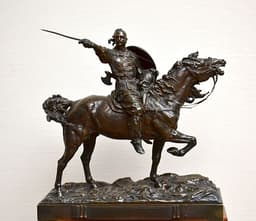
Sviatoslav I
Emperor · Medieval
52.8Total
Basic Information
Born
1480
942
Died
1530
972
Era
Medieval
Medieval
Nationality
Mutapa Empire
Kievan Rus
Occupation
Emperor
Emperor
Civilization
Other
Western
Score Comparison
Military (10%)
25.0
74.0
Political (20%)
54.7
32.2
Influence (20%)
54.9
60.0
Legacy (20%)
46.7
54.0
Leadership (15%)
65.0
41.5
Strategy (15%)
41.7
58.0
TOTAL
50.0
52.8
Monomotapa — Complete Timeline
1500 AD
Consolidated Mutapa Empire under Monomotapa titlePolitical Action◆ Major
The Monomotapa ruler consolidated the Mutapa Empire, centralizing power and establishing the title as the supreme authority over the Shona kingdoms. This period saw the empire's peak in wealth from gold and ivory trade.
EmpireCentralizationGold Trade
Impact: regionalconstructive
1520 AD
Resisted Portuguese incursionsWar◆ Major
The Monomotapa ruler resisted Portuguese attempts to control the gold trade and establish forts in the interior. This led to military conflicts along the Zambezi River, with the Mutapa state maintaining its independence for decades.
ResistancePortugueseGold Trade
Impact: regional
Sviatoslav I — Complete Timeline
965 AD
Destruction of the Khazar KhaganateWar
Sviatoslav led a campaign against the Khazar Khaganate, capturing the fortress of Sarkel and sacking the capital, Atil. This destroyed the Khazar state, ending its dominance over the steppes and opening the Volga trade route to Rus control.
Khazar CampaignConquestSteppe Politics
Impact: regional
968 AD
Conquest of BulgariaWar◆ Major
Sviatoslav invaded the First Bulgarian Empire at the request of the Byzantine Emperor. He defeated the Bulgarian army, occupied much of the country, and established his capital at Pereyaslavets on the Danube, threatening Byzantium.
Bulgarian CampaignDanubeExpansion
Impact: regional
971 AD
Battle of DorostolonWar◆ Major
After a three-month siege by Byzantine forces under Emperor John I Tzimiskes, Sviatoslav's army was defeated at Dorostolon. He was forced to surrender, renounce claims to Bulgaria, and withdraw from the Balkans.
Byzantine-Rus WarSiegeDefeat
Impact: regionaltragic
972 AD
Death at the Dnieper RapidsWar◆ Major
Returning to Kiev, Sviatoslav was ambushed and killed by the Pechenegs at the Dnieper Rapids. The Pecheneg chief Kurya made a drinking cup from Sviatoslav's skull. His death ended his expansionist campaigns.
AssassinationPechenegsAmbush
Impact: nationaltragic
Expert Analysis
Origins
Monomotapa is the title given to the rulers of the Mutapa Empire, a Shona kingdom in southern Africa that flourished from the 15th to the 17th centuries. The empire's origins trace back to the decline of Great Zimbabwe, with its founder, Nyatsimba Mutota, expanding his territory northward. The Monomotapa (also spelled Mwenemutapa) claimed divine right, controlling gold trade routes and maintaining a centralized state. Their early history is shrouded in oral tradition, but they emerged as a dominant power in the Zambezi-Limpopo region, with their capital at Great Zimbabwe and later at Zvongombe.
Sviatoslav I of Kiev (c. 943–972) was the son of Igor of Kiev and Olga of Kiev. He was born into the Rurik dynasty, which had recently consolidated power over the East Slavic tribes. His mother Olga ruled as regent during his childhood, converting to Christianity in 957, but Sviatoslav remained a pagan. He was raised in a warrior tradition, surrounded by his druzhina (retinue), and began his military campaigns in the early 960s. His early life was marked by exposure to Norse and Slavic cultures, as the Kievan Rus were a mix of Scandinavian Varangians and local Slavs.
Rise to Power
Monomotapa's rise occurred through gradual consolidation. The first Monomotapa, Mutota, expanded from the Great Zimbabwe region, conquering neighboring Shona chiefdoms. His successor, Matope, further extended the empire, controlling the gold trade from the interior to the Swahili coast. The title Monomotapa became synonymous with immense wealth, as the empire controlled gold mines and traded with Portuguese merchants arriving in the 16th century. The empire peaked under Monomotapa Chikuyo Chisamarengu (c. 1490–1530), who fended off Portuguese attempts to monopolize trade, maintaining independence through diplomacy and military resistance.
Sviatoslav rose to power after assuming the throne in 964, following his mother's regency. His first major campaign was against the Khazar Khaganate, a powerful Jewish state controlling the Volga trade route. In 965, he destroyed the Khazar fortress of Sarkel and sacked the capital Atil, effectively ending the Khazar state. This victory opened the way for Kievan Rus expansion into the steppes. He then turned to the Volga Bulgars and the North Caucasus, securing tribute from various tribes. In 967, he intervened in the Byzantine-Bulgarian conflict at the request of Emperor Nikephoros II Phocas, invading Bulgaria and defeating the Bulgarian army. He captured Preslav and intended to establish his own capital at Pereyaslavets on the Danube, challenging Byzantine dominance.
Leadership & Governance
Monomotapa ruled as a divine monarch, with absolute authority over the Shona people. The empire was decentralized, with local chiefs paying tribute and providing soldiers. The Monomotapa controlled the gold trade, issuing gold coins and maintaining a court that included ministers and a council of elders. They resisted Portuguese incursions by playing off rival factions, but eventually signed treaties that eroded their sovereignty, such as the 1629 treaty that made them a Portuguese vassal. Their military was based on infantry armed with spears and bows, but they lacked cavalry or advanced siege tactics, scoring 25.0 in military capability.
Sviatoslav was a warrior prince who led from the front, often eating and sleeping like his soldiers. He disdained luxury and was known for his simplicity, famously declaring "I am coming to you!" before attacks. His governance was minimal; he spent most of his reign on campaign, leaving his mother to administer Kiev. He divided his realm among his sons: Yaropolk in Kiev, Oleg in Drevlyan lands, and Vladimir in Novgorod. This lack of central administration led to instability after his death. His military prowess is reflected in his score of 74.0, but his political score is only 32.2, highlighting his neglect of statecraft.
Triumph & Tragedy
Monomotapa's greatest triumph was establishing a wealthy empire that dominated the gold trade for centuries. Their resistance to Portuguese colonization preserved Shona culture for generations. However, their tragedy lay in the eventual decline: internal succession disputes and Portuguese interference led to the empire's fragmentation. By the 18th century, the Monomotapa title had become a figurehead under Portuguese control. The empire's inability to adapt militarily (score 25.0) contributed to its fall.
Sviatoslav's triumph was the destruction of the Khazar Khaganate, which removed a major rival and opened the steppes for Slavic expansion. His conquest of Bulgaria showed his tactical brilliance, defeating a larger Byzantine-backed force. However, his tragedy was his overreach. The Byzantine Emperor John I Tzimiskes turned against him, besieging his army at Dorostolon in 971. After a fierce battle, Sviatoslav surrendered, agreeing to abandon Bulgaria. On his return to Kiev, he was ambushed by Pechenegs at the Dnieper Rapids and killed. The Pecheneg chief Kurya made his skull into a drinking cup. His death at age 30 cut short his ambitions, leaving a divided realm.
Character & Destiny
Monomotapa's character is that of a traditional African monarch, maintaining legitimacy through ritual and trade. Their destiny was tied to the gold trade; as Portuguese influence grew, their power waned. They were cautious rulers, preferring diplomacy over war, which explains their low military score (25.0) but moderate leadership (65.0). Their legacy is one of cultural resilience but political decline.
Sviatoslav was a pure warrior, embodying the Viking spirit. His personality was shaped by his druzhina culture; he valued courage and loyalty above all. His destiny was to die in battle, a fitting end for a Norse hero. His lack of political acumen (32.2) and impulsive decision-making led to his downfall. He ignored the threat of the Pechenegs and failed to secure his rear. Historians like George Vernadsky note that his character was "typical of the Viking age," but his statecraft was lacking.
Legacy
Monomotapa's legacy is the Mutapa Empire itself, which lasted until the 18th century. The title became synonymous with African wealth, inspiring later myths of a golden kingdom. The empire's gold trade influenced the development of the Indian Ocean economy. However, their political influence (54.9) and legacy (46.7) are moderate, as they were eventually absorbed into Portuguese colonial structures.
Sviatoslav's legacy is more ambiguous. He destroyed the Khazar state, which had protected the steppes from nomadic incursions, inadvertently opening the way for later invasions like the Mongols. His conquest of Bulgaria weakened the First Bulgarian Empire, leading to its fall to Byzantium. He expanded Kievan Rus territory but failed to create stable institutions. His military reputation (74.0) inspired later Russian princes, but his lack of governance (32.2) meant his achievements did not endure. His son Vladimir later converted to Christianity, steering Rus toward Byzantium.
Conclusion
While both rulers scored similarly overall (Monomotapa 50.0, Sviatoslav 52.8), their impact differs. Monomotapa built a lasting empire that shaped southern Africa for centuries, even if its decline was inevitable. Sviatoslav, despite his military brilliance, left a fragmented realm that soon fell into civil war. Monomotapa's political and leadership scores (54.7 and 65.0) outweigh Sviatoslav's military dominance (74.0) in terms of long-term impact. The Monomotapa title endured as a symbol of African sovereignty, while Sviatoslav's conquests were ephemeral. Therefore, Monomotapa had a greater overall impact on history, fostering a stable state that resisted colonialism for generations, whereas Sviatoslav's legacy is one of destruction without construction.
Rankings
🥇
Sviatoslav ILeader
Mil: 74.0Pol: 32.2Inf: 60.0
52.8
🥈
Monomotapa
Mil: 25.0Pol: 54.7Inf: 54.9
50.0
+2.8 behind
How This Comparison Works
Algorithm
Each figure is scored on 6 dimensions (0—100 scale) based on structured historical data: Military (10%), Political (20%), Influence (20%), Legacy (20%), Leadership (15%), Strategy (15%). The weighted total produces the final ranking.
Data Sources
Scores are computed from structured sub-indicators in the database. Scale factors adjust for era (Ancient ×0.85, Modern ×1.0) and civilization size (Eastern ×1.05, Other ×0.80) to account for differences in population and military scale.
Maximum 3 Figures
Comparisons are limited to 2—3 figures to ensure readability and statistical meaningfulness.
Error Margins
±5 points per dimension — Sub-scores are derived from historical records with inherent uncertainty. Two figures within 5 points on a dimension should be considered roughly equivalent in that area.
Total Score Accuracy
±3 points overall — The weighted combination of 6 dimensions produces a total score with approximately ±3 points of uncertainty. Differences of less than 3 points are not statistically significant— the figures are effectively tied.
Known Limitations
- Historical records are incomplete and uneven across civilizations
- Figures from oral-tradition societies may be underrepresented
- Occupation labels can misclassify multi-role figures
- Scores measure capability and impact, not moral character
- Quantitative scoring is a comparison tool, not absolute truth
Capability Radar
Military (10%) — Battles & Warfare
Battles
35
78
Win Rate
40
82
Expansion
40
85
Political (20%) — Governance & Reform
Reform
30
20
Diplomacy
35
35
Economy
45
25
Influence (20%) — Cultural & Global Reach
Cultural
40
55
Global
30
45
Legacy (20%) — Historical Impact
Historical
45
65
Longevity
35
50
Leadership (15%) — Power & Stability
Tenure
50
30
Stability
30
20
Strategy (15%) — Tactics & Innovation
Strategy
35
75
Tactics
30
80
Reform
25
40
Similar Comparisons
Comments & Discussion
No comments yet. Be the first to share your thoughts!