Loading...
This comparison has not been analyzed yet.
One-time AI generation (~1 minute). Scores and timeline are already available below.
Mohamed ElBaradei vs Teburoro Tito
Teburoro Tito leads by 3.3 pts · 2 figures compared
…
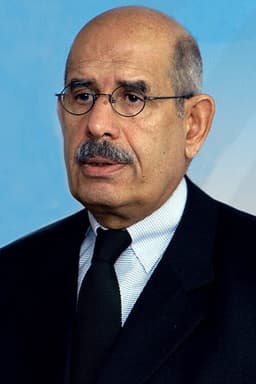
Mohamed ElBaradei
Politician · Modern
47.9Total

Teburoro Tito
Politician · Modern
51.2Total
Basic Information
Born
1942
1953
Died
—
—
Era
Modern
Modern
Nationality
Egypt
Kiribati
Occupation
Politician
Politician
Civilization
Middle Eastern
Other
Score Comparison
Military (10%)
39.4
38.0
Political (20%)
48.0
68.0
Influence (20%)
55.0
56.4
Legacy (20%)
49.2
42.5
Leadership (15%)
41.5
53.2
Strategy (15%)
44.7
44.5
TOTAL
47.9
51.2
Mohamed ElBaradei — Complete Timeline
2003 AD
Opposed Iraq War as IAEA DirectorPolitical Action◆ Major
ElBaradei led IAEA inspections in Iraq prior to the 2003 US-led invasion. He publicly stated that the IAEA found no evidence of an active nuclear weapons program in Iraq, contradicting US and UK claims. His stance made him a controversial figure in the lead-up to the war.
Iraq WarIAEANuclear Inspections
Impact: global
2005 AD
Awarded Nobel Peace PrizeCultural◆ Major
ElBaradei, as Director General of the International Atomic Energy Agency (IAEA), was jointly awarded the Nobel Peace Prize with the IAEA for their efforts to prevent nuclear energy from being used for military purposes and to ensure safe use of nuclear energy. The award recognized his leadership in nuclear non-proliferation.
Nobel PrizeIAEANuclear Non-proliferation
Impact: globalconstructive
2010 AD
Returned to Egypt and Founded Opposition PartyPolitical Action◆ Major
After leaving the IAEA, ElBaradei returned to Egypt in February 2010 and became a leading opposition figure. He founded the National Association for Change, which called for democratic reforms. He played a key role in the 2011 Egyptian Revolution, though he did not hold a formal leadership position.
Egyptian RevolutionOppositionDemocratic Reform
Impact: nationalconstructive
2013 AD
Served as Interim Vice PresidentPolitical Action◆ Major
Following the 2013 Egyptian coup d'
2013 CoupMorsiPolitical Violence
Impact: nationaltragic
Teburoro Tito — Complete Timeline
1994 AD
Elected President of KiribatiPolitical Action◆ Major
Teburoro Tito was elected President of Kiribati in 1994, succeeding Teatao Teannaki. He served as the country's head of state and government. His election marked the beginning of a period focused on economic development and international diplomacy.
PresidencyKiribatiElection
Impact: national
1998 AD
Re-elected President of KiribatiPolitical Action◆ Major
Teburoro Tito was re-elected as President of Kiribati in 1998, securing a second term. His re-election indicated continued public support for his administration's policies, which included economic reforms and infrastructure projects.
PresidencyRe-electionKiribati
Impact: national
2000 AD
Advocated for Climate Change Action at UNPolitical Action◆ Major
President Tito addressed the United Nations Millennium Summit, highlighting the existential threat of sea-level rise to Kiribati and other low-lying island nations. He called for international action to reduce greenhouse gas emissions and provide adaptation funding.
Climate ChangeUNAdvocacy
Impact: globalconstructive
2003 AD
Lost No-Confidence Vote and Left OfficePolitical Action◆ Major
Teburoro Tito lost a no-confidence vote in the Kiribati Parliament in March 2003, ending his nine-year presidency. The vote was triggered by political disputes and allegations of mismanagement. He was succeeded by Anote Tong.
No-ConfidencePolitical CrisisKiribati
Impact: nationaldestructive
This comparison has not been analyzed yet.
One-time AI generation (~1 minute). Scores and timeline are already available below.
Rankings
🥇
Teburoro TitoLeader
Mil: 38.0Pol: 68.0Inf: 56.4
51.2
🥈
Mohamed ElBaradei
Mil: 39.4Pol: 48.0Inf: 55.0
47.9
+3.3 behind
How This Comparison Works
Algorithm
Each figure is scored on 6 dimensions (0—100 scale) based on structured historical data: Military (10%), Political (20%), Influence (20%), Legacy (20%), Leadership (15%), Strategy (15%). The weighted total produces the final ranking.
Data Sources
Scores are computed from structured sub-indicators in the database. Scale factors adjust for era (Ancient ×0.85, Modern ×1.0) and civilization size (Eastern ×1.05, Other ×0.80) to account for differences in population and military scale.
Maximum 3 Figures
Comparisons are limited to 2—3 figures to ensure readability and statistical meaningfulness.
Error Margins
±5 points per dimension — Sub-scores are derived from historical records with inherent uncertainty. Two figures within 5 points on a dimension should be considered roughly equivalent in that area.
Total Score Accuracy
±3 points overall — The weighted combination of 6 dimensions produces a total score with approximately ±3 points of uncertainty. Differences of less than 3 points are not statistically significant— the figures are effectively tied.
Known Limitations
- Historical records are incomplete and uneven across civilizations
- Figures from oral-tradition societies may be underrepresented
- Occupation labels can misclassify multi-role figures
- Scores measure capability and impact, not moral character
- Quantitative scoring is a comparison tool, not absolute truth
Capability Radar
Military (10%) — Battles & Warfare
Battles
22
24
Win Rate
22
22
Expansion
29
26
Political (20%) — Governance & Reform
Reform
30
40
Diplomacy
75
60
Economy
15
35
Influence (20%) — Cultural & Global Reach
Cultural
40
30
Global
65
50
Legacy (20%) — Historical Impact
Historical
55
35
Longevity
30
20
Leadership (15%) — Power & Stability
Tenure
20
55
Stability
10
45
Strategy (15%) — Tactics & Innovation
Strategy
31
30
Tactics
32
31
Reform
36
37
Similar Comparisons
Comments & Discussion
No comments yet. Be the first to share your thoughts!