Loading...
Miles Dempsey vs Zachary Taylor
Miles Dempsey leads by 0.5 pts · 2 figures compared
…

Miles Dempsey
General · Modern
48.6Total
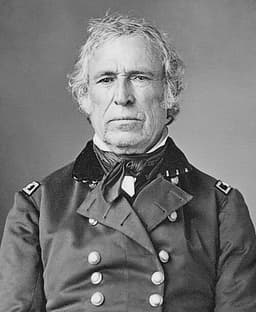
Zachary Taylor
General · Modern
48.1Total
Basic Information
Born
1896
1784
Died
1969
1850
Era
Modern
Modern
Nationality
United Kingdom
United States
Occupation
General
General
Civilization
Western
Western
Score Comparison
Military (10%)
70.0
63.3
Political (20%)
32.2
29.3
Influence (20%)
54.9
53.3
Legacy (20%)
45.0
44.2
Leadership (15%)
43.8
48.4
Strategy (15%)
52.5
57.5
TOTAL
48.6
48.1
Miles Dempsey — Complete Timeline
1944 AD
Commanded the British Second Army on D-DayWar
Dempsey commanded the British Second Army during the Normandy landings on June 6, 1944. His forces landed on Gold, Juno, and Sword beaches and established a foothold in Normandy, beginning the liberation of Western Europe from German occupation.
D-DayWorld War IINormandy Invasion
Impact: global
Led the British Second Army through the Battle of NormandyWar◆ Major
Dempsey's Second Army fought in the Battle of Normandy, including the capture of Caen and the Operation Goodwood offensive. His forces pinned down German panzer divisions, enabling the US breakout at Operation Cobra.
Battle of NormandyWorld War IICaen
Impact: regional
Commanded the British Second Army in the Advance to the RhineWar◆ Major
Dempsey's Second Army advanced through Belgium and the Netherlands, liberating Brussels and Antwerp. His forces participated in Operation Market Garden, the failed attempt to capture bridges over the Rhine, and later crossed the Rhine into Germany.
Market GardenWorld War IIAdvance to Germany
Impact: regional
Zachary Taylor — Complete Timeline
1846 AD
Battle of Palo AltoWar◆ Major
Taylor commanded U.S. forces in the first major battle of the Mexican-American War near present-day Brownsville, Texas. His army defeated Mexican forces under General Mariano Arista, securing the Rio Grande border.
Mexican-American WarBattleMilitary
Impact: regional
1847 AD
Battle of Buena VistaWar◆ Major
Taylor's outnumbered army defeated a larger Mexican force led by Santa Anna at Buena Vista, Coahuila. The victory made Taylor a national hero and boosted his presidential prospects.
Mexican-American WarBattleSanta Anna
Impact: regional
1848 AD
Elected President of the United StatesPolitical Action◆ Major
Taylor won the 1848 presidential election as the Whig candidate, defeating Democrat Lewis Cass and Free Soil candidate Martin Van Buren. His military fame and ambiguous stance on slavery secured victory.
PresidencyElectionWhig Party
Impact: national
1850 AD
Threatened to Veto Compromise of 1850Political Action◆ Major
Taylor opposed the Compromise of 1850, threatening to veto it and even to lead troops against secessionists. His death in July 1850 removed the main obstacle to the compromise's passage.
Compromise of 1850SlaverySecession
Impact: national
Died in OfficeOther◆ Major
Taylor died suddenly on July 9, 1850, after a brief illness likely caused by gastroenteritis. His death elevated Millard Fillmore to the presidency, who then signed the Compromise of 1850.
DeathPresidential Succession
Impact: nationaltragic
Expert Analysis
Origins
Miles Dempsey was born on December 15, 1896, in New Brighton, England, into a middle-class family. He attended Shrewsbury School and the Royal Military College, Sandhurst, commissioning into the Royal Berkshire Regiment in 1915. He served on the Western Front in World War I, where he was wounded and mentioned in dispatches. Zachary Taylor was born on November 24, 1784, in Orange County, Virginia, into a family of planters. He grew up on the Kentucky frontier with minimal formal education. He joined the U.S. Army in 1808 as a first lieutenant, serving in the War of 1812 and the Black Hawk War.
Rise to Power
Dempsey rose through the ranks between the wars, serving as a staff officer and instructor. In 1942, he commanded the 13th Infantry Brigade in the UK, then the 46th Infantry Division. In 1943, he was appointed commander of the British Second Army, tasked with leading the main British assault on D-Day. His careful planning and calm demeanor earned the trust of his superiors, including General Bernard Montgomery. Taylor rose to prominence during the Mexican-American War. In 1845, he was ordered to occupy the disputed Texas border, leading to the Battle of Palo Alto on May 8, 1846, where his forces defeated a larger Mexican army using superior artillery. His victory at Buena Vista on February 22-23, 1847, where his outnumbered army of 4,600 defeated Santa Anna's 15,000, made him a national hero and propelled him to the presidency.
Leadership & Governance
Dempsey's leadership style was methodical and unassuming, focusing on logistics and coordination. He excelled at combined arms operations, integrating infantry, armor, and artillery. During the Battle of Normandy, his Second Army pinned down German panzer divisions, enabling the American breakout. He scored 43.8 in leadership and 52.5 in strategy. Taylor, known as "Old Rough and Ready," led from the front, sharing hardships with his troops. His strategic approach was aggressive and direct, as at Buena Vista. However, his political leadership as president was marked by inexperience and stubbornness. He threatened to veto the Compromise of 1850, which would have preserved the Union, and his death removed the main obstacle to the compromise. Taylor's political score is 29.3, reflecting his brief, contentious presidency.
Triumph & Tragedy
Dempsey's greatest triumph was commanding the Second Army through the Normandy landings and the subsequent campaign, capturing Caen and liberating Brussels and Antwerp. His forces also participated in Operation Market Garden. His tragedy was the failure of Market Garden, where the Second Army could not relieve the paratroopers at Arnhem, resulting in heavy casualties. He also faced criticism for his cautious approach, though this likely saved lives. Taylor's triumph was his undefeated record in the Mexican-American War, particularly Buena Vista, which secured his place in history. His tragedy was his presidency: he died after only 16 months, unable to prevent the crisis over slavery. His threat to veto the Compromise of 1850 alienated Southern Whigs, and his sudden death left the compromise to be passed by his successor, Millard Fillmore.
Character & Destiny
Dempsey was reserved and professional, avoiding the spotlight. He focused on practical matters and delegated effectively. His character shaped his destiny as a reliable but not flashy commander, overshadowed by Montgomery and Patton. He retired after the war and lived quietly until his death in 1969. Taylor was blunt, courageous, and indifferent to politics. His military fame made him a presidential candidate, but his lack of political skills doomed his administration. His destiny was to be a hero in war but a failure in peace, dying before he could fully impact the nation.
Legacy
Dempsey's legacy is as a competent corps-level commander who contributed to the Allied victory in Europe. He scored 45.0 in legacy. His methods influenced post-war British army doctrine, but he is largely unknown to the public. Taylor's legacy is more mixed: his military victories are celebrated, but his presidency is considered below average. He scored 44.2 in legacy. However, his stand against secession influenced later Unionist sentiment. Neither scores high in influence (Dempsey 54.9, Taylor 53.3).
Conclusion
While Dempsey and Taylor have similar total scores (48.6 vs 48.1), Dempsey's impact on World War II was more significant than Taylor's on the Mexican-American War. Dempsey's Second Army was a key component of the Allied war machine, directly contributing to the defeat of Nazi Germany. Taylor's Buena Vista victory, while impressive, did not change the course of history as much. In leadership and strategy, Dempsey's methodical approach proved more effective in modern warfare. Therefore, Dempsey edges out Taylor in overall historical impact.
Rankings
🥇
Miles DempseyLeader
Mil: 70.0Pol: 32.2Inf: 54.9
48.6
🥈
Zachary Taylor
Mil: 63.3Pol: 29.3Inf: 53.3
48.1
+0.5 behind
How This Comparison Works
Algorithm
Each figure is scored on 6 dimensions (0—100 scale) based on structured historical data: Military (10%), Political (20%), Influence (20%), Legacy (20%), Leadership (15%), Strategy (15%). The weighted total produces the final ranking.
Data Sources
Scores are computed from structured sub-indicators in the database. Scale factors adjust for era (Ancient ×0.85, Modern ×1.0) and civilization size (Eastern ×1.05, Other ×0.80) to account for differences in population and military scale.
Maximum 3 Figures
Comparisons are limited to 2—3 figures to ensure readability and statistical meaningfulness.
Error Margins
±5 points per dimension — Sub-scores are derived from historical records with inherent uncertainty. Two figures within 5 points on a dimension should be considered roughly equivalent in that area.
Total Score Accuracy
±3 points overall — The weighted combination of 6 dimensions produces a total score with approximately ±3 points of uncertainty. Differences of less than 3 points are not statistically significant— the figures are effectively tied.
Known Limitations
- Historical records are incomplete and uneven across civilizations
- Figures from oral-tradition societies may be underrepresented
- Occupation labels can misclassify multi-role figures
- Scores measure capability and impact, not moral character
- Quantitative scoring is a comparison tool, not absolute truth
Capability Radar
Military (10%) — Battles & Warfare
Battles
65
65
Win Rate
70
70
Expansion
40
55
Political (20%) — Governance & Reform
Reform
10
10
Diplomacy
30
20
Economy
10
10
Influence (20%) — Cultural & Global Reach
Cultural
15
30
Global
25
20
Legacy (20%) — Historical Impact
Historical
40
40
Longevity
20
25
Leadership (15%) — Power & Stability
Tenure
20
15
Stability
20
25
Strategy (15%) — Tactics & Innovation
Strategy
65
65
Tactics
60
60
Reform
30
20
Similar Comparisons
Comments & Discussion
No comments yet. Be the first to share your thoughts!