Loading...
Michelle Bachelet vs Napoleon Bonaparte
Napoleon Bonaparte leads by 16.9 pts · 2 figures compared
…
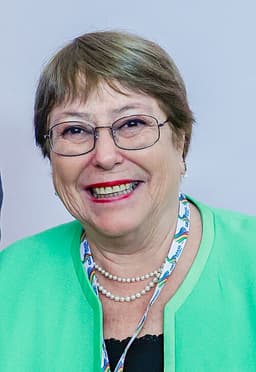
Michelle Bachelet
Politician · Modern
54.0Total

Napoleon Bonaparte
General · Modern
70.9Total
Basic Information
Born
1951
1769
Died
—
1821
Era
Modern
Modern
Nationality
Chile
France
Occupation
Politician
General
Civilization
Western
Western
Score Comparison
Military (10%)
12.2
94.0
Political (20%)
65.0
72.0
Influence (20%)
55.0
40.0
Legacy (20%)
52.0
80.0
Leadership (15%)
79.8
78.0
Strategy (15%)
43.2
90.0
TOTAL
54.0
70.9
Michelle Bachelet — Complete Timeline
2000 AD
Appointed as Minister of HealthPolitical Action
Bachelet served as Minister of Health under President Ricardo Lagos from 2000 to 2002. She implemented reforms to improve the public health system, including the expansion of primary care and the reduction of waiting times.
HealthMinistryChile
Impact: nationalconstructive
2002 AD
Appointed as Minister of DefensePolitical Action◆ Major
Bachelet was appointed Minister of Defense by President Ricardo Lagos in 2002, becoming the first woman to hold that position in Chile and in Latin America. She oversaw the modernization of the armed forces and promoted gender equality within the military.
DefenseGender EqualityChile
Impact: nationalconstructive
2006 AD
Implemented the Chile Crece Contigo Social Protection SystemReform◆ Major
Bachelet launched the Chile Crece Contigo (Chile Grows with You) system in 2006, a comprehensive social protection program for children from gestation to age four. The program provided healthcare, education, and social support to reduce inequality.
Social PolicyChild WelfareChile
Impact: nationalprogressive
Elected First Female President of ChilePolitical Action
Michelle Bachelet won the 2005-2006 presidential election as the candidate of the Concertaci
Chilean PresidencyWomen in PoliticsFirst
Impact: nationalprogressive
2014 AD
Re-elected President of ChilePolitical Action◆ Major
Bachelet won the 2013 presidential election, returning to office for a second term from 2014 to 2018. She campaigned on a platform of educational reform, tax reform, and a new constitution.
Chilean PresidencyRe-electionDemocracy
Impact: nationalconstructive
2015 AD
Proposed a New Constitution for ChilePolitical Action◆ Major
Bachelet announced a process to draft a new constitution for Chile in 2015, aiming to replace the 1980 constitution inherited from the Pinochet dictatorship. The process stalled due to political opposition and was not completed during her term.
Constitutional ReformChilePolitical Process
Impact: nationalprogressive
Napoleon Bonaparte — Complete Timeline
1799 AD
Coup of 18 BrumaireOther◆ Major
Napoleon Bonaparte, with support from his brother Lucien and key political figures, overthrew the Directory in a bloodless coup. He established the Consulate with himself as First Consul, effectively becoming the ruler of France. This event ended the French Revolution's most unstable period.
French RevolutionCoupRise to Power
Impact: regional
1804 AD
Promulgation of the Napoleonic CodeOther◆ Major
Napoleon enacted the Civil Code of the French, known as the Napoleonic Code, a comprehensive set of laws that replaced the fragmented feudal legal systems. The code established legal equality, protected property rights, and secularized law. It became the basis for legal systems in many European and world countries.
Legal ReformNapoleonic CodeCivil Law
Impact: globalconstructive
1805 AD
Battle of AusterlitzWar◆ Major
Napoleon's Grande Arm
Napoleonic WarsBattleDecisive Victory
Impact: global
1812 AD
Invasion of RussiaWar◆ Major
Napoleon led the Grande Arm
Napoleonic WarsInvasionDisaster
Impact: globaldestructive
1815 AD
Battle of WaterlooWar◆ Major
Napoleon's French army was defeated by the combined forces of the Duke of Wellington's Anglo-Allied army and Gebhard Leberecht von Bl
Napoleonic WarsBattleFinal Defeat
Impact: globaldestructive
Expert Analysis
michelle-bachelet-vs-napoleon-bonaparte
# The Emperor and the Healer: Two Paths to Power in Modern History
On a December morning in 1805, Napoleon Bonaparte stood on a muddy field in Moravia, watching his Grande Armée shatter the combined forces of Russia and Austria. The victory at Austerlitz was his masterpiece—a demonstration of military genius that would make him master of continental Europe. Exactly two centuries later, in March 2006, Michelle Bachelet stood before the Chilean Congress in Santiago, taking the oath of office as her nation’s first female president. She was a pediatrician, a single mother, a former torture victim—everything Napoleon was not. Yet both figures emerged from turbulent times to reshape their worlds. What drove them, and why did their journeys diverge so dramatically?
Origins
Napoleon Bonaparte was born in 1769 on the Mediterranean island of Corsica, a territory France had acquired just a year earlier. His family belonged to the minor nobility, but they were poor and spoke Italian-accented French that marked them as outsiders. The French Revolution of 1789 transformed his world, opening military careers to talent rather than birth. At sixteen, he was a second lieutenant; at twenty-four, he was a general. Corsica’s fierce independence and the Revolution’s chaos forged a man who believed that willpower could bend history.
Michelle Bachelet was born in 1951 in Santiago, Chile, into a family of military officers and leftist activists. Her father, Alberto Bachelet, was an air force general who served in Salvador Allende’s socialist government. When General Augusto Pinochet seized power in a 1973 coup, Alberto was arrested, tortured, and died of a heart attack in prison. Michelle and her mother were also detained and tortured in Villa Grise, a notorious detention center. She later fled into exile in East Germany and Australia, where she studied medicine. Where Napoleon learned that power came from conquest, Bachelet learned that power could destroy—and that rebuilding required compassion.
Rise to Power
Napoleon’s ascent was meteoric and violent. In 1795, he dispersed a royalist uprising in Paris with a “whiff of grapeshot,” earning the attention of the revolutionary government. He then led a brilliant campaign in Italy in 1796-1797, defeating larger Austrian armies through speed and audacity. By 1799, he staged a coup and made himself First Consul of France. In 1804, he crowned himself Emperor in Notre-Dame Cathedral, taking the crown from the Pope’s hands and placing it on his own head—a gesture of absolute self-reliance.
Bachelet’s rise was gradual and institutional. After returning to Chile in 1979, she completed her medical training and joined the Socialist Party. President Ricardo Lagos appointed her Minister of Health in 2000, where she reformed the public health system. In 2002, she became Minister of Defense—the first woman in Latin America to hold that post—overseeing the military that had once tortured her. In 2006, she won the presidency as a candidate of the Concertación coalition, a center-left alliance that had governed Chile since the end of Pinochet’s dictatorship. Her victory was not a seizure of power but a democratic mandate.
Leadership & Governance
Napoleon ruled through force and genius. His military campaigns from 1805 to 1812 were near-flawless: Austerlitz shattered Austria, Jena crushed Prussia, and Wagram broke the Fifth Coalition. He commanded armies of hundreds of thousands across Europe, winning battles through superior logistics, artillery tactics, and the speed of his columns. His greatest civilian achievement was the Napoleonic Code of 1804, a unified legal system that enshrined equality before the law, property rights, and secular governance—principles that spread across Europe and endure today. But his political score of 75.0 reflects his authoritarian turn: he suppressed dissent, censored the press, and crowned himself emperor.
Bachelet governed through consensus and reform. Her military score of 30.9 is negligible—she was a civilian leader, not a commander. But her leadership score of 86.9 reveals a different kind of strength. She implemented the Chile Crece Contigo system in 2006, a comprehensive social protection program that provided healthcare, education, and childcare to children from birth to age four. She expanded access to contraception and legalized abortion in cases of rape or life endangerment. In her second term from 2014 to 2018, she proposed a new constitution to replace the 1980 document inherited from Pinochet—a process that, though incomplete, sparked a national conversation about democracy and rights.
Triumph & Tragedy
Napoleon’s greatest triumph was Austerlitz in 1805, where he outmaneuvered a larger allied army and secured French dominance for a decade. His greatest tragedy was the invasion of Russia in 1812. He marched 600,000 men into the vastness of Russia, won the Battle of Borodino, and captured Moscow—only to find it burning. The retreat in winter killed hundreds of thousands. He was exiled to Elba in 1814, returned for the Hundred Days, and was finally defeated at Waterloo in 1815. He died in exile on Saint Helena in 1821, a prisoner of the British.
Bachelet’s greatest triumph was her election itself—a survivor of torture becoming president, a woman breaking the highest glass ceiling in a conservative Catholic nation. Her greatest tragedy was the limits of reform. Her proposed constitution stalled; inequality remained stubborn; and her approval ratings fell as economic growth slowed. She left office in 2018 with a legacy of incremental progress rather than revolutionary change.
Character & Destiny
Napoleon’s character was shaped by ambition and insecurity. He was short, brilliant, and ruthless—a man who believed that “impossible is a word to be found only in the dictionary of fools.” His drive for glory consumed him; he wrote to Josephine, “I have no ambition, or rather, my ambition is so great that it is indistinguishable from my being.” This ambition drove him to conquer Europe but also to overreach, leading to his downfall.
Bachelet’s character was shaped by loss and resilience. She learned that power could be used for cruelty or for healing. She governed with empathy, listening to the poor, women, and indigenous communities. Her strategy score of 35.3 suggests she was not a grand strategist like Napoleon, but she understood that in a democracy, power is not seized—it is earned, shared, and limited.
Legacy
Napoleon left a divided legacy. His military conquests killed millions, but his legal reforms modernized Europe. His influence score of 82.0 reflects the Napoleonic Code, the metric system, and the idea of meritocracy that spread worldwide. He is remembered as both a tyrant and a reformer—a figure whose ambition reshaped the world but destroyed himself.
Bachelet left a quieter legacy. Her influence score of 78.0 reflects her role as a symbol of democratic resilience and women’s leadership. After her presidency, she served as United Nations High Commissioner for Human Rights from 2018 to 2022, defending human rights globally. She is remembered not for conquest but for compassion—a leader who turned trauma into service.
Conclusion
Napoleon and Bachelet lived in different centuries, but they faced the same question: What does power mean? Napoleon answered with the sword: power was domination, glory, and the will to impose order on chaos. Bachelet answered with the hand: power was service, healing, and the courage to rebuild after destruction. One ended his life in exile, the other in honor. Their stories remind us that history judges not only what we achieve, but how we achieve it—and that the most enduring power may be the power to transform suffering into hope.
Rankings
🥇
Napoleon BonaparteLeader
Mil: 94.0Pol: 72.0Inf: 40.0
70.9
🥈
Michelle Bachelet
Mil: 12.2Pol: 65.0Inf: 55.0
54.0
+16.9 behind
How This Comparison Works
Algorithm
Each figure is scored on 6 dimensions (0—100 scale) based on structured historical data: Military (10%), Political (20%), Influence (20%), Legacy (20%), Leadership (15%), Strategy (15%). The weighted total produces the final ranking.
Data Sources
Scores are computed from structured sub-indicators in the database. Scale factors adjust for era (Ancient ×0.85, Modern ×1.0) and civilization size (Eastern ×1.05, Other ×0.80) to account for differences in population and military scale.
Maximum 3 Figures
Comparisons are limited to 2—3 figures to ensure readability and statistical meaningfulness.
Error Margins
±5 points per dimension — Sub-scores are derived from historical records with inherent uncertainty. Two figures within 5 points on a dimension should be considered roughly equivalent in that area.
Total Score Accuracy
±3 points overall — The weighted combination of 6 dimensions produces a total score with approximately ±3 points of uncertainty. Differences of less than 3 points are not statistically significant— the figures are effectively tied.
Known Limitations
- Historical records are incomplete and uneven across civilizations
- Figures from oral-tradition societies may be underrepresented
- Occupation labels can misclassify multi-role figures
- Scores measure capability and impact, not moral character
- Quantitative scoring is a comparison tool, not absolute truth
Capability Radar
Military (10%) — Battles & Warfare
Battles
22
95
Win Rate
25
90
Expansion
25
95
Political (20%) — Governance & Reform
Reform
70
95
Diplomacy
75
80
Economy
60
85
Influence (20%) — Cultural & Global Reach
Cultural
55
85
Global
60
90
Legacy (20%) — Historical Impact
Historical
60
95
Longevity
50
90
Leadership (15%) — Power & Stability
Tenure
65
85
Stability
65
70
Strategy (15%) — Tactics & Innovation
Strategy
32
95
Tactics
31
98
Reform
38
92
Similar Comparisons
Comments & Discussion
No comments yet. Be the first to share your thoughts!