Loading...
This comparison has not been analyzed yet.
One-time AI generation (~1 minute). Scores and timeline are already available below.
Menander I vs Philip II of Macedon
Philip II of Macedon leads by 15.6 pts · 2 figures compared
…

Menander I
Emperor · Ancient
58.3Total
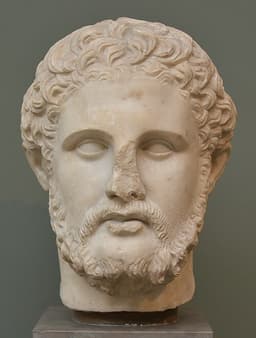
Philip II of Macedon
Emperor · Ancient
73.9Total
Basic Information
Born
-180
-382
Died
-130
-336
Era
Ancient
Ancient
Nationality
Indo-Greek Kingdom
Macedon
Occupation
Emperor
Emperor
Civilization
Indian
Western
Score Comparison
Military (10%)
67.3
65.0
Political (20%)
68.0
76.0
Influence (20%)
61.0
75.0
Legacy (20%)
54.0
70.0
Leadership (15%)
40.0
78.0
Strategy (15%)
66.3
80.3
TOTAL
58.3
73.9
Menander I — Complete Timeline
160 BC
Expansion of the Indo-Greek KingdomWar◆ Major
Menander I expanded the Indo-Greek Kingdom eastward into the Ganges River valley, possibly reaching as far as Pataliputra. This was the greatest territorial extent of the Indo-Greeks.
ExpansionIndiaIndo-Greek Kingdom
Impact: regional
150 BC
Conversion to BuddhismCultural◆ Major
Menander I converted to Buddhism, as recorded in the Buddhist text Milindapanha. He engaged in philosophical dialogues with the monk Nagasena, becoming a patron of Buddhism.
ConversionBuddhismGreco-Buddhist
Impact: regionalprogressive
Patronage of BuddhismCultural
Menander I supported the construction of Buddhist stupas and monasteries. His reign saw the flourishing of Greco-Buddhist art, blending Greek and Indian artistic traditions.
PatronageBuddhismArt
Impact: regionalconstructive
130 BC
Death in BattleWar◆ Major
Menander I died in a military campaign, according to some accounts. His death led to the fragmentation of the Indo-Greek Kingdom into smaller successor states.
DeathBattleIndo-Greek Kingdom
Impact: regionaltragic
Philip II of Macedon — Complete Timeline
359 BC
Reforms of the Macedonian ArmyReform◆ Major
Philip II reorganized the Macedonian army, introducing the sarissa (long pike) and the phalanx formation. He also improved cavalry tactics and logistics, creating a professional, disciplined force that was superior to Greek hoplite armies.
MacedonMilitary ReformPhalanx
Impact: regionalconstructive
338 BC
Battle of ChaeroneaWar
Philip II led the Macedonian army to a decisive victory over the combined forces of Athens and Thebes at Chaeronea. The battle ended Greek independence and established Macedonian hegemony over Greece. Philip's son Alexander commanded the cavalry on the left wing.
MacedonGreeceBattle
Impact: regionaldestructive
337 BC
Formation of the League of CorinthPolitical Action◆ Major
Philip II established the League of Corinth, a federation of Greek states under Macedonian leadership. The league declared war on Persia and appointed Philip as its commander-in-chief, laying the groundwork for Alexander's later invasion.
MacedonGreeceAlliance
Impact: regionalconstructive
336 BC
Assassination at AegaePolitical Action◆ Major
Philip II was assassinated by his bodyguard Pausanias at the wedding of his daughter Cleopatra in Aegae. The motive remains unclear, but his death led to the immediate succession of his son Alexander the Great, who continued his plans for the Persian invasion.
MacedonAssassinationSuccession
Impact: regionaltragic
This comparison has not been analyzed yet.
One-time AI generation (~1 minute). Scores and timeline are already available below.
Rankings
🥇
Philip II of MacedonLeader
Mil: 65.0Pol: 76.0Inf: 75.0
73.9
🥈
Menander I
Mil: 67.3Pol: 68.0Inf: 61.0
58.3
+15.6 behind
How This Comparison Works
Algorithm
Each figure is scored on 6 dimensions (0—100 scale) based on structured historical data: Military (10%), Political (20%), Influence (20%), Legacy (20%), Leadership (15%), Strategy (15%). The weighted total produces the final ranking.
Data Sources
Scores are computed from structured sub-indicators in the database. Scale factors adjust for era (Ancient ×0.85, Modern ×1.0) and civilization size (Eastern ×1.05, Other ×0.80) to account for differences in population and military scale.
Maximum 3 Figures
Comparisons are limited to 2—3 figures to ensure readability and statistical meaningfulness.
Error Margins
±5 points per dimension — Sub-scores are derived from historical records with inherent uncertainty. Two figures within 5 points on a dimension should be considered roughly equivalent in that area.
Total Score Accuracy
±3 points overall — The weighted combination of 6 dimensions produces a total score with approximately ±3 points of uncertainty. Differences of less than 3 points are not statistically significant— the figures are effectively tied.
Known Limitations
- Historical records are incomplete and uneven across civilizations
- Figures from oral-tradition societies may be underrepresented
- Occupation labels can misclassify multi-role figures
- Scores measure capability and impact, not moral character
- Quantitative scoring is a comparison tool, not absolute truth
Capability Radar
Military (10%) — Battles & Warfare
Battles
65
85
Win Rate
70
90
Expansion
70
85
Political (20%) — Governance & Reform
Reform
55
90
Diplomacy
65
92
Economy
60
80
Influence (20%) — Cultural & Global Reach
Cultural
70
80
Global
55
80
Legacy (20%) — Historical Impact
Historical
65
85
Longevity
60
85
Leadership (15%) — Power & Stability
Tenure
60
75
Stability
55
70
Strategy (15%) — Tactics & Innovation
Strategy
65
92
Tactics
60
88
Reform
50
95
Similar Comparisons
Comments & Discussion
No comments yet. Be the first to share your thoughts!