Loading...
Philip II of Macedon vs Thutmose III
Philip II of Macedon leads by 9.4 pts · 2 figures compared
…
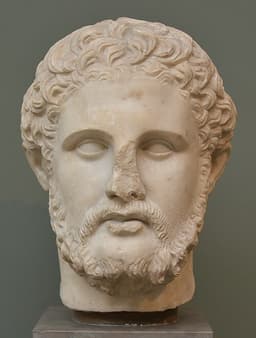
Philip II of Macedon
Emperor · Ancient
73.9Total

Thutmose III
Emperor · Ancient
64.5Total
Basic Information
Born
-382
-1481
Died
-336
-1425
Era
Ancient
Ancient
Nationality
Macedon
Egypt
Occupation
Emperor
Emperor
Civilization
Western
Middle Eastern
Score Comparison
Military (10%)
65.0
86.0
Political (20%)
76.0
58.1
Influence (20%)
75.0
68.0
Legacy (20%)
70.0
40.0
Leadership (15%)
78.0
81.0
Strategy (15%)
80.3
80.1
TOTAL
73.9
64.5
Philip II of Macedon — Complete Timeline
359 BC
Reforms of the Macedonian ArmyReform◆ Major
Philip II reorganized the Macedonian army, introducing the sarissa (long pike) and the phalanx formation. He also improved cavalry tactics and logistics, creating a professional, disciplined force that was superior to Greek hoplite armies.
MacedonMilitary ReformPhalanx
Impact: regionalconstructive
338 BC
Battle of ChaeroneaWar
Philip II led the Macedonian army to a decisive victory over the combined forces of Athens and Thebes at Chaeronea. The battle ended Greek independence and established Macedonian hegemony over Greece. Philip's son Alexander commanded the cavalry on the left wing.
MacedonGreeceBattle
Impact: regionaldestructive
337 BC
Formation of the League of CorinthPolitical Action◆ Major
Philip II established the League of Corinth, a federation of Greek states under Macedonian leadership. The league declared war on Persia and appointed Philip as its commander-in-chief, laying the groundwork for Alexander's later invasion.
MacedonGreeceAlliance
Impact: regionalconstructive
336 BC
Assassination at AegaePolitical Action◆ Major
Philip II was assassinated by his bodyguard Pausanias at the wedding of his daughter Cleopatra in Aegae. The motive remains unclear, but his death led to the immediate succession of his son Alexander the Great, who continued his plans for the Persian invasion.
MacedonAssassinationSuccession
Impact: regionaltragic
Thutmose III — Complete Timeline
1457 BC
Battle of MegiddoWar
Thutmose III led his army through the Aruna Pass to surprise a Canaanite coalition at Megiddo. The Egyptian victory secured control over Syria-Palestine and marked the first recorded battle in history with a detailed tactical account.
Military CampaignCanaanSiege
Impact: regional
1456 BC
Campaigns in Syria and MitanniWar◆ Major
Thutmose III conducted a series of annual campaigns into Syria, capturing cities such as Kadesh and Carchemish. He crossed the Euphrates River into Mitanni territory, extending Egyptian influence to its greatest geographical extent.
Imperial ExpansionMitanniEuphrates
Impact: regional
1450 BC
Construction of the Festival Hall at KarnakCultural◆ Major
Thutmose III built the Akh-menu, or Festival Hall, at the Karnak temple complex in Thebes. The hall featured reliefs depicting his military campaigns and served as a center for the Heb-sed festival, reinforcing his divine kingship.
ArchitectureKarnakReligious Center
Impact: nationalconstructive
1445 BC
Obelisk Erection at KarnakCultural
Thutmose III erected two large obelisks at the Karnak temple, one of which now stands in Istanbul. The obelisks commemorated his military victories and were inscribed with texts praising his achievements as a warrior pharaoh.
MonumentObeliskCommemoration
Impact: nationalconstructive
1440 BC
Suppression of the Rebellion in NubiaWar
Thutmose III led a campaign into Nubia to crush a rebellion against Egyptian rule. The victory secured the southern border and ensured continued access to gold mines and trade routes in the region.
NubiaRebellionGold Trade
Impact: regional
Expert Analysis
Origins
Philip II of Macedon was born in 382 BCE in Pella, the son of King Amyntas III and Eurydice. He spent his youth as a hostage in Thebes, where he studied under Epaminondas, learning military tactics and Greek politics. His early life was marked by instability, as Macedonia was a peripheral kingdom often threatened by Illyrians and Greek city-states.
Thutmose III was born around 1481 BCE, the son of Pharaoh Thutmose II and a lesser wife, Iset. He became pharaoh as a child after his father's death, but his stepmother Hatshepsut initially ruled as regent. Thutmose III spent his early years training in military and administration, but was sidelined during Hatshepsut's two-decade reign.
Rise to Power
Philip II became king in 359 BCE after his brother Perdiccas III was killed in battle. He inherited a weakened kingdom facing invasion. He quickly defeated the Illyrians and Paeonians, then secured his northern borders. He modernized the army and began expanding into Thessaly and Thrace. His decisive victory at the Battle of Chaeronea in 338 BCE over the combined forces of Athens and Thebes established Macedonian hegemony over Greece. He then formed the League of Corinth in 337 BCE, uniting the Greek states under his leadership for a planned invasion of Persia.
Thutmose III rose to power after Hatshepsut's death around 1458 BCE. He immediately asserted his authority and launched a campaign to quell a rebellion in Syria-Palestine. His first major action was the Battle of Megiddo in 1457 BCE, where he led a risky march through the Aruna Pass to surprise the Canaanite coalition. The victory was complete, and he besieged and captured Megiddo after a seven-month siege. This established his reputation as a military commander and secured Egyptian dominance in the region.
Leadership & Governance
Philip II was a political and military reformer who centralized Macedonian power. He reorganized the army into the Macedonian phalanx, armed with the sarissa (a 6-meter pike), and integrated heavy cavalry as a striking force. He also established a system of alliances through marriage and diplomacy, often using his seven wives to secure treaties. He founded cities and promoted trade, and his rule brought stability and economic growth to Macedonia. However, his authoritarian style and suppression of Greek autonomy caused resentment.
Thutmose III was an expansionist pharaoh who personally led campaigns. He conducted at least 17 campaigns into Syria and Nubia, extending Egypt's empire to its greatest extent. He established a system of vassal states and tribute, and brought back wealth that funded massive building projects. He also reformed the administration, appointing loyal officials and integrating conquered elites. His governance was marked by efficiency and consolidation, but he relied heavily on military force to maintain control.
Triumph & Tragedy
Philip II's greatest triumph was unifying Greece and creating the army that would conquer Persia. His military reforms, scoring 80.3 in strategy, were innovative and effective. His greatest failure was his assassination in 336 BCE at the wedding of his daughter Cleopatra, which disrupted his plans and left his empire to his son Alexander. The murder may have been motivated by personal grievances or political intrigue, but it cut short his reign.
Thutmose III's greatest triumph was the Battle of Megiddo, which set the stage for his campaigns that expanded Egypt to its zenith. He scored 86.0 in military, the highest among ancient pharaohs. His failure was the suppression of Hatshepsut's legacy; he had her images and cartouches defaced, an act that some see as a personal vendetta. However, this may have been a political move to legitimize his rule. His later campaigns were less successful in holding territory, as some vassal states rebelled.
Character & Destiny
Philip II was pragmatic, calculating, and ambitious. He was a skilled diplomat who used marriage and bribery as often as force. His character shaped his fate: his willingness to take risks (e.g., marching into Illyria with a small force) paid off, but his personal life created enemies. His decision to marry Cleopatra Eurydice, a Macedonian noble, alienated his first wife Olympias and their son Alexander, leading to family strife. His assassination was a direct result of court intrigues.
Thutmose III was patient, determined, and militarily brilliant. He waited years to assume full power, then acted decisively. His character is reflected in his meticulous planning of campaigns, as seen at Megiddo. He was also a builder, erecting obelisks and temples to cement his legacy. His destiny was to become the greatest warrior pharaoh, but his legacy was later overshadowed by Ramesses II. His erasure of Hatshepsut shows a ruthless side, but also a desire for sole recognition.
Legacy
Philip II's legacy is pivotal: he transformed Macedonia from a backwater into a major power and created the military machine that Alexander used to conquer the Persian Empire. His political unification of Greece and the League of Corinth set a precedent for Hellenistic leagues. He scored 75.0 in influence and 70.0 in legacy. His tactical innovations, such as the combined use of phalanx and cavalry, influenced warfare for centuries.
Thutmose III's legacy is as the Napoleon of Egypt, expanding the empire to its greatest territorial extent. He scored 68.0 in influence but only 40.0 in legacy, partly because his achievements were later eclipsed by other pharaohs. His military campaigns were recorded in detail at Karnak, providing valuable historical data. His building projects, like the Festival Hall, contributed to Egyptian architecture. However, his empire did not endure; after his death, Egypt gradually lost control of Syria.
Conclusion
Philip II had a greater overall impact than Thutmose III. While Thutmose III expanded Egypt to its peak, his empire was temporary and his legacy faded. Philip II, scoring 73.9 total versus Thutmose III's 64.5, fundamentally changed the course of Western history by creating the conditions for Alexander's conquests and the Hellenistic world. His military and political reforms were more enduring, influencing later European and Middle Eastern powers. Thutmose III was a brilliant military commander, but Philip II was a transformative leader who shaped the ancient world's future.
Rankings
🥇
Philip II of MacedonLeader
Mil: 65.0Pol: 76.0Inf: 75.0
73.9
🥈
Thutmose III
Mil: 86.0Pol: 58.1Inf: 68.0
64.5
+9.4 behind
How This Comparison Works
Algorithm
Each figure is scored on 6 dimensions (0—100 scale) based on structured historical data: Military (10%), Political (20%), Influence (20%), Legacy (20%), Leadership (15%), Strategy (15%). The weighted total produces the final ranking.
Data Sources
Scores are computed from structured sub-indicators in the database. Scale factors adjust for era (Ancient ×0.85, Modern ×1.0) and civilization size (Eastern ×1.05, Other ×0.80) to account for differences in population and military scale.
Maximum 3 Figures
Comparisons are limited to 2—3 figures to ensure readability and statistical meaningfulness.
Error Margins
±5 points per dimension — Sub-scores are derived from historical records with inherent uncertainty. Two figures within 5 points on a dimension should be considered roughly equivalent in that area.
Total Score Accuracy
±3 points overall — The weighted combination of 6 dimensions produces a total score with approximately ±3 points of uncertainty. Differences of less than 3 points are not statistically significant— the figures are effectively tied.
Known Limitations
- Historical records are incomplete and uneven across civilizations
- Figures from oral-tradition societies may be underrepresented
- Occupation labels can misclassify multi-role figures
- Scores measure capability and impact, not moral character
- Quantitative scoring is a comparison tool, not absolute truth
Capability Radar
Military (10%) — Battles & Warfare
Battles
85
95
Win Rate
90
98
Expansion
85
95
Political (20%) — Governance & Reform
Reform
90
80
Diplomacy
92
85
Economy
80
82
Influence (20%) — Cultural & Global Reach
Cultural
80
75
Global
80
70
Legacy (20%) — Historical Impact
Historical
85
85
Longevity
85
80
Leadership (15%) — Power & Stability
Tenure
75
88
Stability
70
85
Strategy (15%) — Tactics & Innovation
Strategy
92
95
Tactics
88
92
Reform
95
85
Similar Comparisons
Comments & Discussion
No comments yet. Be the first to share your thoughts!