Loading...
Mehmed Talat vs Napoleon Bonaparte
Napoleon Bonaparte leads by 15.4 pts · 2 figures compared
…
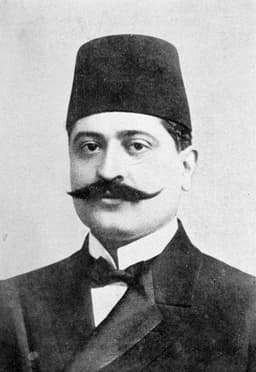
Mehmed Talat
Politician · Modern
55.5Total

Napoleon Bonaparte
General · Modern
70.9Total
Basic Information
Born
1874
1769
Died
1921
1821
Era
Modern
Modern
Nationality
Ottoman Empire
France
Occupation
Politician
General
Civilization
Middle Eastern
Western
Score Comparison
Military (10%)
50.0
94.0
Political (20%)
68.0
72.0
Influence (20%)
56.4
40.0
Legacy (20%)
49.2
80.0
Leadership (15%)
65.0
78.0
Strategy (15%)
41.4
90.0
TOTAL
55.5
70.9
Mehmed Talat — Complete Timeline
1913 AD
Appointed Minister of InteriorPolitical Action◆ Major
Mehmed Talat was appointed Minister of Interior in the CUP government. He became the de facto strongman of the empire, controlling internal security and implementing policies of Turkification and population transfers.
CUPInterior MinisterTurkification
Impact: national
1915 AD
Ordered the Armenian DeportationsPolitical Action
As Interior Minister, Mehmed Talat issued the orders for the mass deportation of Armenians from eastern Anatolia. He personally directed the implementation, which resulted in the Armenian Genocide. His role made him the primary architect of the genocide.
Armenian GenocideDeportationWar Crimes
Impact: globaldestructive
1917 AD
Appointed Grand VizierPolitical Action◆ Major
Mehmed Talat was appointed Grand Vizier, succeeding Said Halim Pasha. He led the Ottoman government during the final years of World War I, overseeing the empire's war effort and the continuation of genocidal policies.
Grand VizierWorld War ICUP
Impact: national
1918 AD
Fled to GermanyPolitical Action◆ Major
After the Ottoman defeat in World War I, Mehmed Talat fled to Germany along with other CUP leaders. He was tried in absentia by an Ottoman military court and sentenced to death for his role in the Armenian Genocide.
ExileWar Crimes TrialArmenian Genocide
Impact: nationaltragic
1921 AD
Assassinated in BerlinPolitical Action◆ Major
Mehmed Talat was assassinated in Berlin by Armenian student Soghomon Tehlirian as an act of vengeance for the Armenian Genocide. His assassination was part of Operation Nemesis, a covert Armenian retribution campaign.
AssassinationOperation NemesisArmenian Genocide
Impact: globaltragic
Napoleon Bonaparte — Complete Timeline
1799 AD
Coup of 18 BrumaireOther◆ Major
Napoleon Bonaparte, with support from his brother Lucien and key political figures, overthrew the Directory in a bloodless coup. He established the Consulate with himself as First Consul, effectively becoming the ruler of France. This event ended the French Revolution's most unstable period.
French RevolutionCoupRise to Power
Impact: regional
1804 AD
Promulgation of the Napoleonic CodeOther◆ Major
Napoleon enacted the Civil Code of the French, known as the Napoleonic Code, a comprehensive set of laws that replaced the fragmented feudal legal systems. The code established legal equality, protected property rights, and secularized law. It became the basis for legal systems in many European and world countries.
Legal ReformNapoleonic CodeCivil Law
Impact: globalconstructive
1805 AD
Battle of AusterlitzWar◆ Major
Napoleon's Grande Arm
Napoleonic WarsBattleDecisive Victory
Impact: global
1812 AD
Invasion of RussiaWar◆ Major
Napoleon led the Grande Arm
Napoleonic WarsInvasionDisaster
Impact: globaldestructive
1815 AD
Battle of WaterlooWar◆ Major
Napoleon's French army was defeated by the combined forces of the Duke of Wellington's Anglo-Allied army and Gebhard Leberecht von Bl
Napoleonic WarsBattleFinal Defeat
Impact: globaldestructive
Expert Analysis
Origins
Mehmed Talat (1874-1921) was born into a modest family in Edirne, Ottoman Empire. His father was a minor official. Talat attended a local school and later worked as a postal clerk, which exposed him to the inefficiencies of the Ottoman bureaucracy. He joined the Committee of Union and Progress (CUP) as a young man, drawn to its modernizing and nationalist ideals.
Napoleon Bonaparte (1769-1821) was born in Ajaccio, Corsica, to a minor noble family. His father, Carlo Bonaparte, was a lawyer who secured a royal scholarship for Napoleon to attend military school in mainland France. Napoleon graduated from the École Militaire in Paris in 1785, becoming a second lieutenant in the artillery. His Corsican background initially marked him as an outsider in French society.
Rise to Power
Talat rose through the ranks of the CUP, becoming a key figure after the Young Turk Revolution of 1908. He was appointed Minister of Interior in 1913, effectively becoming the empire's de facto strongman. Talat's power peaked during World War I, when he orchestrated the Armenian deportations and later became Grand Vizier in 1917.
Napoleon's rise was meteoric. He gained fame during the Siege of Toulon (1793) and later suppressed a royalist uprising in Paris (1795). In 1796, he was given command of the French army in Italy, where he won a series of stunning victories. His political acumen led to the Coup of 18 Brumaire (1799), making him First Consul. By 1804, he crowned himself Emperor of the French.
Leadership & Governance
Talat ruled through the CUP's central committee, employing a mix of coercion and persuasion. He centralized control, suppressed dissent, and implemented policies of Turkification. His governance was marked by the systematic deportation of Armenians, which he personally directed. Talat's political score of 68.0 reflects his ability to navigate Ottoman politics, but his legacy is tainted by genocide.
Napoleon's leadership was transformative. He centralized the French state, established the Napoleonic Code (1804), reorganized education, and created the Banque de France. His military leadership is legendary, with a military score of 94.0. However, his authoritarian turn and wars of conquest ultimately led to his downfall. His political score of 72.0 shows a mixed record.
Triumph & Tragedy
Talat's greatest success was maintaining Ottoman control during World War I, but his greatest failure was the Armenian Genocide, which killed an estimated 1.5 million people. The deportations were a catastrophic humanitarian disaster and a crime against humanity. Talat fled to Germany after the war and was assassinated in Berlin in 1921 by an Armenian avenger.
Napoleon's triumphs include the Battle of Austerlitz (1805), where he decisively defeated the combined Russian and Austrian armies, and the Napoleonic Code, which influenced legal systems worldwide. His invasion of Russia (1812) was a disaster, losing over 400,000 men. His final defeat at Waterloo (1815) ended his rule. Napoleon died in exile on Saint Helena in 1821.
Character & Destiny
Talat was pragmatic, ruthless, and ideologically committed to Turkish nationalism. He believed the Armenian population posed a threat to the empire's integrity. His decision-making was driven by wartime exigencies and nationalist fervor. Historical assessments condemn him as the architect of genocide.
Napoleon was ambitious, charismatic, and a strategic genius. His character combined brilliance with hubris. He often overreached, as in Russia and Spain. Historians view him as a military titan but also as a tyrant who caused immense suffering. His leadership score of 78.0 reflects his ability to inspire, but his strategy score of 90.0 underscores his tactical brilliance.
Legacy
Talat's legacy is overwhelmingly negative. He is remembered as the mastermind of the Armenian Genocide, a crime that continues to affect Turkish-Armenian relations. His influence score of 56.4 and legacy score of 49.2 reflect his limited enduring impact beyond the genocide. The CUP's policies of Turkification contributed to the eventual dissolution of the Ottoman Empire.
Napoleon's legacy is vast and complex. The Napoleonic Code remains a foundation of civil law in many countries. He reshaped European borders and spread nationalism. His military campaigns are studied worldwide. With a legacy score of 80.0, Napoleon's impact on modern Europe is undeniable. However, his wars caused millions of deaths.
Conclusion
Napoleon Bonaparte had a far greater impact on world history than Mehmed Talat. Napoleon's total score of 70.9 exceeds Talat's 55.5 by 15.4 points. While Talat's actions were consequential, they were localized and ultimately destructive. Napoleon's reforms, military campaigns, and legal innovations shaped the modern world. Talat's legacy is a cautionary tale of nationalism and genocide; Napoleon's is a testament to the power of individual ambition to reshape continents. The data supports Napoleon as the more influential figure.
Rankings
🥇
Napoleon BonaparteLeader
Mil: 94.0Pol: 72.0Inf: 40.0
70.9
🥈
Mehmed Talat
Mil: 50.0Pol: 68.0Inf: 56.4
55.5
+15.4 behind
How This Comparison Works
Algorithm
Each figure is scored on 6 dimensions (0—100 scale) based on structured historical data: Military (10%), Political (20%), Influence (20%), Legacy (20%), Leadership (15%), Strategy (15%). The weighted total produces the final ranking.
Data Sources
Scores are computed from structured sub-indicators in the database. Scale factors adjust for era (Ancient ×0.85, Modern ×1.0) and civilization size (Eastern ×1.05, Other ×0.80) to account for differences in population and military scale.
Maximum 3 Figures
Comparisons are limited to 2—3 figures to ensure readability and statistical meaningfulness.
Error Margins
±5 points per dimension — Sub-scores are derived from historical records with inherent uncertainty. Two figures within 5 points on a dimension should be considered roughly equivalent in that area.
Total Score Accuracy
±3 points overall — The weighted combination of 6 dimensions produces a total score with approximately ±3 points of uncertainty. Differences of less than 3 points are not statistically significant— the figures are effectively tied.
Known Limitations
- Historical records are incomplete and uneven across civilizations
- Figures from oral-tradition societies may be underrepresented
- Occupation labels can misclassify multi-role figures
- Scores measure capability and impact, not moral character
- Quantitative scoring is a comparison tool, not absolute truth
Capability Radar
Military (10%) — Battles & Warfare
Battles
22
95
Win Rate
23
90
Expansion
30
95
Political (20%) — Governance & Reform
Reform
65
95
Diplomacy
55
80
Economy
40
85
Influence (20%) — Cultural & Global Reach
Cultural
30
85
Global
50
90
Legacy (20%) — Historical Impact
Historical
55
95
Longevity
40
90
Leadership (15%) — Power & Stability
Tenure
60
85
Stability
20
70
Strategy (15%) — Tactics & Innovation
Strategy
28
95
Tactics
36
98
Reform
39
92
Similar Comparisons
Comments & Discussion
No comments yet. Be the first to share your thoughts!