Loading...
Ali Hassan al-Majid vs Wojciech Jaruzelski
Wojciech Jaruzelski leads by 10.1 pts · 2 figures compared
…

Ali Hassan al-Majid
General · Modern
41.7Total
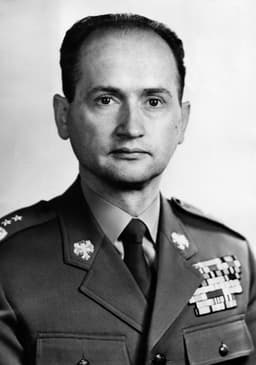
Wojciech Jaruzelski
General · Modern
51.8Total
Basic Information
Born
1941
1923
Died
—
—
Era
Modern
Modern
Nationality
Iraq
Poland
Occupation
General
General
Civilization
Middle Eastern
Western
Score Comparison
Military (10%)
50.0
50.0
Political (20%)
25.0
45.1
Influence (20%)
49.4
56.4
Legacy (20%)
41.7
47.5
Leadership (15%)
47.3
65.0
Strategy (15%)
30.3
43.3
TOTAL
41.7
51.8
Ali Hassan al-Majid — Complete Timeline
1987 AD
Command of the Northern BureauPolitical Action◆ Major
Al-Majid was appointed head of the Ba'ath Party's Northern Bureau, giving him authority over Kurdish regions. He implemented a policy of forced displacement and Arabization, known as the Anfal campaign, targeting Kurdish populations.
AnfalKurdsArabization
Impact: regionaldestructive
1988 AD
Halabja chemical attackWar
Al-Majid ordered the use of chemical weapons against the Kurdish town of Halabja, killing an estimated 5,000 civilians. The attack, which included mustard gas and nerve agents, became a symbol of Saddam's brutality and led to his nickname 'Chemical Ali'.
Chemical WeaponsWar CrimeHalabja
Impact: globaldestructive
1991 AD
Suppression of the 1991 Shia uprisingWar◆ Major
Al-Majid was sent to southern Iraq to crush the Shia uprising following the Gulf War. He used indiscriminate force, including artillery and helicopter attacks, on civilian areas, resulting in thousands of deaths and the destruction of holy sites.
UprisingRepressionShia
Impact: nationaldestructive
2003 AD
Capture, trial, and executionPolitical Action◆ Major
Al-Majid was captured by US forces in August 2003. He was tried by the Iraqi High Tribunal for genocide, crimes against humanity, and war crimes. He was sentenced to death multiple times and executed by hanging in 2010.
CaptureTrialExecution
Impact: nationaltragic
Wojciech Jaruzelski — Complete Timeline
1981 AD
Appointment as First Secretary of the Polish United Workers' PartyPolitical Action◆ Major
Jaruzelski became First Secretary of the Polish United Workers' Party (PZPR) amid a deep political and economic crisis. He also held the posts of Prime Minister and Minister of Defense, concentrating power in his hands.
Communist leadership
Impact: national
Imposition of Martial Law in PolandPolitical Action
Jaruzelski declared martial law on December 13, 1981, to crush the Solidarity trade union movement. The military arrested thousands of activists, including Lech Walesa, and suspended civil liberties. The crackdown was widely condemned internationally.
Martial lawRepression
Impact: nationaldestructive
1989 AD
Round Table TalksPolitical Action
Facing mounting pressure and economic collapse, Jaruzelski agreed to Round Table Talks with the opposition, including Solidarity. The talks led to partially free elections, which Solidarity won, marking the beginning of the end of communist rule in Poland.
Political transitionFall of communism
Impact: globalconstructive
1990 AD
Resignation as PresidentPolitical Action◆ Major
Jaruzelski resigned as President of Poland, handing over power to Lech Walesa, the leader of Solidarity. This completed the peaceful transition from communist to democratic rule in Poland.
Political transition
Impact: national
Expert Analysis
Origins
Ali Hassan al-Majid was born in 1941 in Tikrit, Iraq, into a modest family. He was a cousin of Saddam Hussein, which facilitated his entry into the Ba'ath Party. He had little formal military education but rose through party loyalty. Wojciech Jaruzelski was born in 1923 in Kurów, Poland, into a landowning family. He was deported to Siberia during World War II and later joined the Soviet-backed Polish Army, graduating from the Higher Infantry School.
Rise to Power
Al-Majid's rise was tied to Saddam's regime. In the 1980s, he was appointed head of the Northern Bureau, overseeing Kurdish regions. His ruthless tactics against Kurdish insurgents earned him the nickname "Chemical Ali" after the 1988 Halabja attack. Jaruzelski became First Secretary of the Polish United Workers' Party in 1981 amid economic crisis and growing Solidarity movement. He also held the posts of Prime Minister and Minister of Defense, consolidating power.
Leadership & Governance
Al-Majid governed through terror. In Halabja, he ordered chemical weapons, killing 5,000 civilians. He implemented forced displacement of Kurds, destroying villages. During the 1991 Shia uprising, he used artillery and helicopter gunships against civilians. His leadership score is 47.3, reflecting his reliance on violence. Jaruzelski imposed martial law on December 13, 1981, arresting thousands of Solidarity activists. However, he later initiated the Round Table Talks in 1989, leading to semi-free elections and a peaceful transition. His leadership score of 65.0 indicates a more complex approach.
Triumph & Tragedy
Al-Majid's greatest success was suppressing Kurdish and Shia rebellions, but his legacy is defined by the Halabja massacre—a war crime. He was captured in 2003, tried for genocide, and executed in 2010. His total score is 41.7. Jaruzelski's triumph was avoiding Soviet invasion by imposing martial law, but his tragedy was crushing a democratic movement. Later, he facilitated the Round Table Talks, leading to Poland's peaceful transition from communism. His total score is 51.8.
Character & Destiny
Al-Majid was a loyal enforcer, devoid of strategic vision. He followed orders without hesitation, leading to his downfall. Jaruzelski was a pragmatic communist who believed martial law was the lesser evil. He was conflicted, later expressing regret but defending his actions. His character shaped a legacy of both repression and reform.
Legacy
Al-Majid is remembered as a symbol of Ba'athist brutality. His actions led to international condemnation and contributed to the Iraqi High Tribunal's precedent for prosecuting chemical attacks. Jaruzelski remains controversial: to some, a traitor; to others, a patriot who saved Poland from Soviet intervention. His legacy includes the peaceful end of communism in Poland.
Conclusion
While both used repression, Jaruzelski's impact is greater. He scored 51.8 overall versus Al-Majid's 41.7. Jaruzelski's political score of 45.1 and leadership of 65.0 reflect his role in transitioning Poland to democracy. Al-Majid's influence (49.4) is solely negative, tied to atrocities. Jaruzelski's legacy includes a peaceful outcome; Al-Majid's is only destruction. Therefore, Jaruzelski had a more significant and complex impact on history.
Rankings
🥇
Wojciech JaruzelskiLeader
Mil: 50.0Pol: 45.1Inf: 56.4
51.8
🥈
Ali Hassan al-Majid
Mil: 50.0Pol: 25.0Inf: 49.4
41.7
+10.1 behind
How This Comparison Works
Algorithm
Each figure is scored on 6 dimensions (0—100 scale) based on structured historical data: Military (10%), Political (20%), Influence (20%), Legacy (20%), Leadership (15%), Strategy (15%). The weighted total produces the final ranking.
Data Sources
Scores are computed from structured sub-indicators in the database. Scale factors adjust for era (Ancient ×0.85, Modern ×1.0) and civilization size (Eastern ×1.05, Other ×0.80) to account for differences in population and military scale.
Maximum 3 Figures
Comparisons are limited to 2—3 figures to ensure readability and statistical meaningfulness.
Error Margins
±5 points per dimension — Sub-scores are derived from historical records with inherent uncertainty. Two figures within 5 points on a dimension should be considered roughly equivalent in that area.
Total Score Accuracy
±3 points overall — The weighted combination of 6 dimensions produces a total score with approximately ±3 points of uncertainty. Differences of less than 3 points are not statistically significant— the figures are effectively tied.
Known Limitations
- Historical records are incomplete and uneven across civilizations
- Figures from oral-tradition societies may be underrepresented
- Occupation labels can misclassify multi-role figures
- Scores measure capability and impact, not moral character
- Quantitative scoring is a comparison tool, not absolute truth
Capability Radar
Military (10%) — Battles & Warfare
Battles
15
20
Win Rate
10
25
Expansion
10
10
Political (20%) — Governance & Reform
Reform
5
30
Diplomacy
10
40
Economy
10
25
Influence (20%) — Cultural & Global Reach
Cultural
5
30
Global
20
40
Legacy (20%) — Historical Impact
Historical
30
45
Longevity
10
30
Leadership (15%) — Power & Stability
Tenure
40
60
Stability
5
20
Strategy (15%) — Tactics & Innovation
Strategy
15
40
Tactics
20
30
Reform
5
35
Similar Comparisons
Comments & Discussion
No comments yet. Be the first to share your thoughts!