Loading...
Matsukata Masayoshi vs Napoleon Bonaparte
Napoleon Bonaparte leads by 14.6 pts · 2 figures compared
…
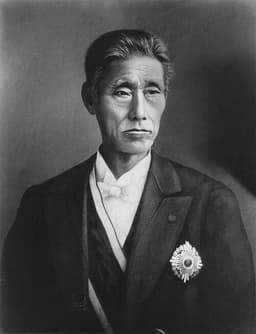
Matsukata Masayoshi
Politician · Modern
56.3Total

Napoleon Bonaparte
General · Modern
70.9Total
Basic Information
Born
1835
1769
Died
1924
1821
Era
Modern
Modern
Nationality
Japan
France
Occupation
Politician
General
Civilization
Eastern
Western
Score Comparison
Military (10%)
10.4
94.0
Political (20%)
78.0
72.0
Influence (20%)
58.0
40.0
Legacy (20%)
54.0
80.0
Leadership (15%)
80.0
78.0
Strategy (15%)
35.5
90.0
TOTAL
56.3
70.9
Matsukata Masayoshi — Complete Timeline
1881 AD
Matsukata Fiscal PolicyReform◆ Major
As Finance Minister, Matsukata implemented the Matsukata Fiscal Policy, a series of deflationary measures to combat inflation and stabilize the currency. He established the Bank of Japan in 1882 and introduced a new tax system. These policies laid the foundation for Japan's modern economy.
FinanceReformEconomy
Impact: nationalconstructive
1891 AD
Served as Prime MinisterPolitical Action◆ Major
Matsukata Masayoshi served as the fourth Prime Minister of Japan from 1891 to 1892. His first term was marked by political instability and economic challenges. He was known for his conservative fiscal policies.
Prime MinisterGovernmentPolitics
Impact: national
1896 AD
Second Term as Prime MinisterPolitical Action◆ Major
Matsukata served a second term as Prime Minister from 1896 to 1898. His second term was also short and marked by political conflicts. He focused on foreign policy, including the Triple Intervention after the First Sino-Japanese War.
Prime MinisterGovernmentPolitics
Impact: national
1897 AD
Established the Gold StandardReform◆ Major
Matsukata, as Finance Minister, led Japan's adoption of the gold standard in 1897. This move stabilized the yen and facilitated foreign trade and investment. It was a key step in Japan's integration into the global economy.
Gold StandardFinanceEconomy
Impact: globalconstructive
Napoleon Bonaparte — Complete Timeline
1799 AD
Coup of 18 BrumaireOther◆ Major
Napoleon Bonaparte, with support from his brother Lucien and key political figures, overthrew the Directory in a bloodless coup. He established the Consulate with himself as First Consul, effectively becoming the ruler of France. This event ended the French Revolution's most unstable period.
French RevolutionCoupRise to Power
Impact: regional
1804 AD
Promulgation of the Napoleonic CodeOther◆ Major
Napoleon enacted the Civil Code of the French, known as the Napoleonic Code, a comprehensive set of laws that replaced the fragmented feudal legal systems. The code established legal equality, protected property rights, and secularized law. It became the basis for legal systems in many European and world countries.
Legal ReformNapoleonic CodeCivil Law
Impact: globalconstructive
1805 AD
Battle of AusterlitzWar◆ Major
Napoleon's Grande Arm
Napoleonic WarsBattleDecisive Victory
Impact: global
1812 AD
Invasion of RussiaWar◆ Major
Napoleon led the Grande Arm
Napoleonic WarsInvasionDisaster
Impact: globaldestructive
1815 AD
Battle of WaterlooWar◆ Major
Napoleon's French army was defeated by the combined forces of the Duke of Wellington's Anglo-Allied army and Gebhard Leberecht von Bl
Napoleonic WarsBattleFinal Defeat
Impact: globaldestructive
Expert Analysis
matsukata-masayoshi-vs-napoleon-bonaparte
# The Conqueror and the Accountant
On a June morning in 1815, Napoleon Bonaparte watched his legions march toward a muddy field near Waterloo, confident that one more victory would cement his mastery of Europe. Half a world away and decades later, in 1881, Matsukata Masayoshi sat in a Tokyo office, staring at ledgers that told a different kind of war story: Japan’s economy was bleeding inflation, its currency worthless, its future uncertain. One man commanded armies of hundreds of thousands; the other commanded only numbers. Yet both would reshape their nations forever. What drove these two men—one a conqueror of continents, the other a quiet reformer—to such different fates?
Origins
Napoleon was born in 1769 on Corsica, an island that had just become French, into a minor noble family with more pride than money. The son of a lawyer, he grew up speaking Italian, not French, and carried the chip of an outsider on his shoulder. The French Revolution, erupting when he was twenty, shattered the old order and created a vacuum that a brilliant young artillery officer could fill. His era was one of chaos, opportunity, and war as a way of life.
Matsukata Masayoshi, born in 1835 in Satsuma domain (now Kagoshima), came of age in a Japan still locked in feudal isolation under the Tokugawa shogunate. His father was a low-ranking samurai, and Matsukata grew up in a world where birth determined destiny. But in 1853, when he was eighteen, Commodore Perry’s black ships appeared off Japan’s coast, triggering a crisis that would topple the shogunate and thrust men like Matsukata—pragmatic, ambitious, and steeped in Confucian discipline—into power. His era demanded not conquest, but survival through modernization.
Rise to Power
Napoleon’s rise was a thunderbolt. At age twenty-four, he drove the British out of Toulon; at twenty-six, he crushed a royalist uprising in Paris with a “whiff of grapeshot.” By thirty, he had conquered Italy and Egypt, returning to France in 1799 to seize power as First Consul. His path was built on military genius—his Strategy score of 93 and Military score of 94 reflect a mind that could read a battlefield like a chessboard. He did not wait for opportunity; he created it.
Matsukata’s ascent was glacial by comparison. After the Meiji Restoration in 1868, he served in various bureaucratic posts, learning the intricacies of finance and taxation. His key turning point came in 1881, when he became Finance Minister and faced a crisis: inflation from government spending had devastated the economy. Unlike Napoleon, who stormed into power, Matsukata earned it through competence. His Political score of 78 and Leadership score of 81 show a man who governed through consensus and expertise, not force.
Leadership & Governance
Napoleon ruled as emperor, centralizing power in his own hands. He reformed France through the Napoleonic Code—a legal system that abolished feudal privileges and enshrined merit—but he also suppressed dissent and crowned himself in 1804. His military campaigns were masterpieces of speed and deception: at Austerlitz in 1805, he lured the Austro-Russian army into a trap and destroyed it. But his political wisdom was flawed; he could not stop conquering, and his empire stretched too thin. His Leadership score of 80 reflects a man who inspired devotion but also hubris.
Matsukata governed as a technocrat. His Matsukata Fiscal Policy of 1881–1885 was a masterpiece of financial discipline: he slashed government spending, raised taxes, and created a central bank to stabilize the currency. It was painful—deflation caused suffering—but it worked. In 1897, he led Japan onto the gold standard, linking the yen to global markets and attracting foreign investment. His Strategy score of 59.6 seems modest, but it measures a different kind of strategy: not of battle, but of national survival. He did not conquer; he built.
Triumph & Tragedy
Napoleon’s greatest triumph was his empire at its height in 1810—France ruled from Spain to Poland. His greatest tragedy was the invasion of Russia in 1812, where 600,000 men marched east and only 40,000 returned. Exiled to Elba, he escaped and ruled for a hundred days before Waterloo ended it all in 1815. His death on Saint Helena in 1821, at age fifty-one, was a lonely end for a man who had shaken the world.
Matsukata’s triumphs were quieter but enduring. His financial reforms stabilized Japan, enabling its rise as an industrial power. He served as Prime Minister twice—1891–1892 and 1896–1898—but both terms were short and politically turbulent. His tragedy was that his work was invisible: no battles, no monuments, just balance sheets. He died in 1924 at age eighty-nine, respected but unsung.
Character & Destiny
Napoleon was driven by an insatiable will. “Impossible is a word to be found only in the dictionary of fools,” he said. He believed he could shape history through sheer force, and for a time, he was right. But his personality—arrogant, restless, unable to stop—became his undoing. He could not consolidate; he only conquered.
Matsukata was driven by duty. A samurai’s son, he believed in service, patience, and frugality. He once said, “The foundation of a nation is its finances,” a sentence Napoleon would have found laughable. But Matsukata understood that lasting power comes not from glory, but from stability. His personality—cautious, methodical, self-effacing—was his strength. He could not conquer; he only built.
Legacy
Napoleon’s legacy is written in stone and law. The Napoleonic Code influenced legal systems across Europe and the world. His campaigns redefined warfare. His name is synonymous with ambition and tragedy. His Legacy score of 78 reflects a figure who is both admired and debated.
Matsukata’s legacy is written in yen and stability. He is remembered as the “father of Japanese finance,” but few outside Japan know his name. His Legacy score of 65.9 is modest, but it underestimates his impact: without his reforms, Japan might have collapsed into chaos or remained a feudal backwater. He enabled the modernization that would make Japan a world power.
Conclusion
Napoleon and Matsukata were opposites: one a conqueror who shaped the 19th century through war, the other a reformer who shaped Japan through ledgers. Yet both faced the same question: how to forge order from chaos. Napoleon answered with the sword, Matsukata with the pen. One built an empire that crumbled, the other built a nation that endured. In the end, the accountant may have taught the conqueror a lesson: that the most lasting victories are not won on battlefields, but in the quiet, patient work of building foundations that no army can destroy.
Rankings
🥇
Napoleon BonaparteLeader
Mil: 94.0Pol: 72.0Inf: 40.0
70.9
🥈
Matsukata Masayoshi
Mil: 10.4Pol: 78.0Inf: 58.0
56.3
+14.6 behind
How This Comparison Works
Algorithm
Each figure is scored on 6 dimensions (0—100 scale) based on structured historical data: Military (10%), Political (20%), Influence (20%), Legacy (20%), Leadership (15%), Strategy (15%). The weighted total produces the final ranking.
Data Sources
Scores are computed from structured sub-indicators in the database. Scale factors adjust for era (Ancient ×0.85, Modern ×1.0) and civilization size (Eastern ×1.05, Other ×0.80) to account for differences in population and military scale.
Maximum 3 Figures
Comparisons are limited to 2—3 figures to ensure readability and statistical meaningfulness.
Error Margins
±5 points per dimension — Sub-scores are derived from historical records with inherent uncertainty. Two figures within 5 points on a dimension should be considered roughly equivalent in that area.
Total Score Accuracy
±3 points overall — The weighted combination of 6 dimensions produces a total score with approximately ±3 points of uncertainty. Differences of less than 3 points are not statistically significant— the figures are effectively tied.
Known Limitations
- Historical records are incomplete and uneven across civilizations
- Figures from oral-tradition societies may be underrepresented
- Occupation labels can misclassify multi-role figures
- Scores measure capability and impact, not moral character
- Quantitative scoring is a comparison tool, not absolute truth
Capability Radar
Military (10%) — Battles & Warfare
Battles
15
95
Win Rate
19
90
Expansion
21
95
Political (20%) — Governance & Reform
Reform
75
95
Diplomacy
70
80
Economy
85
85
Influence (20%) — Cultural & Global Reach
Cultural
40
85
Global
50
90
Legacy (20%) — Historical Impact
Historical
60
95
Longevity
55
90
Leadership (15%) — Power & Stability
Tenure
65
85
Stability
70
70
Strategy (15%) — Tactics & Innovation
Strategy
22
95
Tactics
29
98
Reform
26
92
Similar Comparisons
Comments & Discussion
数据铁匠6/17/2026
你们拿拿破仑和松方比?简直是对统计学的侮辱。拿破仑在滑铁卢损失了两万五千人,一天就结束了;松方的紧缩政策让日本米价跌了一半,农民卖女儿换粮,持续四年。前者是军事赌博,后者是冷酷的财政实验,用全国穷人的泪写就平衡表。别跟我扯英雄气概,算算每一条人命的边际成本。
历史发烧友6/17/2026
拿破仑是千年一遇的战争奇才,松方松方正義只是个账房先生。别误会,我尊重后者帮日本躲过殖民地命运,但前者改变了整个欧洲的政治版图,法典制度至今在用。把滑铁卢之战和地租改正条例放一起比?好比让拿破仑去种田。松方是优秀的危机管理者,拿破仑是历史创造者,层次根本不同。
Historian1856/17/2026
Napoleon won battles because he understood cannon trajectories and troop morale—Matsukata won Japan’s future because he understood silver flows and land taxes. One bled Europe for a crown; the other squeezed a dying feudal system to fund Meiji railways. Waterloo ended a man’s ambition, but the Matsukata Deflation of the 1880s ended centuries of samurai privilege. Which legacy do you think still echoes in geopolitics today? The general is remembered; the accountant is felt.
BoldEye806/17/2026
One marched on Moscow with half a million men; the other marched on paper with a decimal system. Napoleon’s Grand Army burned for glory; Matsukata’s tax registers lit the path to industrial empire. Plutarch would have written a paired life: the comet and the compass. The Corsican’s fall left a continent in rubble; the samurai’s rise left a ledger book—and the template for modern Japan’s miracle. Both are architects, but only one built to last.
Historian7786/17/2026
Spare me the hagiography. Napoleon’s “genius” cost France over a million dead and left it smaller than before. Matsukata’s dull tax reforms built the fiscal base for Japan’s leap without a single foreign war. The emperor-worshippers call Napoleon great; I call him a gambler who rolled the bones of his people. Matsukata’s quiet violence—deliberate deflation, peasant immiseration—is less romantic but more honest. Heroes are just the ones who kill slowly on a spreadsheet instead of a battlefield.