Loading...
Mark Rutte vs Napoleon Bonaparte
Napoleon Bonaparte leads by 13.3 pts · 2 figures compared
…
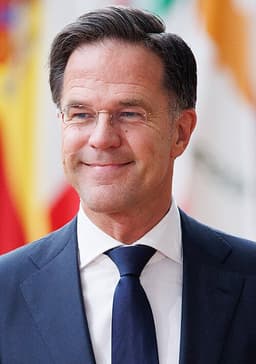
Mark Rutte
Politician · Modern
57.6Total

Napoleon Bonaparte
General · Modern
70.9Total
Basic Information
Born
1967
1769
Died
—
1821
Era
Modern
Modern
Nationality
Netherlands
France
Occupation
Politician
General
Civilization
Western
Western
Score Comparison
Military (10%)
41.8
94.0
Political (20%)
65.0
72.0
Influence (20%)
57.2
40.0
Legacy (20%)
48.3
80.0
Leadership (15%)
75.0
78.0
Strategy (15%)
60.0
90.0
TOTAL
57.6
70.9
Mark Rutte — Complete Timeline
2006 AD
Elected Leader of the People's Party for Freedom and DemocracyPolitical Action◆ Major
Mark Rutte became the political leader of the VVD, the Dutch liberal-conservative party. He led the party through several election campaigns, eventually becoming prime minister in 2010.
Dutch PoliticsVVDParty Leadership
Impact: nationalconstructive
2010 AD
Became Prime Minister of the NetherlandsPolitical Action
Rutte became Prime Minister of the Netherlands, leading a minority coalition government with support from the Party for Freedom (PVV). His first term focused on austerity measures and immigration reforms.
Dutch PoliticsPrime MinisterCoalition
Impact: nationalconstructive
2020 AD
Led Netherlands Through COVID-19 PandemicPolitical Action◆ Major
Rutte oversaw the Dutch response to COVID-19, including lockdowns, vaccination campaigns, and economic support measures. His government faced criticism over the slow start of vaccinations and handling of the second wave.
COVID-19Dutch PoliticsPublic Health
Impact: national
2021 AD
Survived No-Confidence Vote Over Childcare Benefits ScandalPolitical Action◆ Major
Rutte's government faced a no-confidence vote after a parliamentary inquiry revealed that tax authorities falsely accused thousands of parents of fraud in childcare benefits. The scandal led to the resignation of his cabinet, though Rutte remained as caretaker prime minister.
Dutch PoliticsScandalChildcare Benefits
Impact: nationaldestructive
2023 AD
Announced Retirement from PoliticsPolitical Action◆ Major
Rutte announced he would leave politics after the 2023 general election, ending his 13-year tenure as prime minister. He cited the need for new leadership and the end of his political career.
Dutch PoliticsRetirementEnd of Era
Impact: national
Napoleon Bonaparte — Complete Timeline
1799 AD
Coup of 18 BrumaireOther◆ Major
Napoleon Bonaparte, with support from his brother Lucien and key political figures, overthrew the Directory in a bloodless coup. He established the Consulate with himself as First Consul, effectively becoming the ruler of France. This event ended the French Revolution's most unstable period.
French RevolutionCoupRise to Power
Impact: regional
1804 AD
Promulgation of the Napoleonic CodeOther◆ Major
Napoleon enacted the Civil Code of the French, known as the Napoleonic Code, a comprehensive set of laws that replaced the fragmented feudal legal systems. The code established legal equality, protected property rights, and secularized law. It became the basis for legal systems in many European and world countries.
Legal ReformNapoleonic CodeCivil Law
Impact: globalconstructive
1805 AD
Battle of AusterlitzWar◆ Major
Napoleon's Grande Arm
Napoleonic WarsBattleDecisive Victory
Impact: global
1812 AD
Invasion of RussiaWar◆ Major
Napoleon led the Grande Arm
Napoleonic WarsInvasionDisaster
Impact: globaldestructive
1815 AD
Battle of WaterlooWar◆ Major
Napoleon's French army was defeated by the combined forces of the Duke of Wellington's Anglo-Allied army and Gebhard Leberecht von Bl
Napoleonic WarsBattleFinal Defeat
Impact: globaldestructive
Expert Analysis
mark-rutte-vs-napoleon-bonaparte
The Corsican and the Conciliator
On a June morning in 1815, Napoleon Bonaparte stood on a muddy field near Waterloo, watching his Imperial Guard march into cannon fire. Less than two centuries later, on a quiet afternoon in The Hague, Mark Rutte cycled to his office, a plastic cup of coffee in one hand, his phone buzzing with coalition negotiations. One man conquered a continent; the other managed a kingdom of cheese, windmills, and consensus. What separates a titan from a technician? The answer lies not in talent alone, but in the raw material of ambition and the crucible of circumstance.
Origins
Napoleon was born in 1769 on Corsica, an island of vendettas and clan loyalties, recently annexed by France. His family was minor nobility, poor enough to feel the sting of contempt from mainland aristocrats. He spoke Italian-accented French, a mark of the outsider. The French Revolution, which erupted when he was twenty, shattered the old order and opened a door for a young artillery officer who had nothing to lose. His world was one of upheaval, where a man could rise from nothing to emperor in a decade.
Mark Rutte, born in 1967 in The Hague, grew up in a Calvinist household where ambition was measured in diligence, not glory. His father was a businessman, his mother a secretary. The Netherlands in the 1970s was a placid democracy, prosperous and dull. Rutte studied history—a discipline that taught him the value of patience, not conquest. He joined the liberal VVD party as a young man, climbing the ladder of committees and ministries. His era was one of stability, where power came not from seizing it, but from being chosen.
Rise to Power
Napoleon’s ascent was a series of gambles. At twenty-four, he recaptured Toulon from British forces with a bold artillery plan. At twenty-six, he suppressed a royalist insurrection in Paris with a "whiff of grapeshot." By thirty, he was commanding armies in Italy, where he outmaneuvered Austrian forces and dictated peace terms. Each victory fed his legend. In 1799, he overthrew the Directory in a coup d'état, declaring himself First Consul. By 1804, he crowned himself Emperor of the French. His path was forged in fire and blood.
Rutte’s rise was a slow, deliberate march through committee rooms. In 2006, he was elected leader of the VVD, a party then in opposition. He was not a firebrand; he was a pragmatist who spoke in careful, unmemorable sentences. In 2010, after a hung parliament, he became prime minister at the head of a minority coalition. His power came not from conquest but from negotiation—a deal here, a compromise there. He was the man who could hold a government together, not the one who would tear an empire apart.
Leadership & Governance
Napoleon ruled with a blend of genius and tyranny. His military strategy was revolutionary: rapid marches, massed artillery, and decisive battles that shattered enemy armies. He won at Austerlitz in 1805, a masterpiece of deception and timing. He reformed France with the Napoleonic Code, a legal system that enshrined equality before the law—though not for women. He built roads, standardized education, and centralized the state. But his ambition knew no limits. He invaded Russia in 1812, losing half a million men to winter and starvation. He could not stop; his system required constant victory.
Rutte governed through consensus and crisis management. His military score is low—he was a civilian in a nation that had long abandoned great-power ambitions. His strategy was not to conquer but to survive. He led the Netherlands through the COVID-19 pandemic, imposing lockdowns and vaccine campaigns while balancing economic pressures. In 2021, his government collapsed over a childcare benefits scandal, where tax authorities falsely accused thousands of families of fraud. Rutte survived a no-confidence vote by a narrow margin, apologizing but refusing to resign. He was not a reformer; he was a caretaker, keeping the ship steady in choppy waters.
Triumph & Tragedy
Napoleon’s greatest moment was Austerlitz, where he crushed a combined Russian and Austrian army, ending the Third Coalition. His tragedy was Waterloo, where his last gamble failed, and he was exiled to Saint Helena, a volcanic rock in the South Atlantic. He died in 1821 at fifty-one, a prisoner of his own ambition.
Rutte’s triumph was longevity. He served thirteen years as prime minister, the longest in Dutch history, steering his country through economic crises, migration waves, and a pandemic. His tragedy was the scandal that tainted his legacy—the thousands of families driven into debt and despair by a bureaucratic error he failed to stop. He announced his retirement in 2023, walking away not in chains but to a quiet life.
Character & Destiny
Napoleon was driven by an insatiable hunger for glory. He once said, "Impossible is a word to be found only in the dictionary of fools." His personality was a force of nature—charismatic, ruthless, brilliant. But it was also his undoing. He could not delegate, could not compromise, could not stop. His destiny was shaped by his refusal to accept limits.
Rutte was driven by a different impulse: the desire to be useful. He was known for his unpretentious manner, cycling to work, teaching Sunday school. He once described himself as "a manager, not a visionary." His personality was one of patience and caution. He survived political storms by bending, not breaking. His destiny was shaped by his acceptance of limits.
Legacy
Napoleon left a continent transformed. His legal code influenced civil law across Europe and beyond. His wars redrew borders, toppled monarchies, and sparked nationalism. He is remembered as a genius and a tyrant, a liberator and a conqueror. His name still evokes awe.
Rutte left a country intact. His legacy is less dramatic—a stable economy, a functional government, a society that weathered crises. He will be remembered as a decent, competent leader in an age that prized stability over glory. His name will fade, but the institutions he preserved will endure.
Conclusion
Napoleon and Rutte are products of their times as much as their choices. One was born into revolution, the other into consensus. One built an empire of cannon and code, the other a career of coalitions and coffee. The difference between them is not simply skill or ambition—it is the world they inherited and the world they chose to make. Napoleon’s story is a warning about the cost of greatness. Rutte’s is a reminder of the value of steadiness. Which is more admirable? That depends on whether you prefer a storm or a shelter.
Rankings
🥇
Napoleon BonaparteLeader
Mil: 94.0Pol: 72.0Inf: 40.0
70.9
🥈
Mark Rutte
Mil: 41.8Pol: 65.0Inf: 57.2
57.6
+13.3 behind
How This Comparison Works
Algorithm
Each figure is scored on 6 dimensions (0—100 scale) based on structured historical data: Military (10%), Political (20%), Influence (20%), Legacy (20%), Leadership (15%), Strategy (15%). The weighted total produces the final ranking.
Data Sources
Scores are computed from structured sub-indicators in the database. Scale factors adjust for era (Ancient ×0.85, Modern ×1.0) and civilization size (Eastern ×1.05, Other ×0.80) to account for differences in population and military scale.
Maximum 3 Figures
Comparisons are limited to 2—3 figures to ensure readability and statistical meaningfulness.
Error Margins
±5 points per dimension — Sub-scores are derived from historical records with inherent uncertainty. Two figures within 5 points on a dimension should be considered roughly equivalent in that area.
Total Score Accuracy
±3 points overall — The weighted combination of 6 dimensions produces a total score with approximately ±3 points of uncertainty. Differences of less than 3 points are not statistically significant— the figures are effectively tied.
Known Limitations
- Historical records are incomplete and uneven across civilizations
- Figures from oral-tradition societies may be underrepresented
- Occupation labels can misclassify multi-role figures
- Scores measure capability and impact, not moral character
- Quantitative scoring is a comparison tool, not absolute truth
Capability Radar
Military (10%) — Battles & Warfare
Battles
46
95
Win Rate
50
90
Expansion
53
95
Political (20%) — Governance & Reform
Reform
60
95
Diplomacy
75
80
Economy
70
85
Influence (20%) — Cultural & Global Reach
Cultural
30
85
Global
55
90
Legacy (20%) — Historical Impact
Historical
50
95
Longevity
40
90
Leadership (15%) — Power & Stability
Tenure
85
85
Stability
80
70
Strategy (15%) — Tactics & Innovation
Strategy
59
95
Tactics
59
98
Reform
61
92
Similar Comparisons
Comments & Discussion
No comments yet. Be the first to share your thoughts!