Loading...
Manuel Roxas vs Napoleon Bonaparte
Napoleon Bonaparte leads by 22.2 pts · 2 figures compared
…
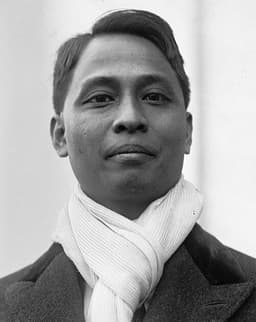
Manuel Roxas
Politician · Modern
48.7Total

Napoleon Bonaparte
General · Modern
70.9Total
Basic Information
Born
1892
1769
Died
1948
1821
Era
Modern
Modern
Nationality
Philippines
France
Occupation
Politician
General
Civilization
Eastern
Western
Score Comparison
Military (10%)
15.4
94.0
Political (20%)
68.0
72.0
Influence (20%)
54.1
40.0
Legacy (20%)
44.2
80.0
Leadership (15%)
64.0
78.0
Strategy (15%)
27.5
90.0
TOTAL
48.7
70.9
Manuel Roxas — Complete Timeline
1946 AD
Suppressed the Hukbalahap RebellionWar◆ Major
Roxas launched a military campaign against the Hukbalahap (Huk) guerrillas, a communist-led peasant army in Central Luzon. The conflict escalated into a full-scale rebellion that continued after his death.
InsurgencyHukbalahapMilitary Campaign
Impact: regionaldestructive
Became First President of Independent PhilippinesPolitical Action◆ Major
Roxas was inaugurated as the first president of the independent Republic of the Philippines on July 4, 1946, after the United States granted independence. He oversaw the transition from colonial rule to sovereignty.
IndependencePresidencyTransition
Impact: nationalconstructive
Signed the Philippine Trade Act (Bell Trade Act)Political Action◆ Major
Roxas signed the Philippine Trade Act, which granted the United States preferential trade terms and parity rights for American citizens in the Philippines. The act was controversial and seen as limiting Philippine economic sovereignty.
Trade AgreementUS RelationsEconomic Policy
Impact: nationaldestructive
1948 AD
Died in OfficeOther◆ Major
Roxas died of a heart attack at Clark Air Base in Pampanga at the age of 56. His death cut short his presidency and led to the succession of Vice President Elpidio Quirino.
DeathSuccessionPresidency
Impact: nationaltragic
Napoleon Bonaparte — Complete Timeline
1799 AD
Coup of 18 BrumaireOther◆ Major
Napoleon Bonaparte, with support from his brother Lucien and key political figures, overthrew the Directory in a bloodless coup. He established the Consulate with himself as First Consul, effectively becoming the ruler of France. This event ended the French Revolution's most unstable period.
French RevolutionCoupRise to Power
Impact: regional
1804 AD
Promulgation of the Napoleonic CodeOther◆ Major
Napoleon enacted the Civil Code of the French, known as the Napoleonic Code, a comprehensive set of laws that replaced the fragmented feudal legal systems. The code established legal equality, protected property rights, and secularized law. It became the basis for legal systems in many European and world countries.
Legal ReformNapoleonic CodeCivil Law
Impact: globalconstructive
1805 AD
Battle of AusterlitzWar◆ Major
Napoleon's Grande Arm
Napoleonic WarsBattleDecisive Victory
Impact: global
1812 AD
Invasion of RussiaWar◆ Major
Napoleon led the Grande Arm
Napoleonic WarsInvasionDisaster
Impact: globaldestructive
1815 AD
Battle of WaterlooWar◆ Major
Napoleon's French army was defeated by the combined forces of the Duke of Wellington's Anglo-Allied army and Gebhard Leberecht von Bl
Napoleonic WarsBattleFinal Defeat
Impact: globaldestructive
Expert Analysis
manuel-roxas-vs-napoleon-bonaparte
# The Conqueror and the Founder
On a July morning in 1946, Manuel Roxas stood before a crowd in Manila, his hand raised in oath as the first president of an independent Philippines. Half a world away and more than a century earlier, Napoleon Bonaparte had crowned himself emperor in Notre-Dame, his hand seizing the laurel from the Pope. One man built an empire that crumbled in a single decade; the other built a nation that endures. What separates a titan from a founder? The answer lies not in ambition, but in the soil in which their dreams were rooted.
Origins
Napoleon Bonaparte was born in 1769 on the island of Corsica, a land conquered by France only months before his birth. His family belonged to the minor nobility, but they were poor, and he was a small, awkward boy with a thick accent that drew mockery at French military academies. That humiliation forged something inside him—a hunger to prove that a Corsican outsider could master France itself. He devoured history and military science, and by the time he was a young artillery officer, he had already begun to see the world as a chessboard.
Manuel Roxas came into the world in 1892, in Capiz, a province of the Spanish Philippines. His family was wealthy and politically connected—his grandfather had been a revolutionary leader. He studied law at the University of the Philippines, then entered politics under American colonial rule. Where Napoleon’s world was one of cannon fire and revolution, Roxas’s was one of negotiations, petitions, and careful maneuvering between colonial powers. His era demanded patience, not audacity.
Rise to Power
Napoleon’s ascent was an explosion. In 1793, at age 24, he drove the British from Toulon with a brilliant use of artillery. By 1796, he commanded the Army of Italy and turned a ragged force into a conquering machine, winning battles that seemed impossible. In 1799, he staged a coup and became First Consul. By 1804, he was emperor. Every step was a gamble, every victory a leap forward.
Roxas rose differently. He served as a legislator, then as a cabinet member under the American governor-general. During World War II, he collaborated with the Japanese occupation—a decision that would later be both a stain and a political tool. After the war, he ran for president of the Commonwealth, and when independence came on July 4, 1946, he became the first president of the Republic. His path was not a charge but a climb—each rung earned through compromise, survival, and timing.
Leadership & Governance
Napoleon governed like he fought: with speed, clarity, and absolute control. He reformed French law into the Napoleonic Code, a system that standardized justice across Europe. He centralized the state, built schools, and reorganized the economy. But his genius was also his flaw—he could not stop. He demanded total loyalty, and his ambition drove him to invade Russia in 1812, a catastrophic campaign that lost half a million men. His political wisdom was real but limited: he believed in order, not liberty.
Roxas faced a different kind of war. The Philippines was devastated by World War II—Manila lay in ruins, the economy was shattered, and communist-led Hukbalahap guerrillas threatened the countryside. He signed the Philippine Trade Act with the United States, which granted American businesses parity rights—a controversial move that critics said traded sovereignty for survival. He launched a military campaign against the Huk rebellion in 1946, suppressing it with force. His leadership was pragmatic, not visionary. He chose stability over reform, and survival over glory.
Triumph & Tragedy
Napoleon’s greatest moment was perhaps Austerlitz in 1805, where he crushed the Russian and Austrian armies with a masterful trap. His worst came at Waterloo in 1815, where a combination of bad timing, bad weather, and British stubbornness ended his empire. He died in exile on Saint Helena in 1821, at age 51, a prisoner of his own ambition.
Roxas’s triumph was simply reaching independence day—a moment of hope after centuries of colonial rule. His tragedy was that he died in office on April 15, 1948, of a heart attack at Clark Air Base, at age 56. His presidency lasted less than two years. He never saw the nation he founded grow into its own.
Character & Destiny
Napoleon was a man of iron will and burning ego. He believed he was destiny’s instrument, and for a time, he was right. But his personality—restless, obsessive, incapable of pause—drove him to overreach. He once said, “There is no such thing as accident; it is fate misnamed.” Yet he chose every step that led to his fall.
Roxas was a survivor, not a conqueror. He navigated colonialism, war, and occupation with a pragmatism that some called betrayal. He was a man of compromises, and his nation’s independence came with strings attached. He once declared, “We cannot afford to be too proud to accept help.” That humility—or realism—defined his path. He built a foundation, not a monument.
Legacy
Napoleon’s legacy is global: the Napoleonic Code, modern warfare, the redrawing of European borders, the spread of nationalism. He is remembered as a genius and a tyrant, a liberator and a conqueror. His total score of 82.4 reflects a figure who shaped history’s current, for better and worse.
Roxas’s legacy is quieter. He is the first president of an independent Philippines—a title that carries weight but not fame. His score of 64.2 reflects a leader who did his job, made hard choices, and died before they could be judged. He is honored in textbooks and statues, but not in epics.
Conclusion
Napoleon built an empire that collapsed in a generation. Roxas built a nation that still stands. Which is greater? The conqueror who changed the world, or the founder who gave his people a place in it? Perhaps the answer is that history needs both—the fire that illuminates and the steady hand that builds. Napoleon dreamed of glory and found exile. Roxas dreamed of independence and found an early grave. But the Philippines endures, while the Napoleonic Empire is a memory. In the end, the quiet founder may have built something more lasting than the roaring conqueror ever could.
Rankings
🥇
Napoleon BonaparteLeader
Mil: 94.0Pol: 72.0Inf: 40.0
70.9
🥈
Manuel Roxas
Mil: 15.4Pol: 68.0Inf: 54.1
48.7
+22.2 behind
How This Comparison Works
Algorithm
Each figure is scored on 6 dimensions (0—100 scale) based on structured historical data: Military (10%), Political (20%), Influence (20%), Legacy (20%), Leadership (15%), Strategy (15%). The weighted total produces the final ranking.
Data Sources
Scores are computed from structured sub-indicators in the database. Scale factors adjust for era (Ancient ×0.85, Modern ×1.0) and civilization size (Eastern ×1.05, Other ×0.80) to account for differences in population and military scale.
Maximum 3 Figures
Comparisons are limited to 2—3 figures to ensure readability and statistical meaningfulness.
Error Margins
±5 points per dimension — Sub-scores are derived from historical records with inherent uncertainty. Two figures within 5 points on a dimension should be considered roughly equivalent in that area.
Total Score Accuracy
±3 points overall — The weighted combination of 6 dimensions produces a total score with approximately ±3 points of uncertainty. Differences of less than 3 points are not statistically significant— the figures are effectively tied.
Known Limitations
- Historical records are incomplete and uneven across civilizations
- Figures from oral-tradition societies may be underrepresented
- Occupation labels can misclassify multi-role figures
- Scores measure capability and impact, not moral character
- Quantitative scoring is a comparison tool, not absolute truth
Capability Radar
Military (10%) — Battles & Warfare
Battles
14
95
Win Rate
15
90
Expansion
21
95
Political (20%) — Governance & Reform
Reform
35
95
Diplomacy
45
80
Economy
30
85
Influence (20%) — Cultural & Global Reach
Cultural
30
85
Global
25
90
Legacy (20%) — Historical Impact
Historical
40
95
Longevity
25
90
Leadership (15%) — Power & Stability
Tenure
30
85
Stability
25
70
Strategy (15%) — Tactics & Innovation
Strategy
21
95
Tactics
28
98
Reform
31
92
Similar Comparisons
Comments & Discussion
SwordAndScale6/17/2026
Napoleon conquered Europe but couldn't hold it—his empire collapsed in 11 years because he treated nations as trophies. Roxas didn't need to conquer; he negotiated independence from the U.S. in 1946, building institutions that outlasted any emperor's vanity. History remembers conquerors, but it lives in founders. Give me Roxas's steady hand over Napoleon's burning ambition any day.
炮兵伯爵6/17/2026
拿破仑的军事天才让人敬畏,但别忘了,他在俄罗斯冻死了五十万法军,只为自己的荣耀。罗哈斯呢?他面对的是日本占领后的废墟,却用谈判和经济改革重建了一个国家。一个只会毁灭,一个懂得建设。我不在乎谁更会打仗,我只看谁让人民活得更好。
DataSkeptic0076/17/2026
The analysis lacks rigor. It compares a 19th-century mass conqueror to a 20th-century transitional president without controlling for scale or historical context. Napoleon mobilized 600,000 men for his Russian campaign; Roxas governed 19 million Filipinos. Different eras, different metrics. Let's stop romanticizing and start measuring actual outcomes—like GDP growth or mortality rates under each.
纸上将军6/17/2026
你们都被‘英雄叙事’骗了。罗哈斯独立时的菲律宾经济完全依赖美国,连国防都要靠美军基地—这算什么‘建国’?拿破仑至少编了《拿破仑法典》,奠定了现代法律基础。罗哈斯留下的遗产呢?一个亲美的寡头政治体系。别把妥协捧成智慧,把占领美化成独立。
PhilhelleneInAsia6/17/2026
Napoleon restored the French Academy and patronized the arts, but Roxas faced a harsher reality: rebuilding after WWII's devastation. Yet there's a deeper irony—both men were outsiders: Napoleon the Corsican, Roxas the provincial from Capiz. Roxas, however, didn't need to march on Moscow. He won by diplomatcy and compromise, which is harder than any military victory. Empires fall; nations, if founded right, endure.
逆风船长6/17/2026
别吹罗哈斯了,他的‘独立’是1946年7月4日,恰好是踩着美军的安排走的。而拿破仑至少敢在1804年自己拿王冠,告诉全世界:‘我配得上这皇位’。罗哈斯配吗?他连本国货币都控制不了,经济命脉全在华盛顿手里。一个是真正的革命之子,一个是殖民地的妥协产物。我会选那个敢握剑的人。