Loading...
This comparison has not been analyzed yet.
One-time AI generation (~1 minute). Scores and timeline are already available below.
Manuel L. Quezon vs Zhang Chunqiao
Manuel L. Quezon leads by 13.8 pts · 2 figures compared
…
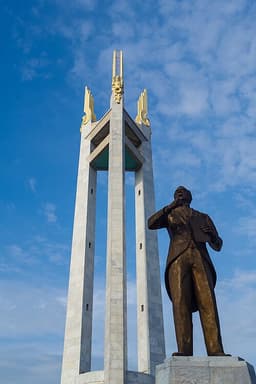
Manuel L. Quezon
Politician · Modern
53.8Total

Zhang Chunqiao
Politician · Modern
40.0Total
Basic Information
Born
1878
1917
Died
1944
2005
Era
Modern
Modern
Nationality
Philippines
China
Occupation
Politician
Politician
Civilization
Eastern
Eastern
Score Comparison
Military (10%)
10.7
15.4
Political (20%)
72.0
26.4
Influence (20%)
62.0
48.6
Legacy (20%)
52.0
40.0
Leadership (15%)
66.0
65.7
Strategy (15%)
35.3
25.4
TOTAL
53.8
40.0
Manuel L. Quezon — Complete Timeline
1934 AD
Signed the Tydings-McDuffie ActPolitical Action◆ Major
Quezon, as president of the Philippine Senate, negotiated and secured the passage of the Tydings-McDuffie Act in the U.S. Congress. This act established the Philippine Commonwealth and set a 10-year transition period to full independence.
LegislationIndependenceU.S.-Philippines Relations
Impact: nationalconstructive
1935 AD
Became First President of the Philippine CommonwealthPolitical Action
Manuel L. Quezon was elected as the first president of the Philippine Commonwealth, a transitional government established under U.S. sovereignty leading to full independence. He was inaugurated on November 15, 1935.
PresidencyCommonwealthIndependence
Impact: nationalconstructive
1937 AD
Established the National Language (Filipino)Cultural◆ Major
Quezon proclaimed Tagalog as the basis of the national language of the Philippines, later named Filipino. This decision aimed to unify the diverse linguistic groups of the archipelago and promote national identity.
Language PolicyNational IdentityCultural Unification
Impact: nationalconstructive
1942 AD
Went into Exile During Japanese OccupationPolitical Action◆ Major
After the Japanese invasion of the Philippines, Quezon fled to the United States, establishing a government-in-exile in Washington, D.C. He continued to lead the Commonwealth government and advocate for Philippine interests during World War II.
ExileWorld War IIGovernment-in-Exile
Impact: national
1944 AD
Died in ExileOther
Quezon died of tuberculosis in Saranac Lake, New York, while still in exile. His death occurred before the liberation of the Philippines, and he was succeeded by Vice President Sergio Osme
DeathExileWorld War II
Impact: nationaltragic
Zhang Chunqiao — Complete Timeline
1938 AD
Joined the Chinese Communist PartyPolitical Action
Zhang Chunqiao joined the CCP in 1938 during the Second Sino-Japanese War. He became a propaganda official in the Shaanxi-Gansu-Ningxia border region, building his political base.
CCPPropagandaEarly Career
Impact: nationalconstructive
1966 AD
Rose to Power During the Cultural RevolutionPolitical Action◆ Major
Zhang Chunqiao became a leading figure in the Cultural Revolution, serving as head of the Shanghai Revolutionary Committee. He orchestrated the seizure of power from local party officials and promoted radical Maoist policies.
Cultural RevolutionShanghaiRadicalism
Impact: nationaldestructive
1976 AD
Arrested as a Member of the Gang of FourPolitical Action
Zhang Chunqiao was arrested on October 6, 1976, along with other Gang of Four members, in a coup led by Hua Guofeng and the military. This ended the Cultural Revolution and led to his trial and imprisonment.
Gang of FourArrestEnd of Cultural Revolution
Impact: national
1981 AD
Sentenced to Death with a Two-Year ReprievePolitical Action◆ Major
Zhang Chunqiao was sentenced to death with a two-year reprieve in 1981 for his role in the Cultural Revolution. The sentence was later commuted to life imprisonment. He was released on medical parole in 1997 and died in 2005.
TrialSentencingGang of Four
Impact: national
This comparison has not been analyzed yet.
One-time AI generation (~1 minute). Scores and timeline are already available below.
Rankings
🥇
Manuel L. QuezonLeader
Mil: 10.7Pol: 72.0Inf: 62.0
53.8
🥈
Zhang Chunqiao
Mil: 15.4Pol: 26.4Inf: 48.6
40.0
+13.8 behind
How This Comparison Works
Algorithm
Each figure is scored on 6 dimensions (0—100 scale) based on structured historical data: Military (10%), Political (20%), Influence (20%), Legacy (20%), Leadership (15%), Strategy (15%). The weighted total produces the final ranking.
Data Sources
Scores are computed from structured sub-indicators in the database. Scale factors adjust for era (Ancient ×0.85, Modern ×1.0) and civilization size (Eastern ×1.05, Other ×0.80) to account for differences in population and military scale.
Maximum 3 Figures
Comparisons are limited to 2—3 figures to ensure readability and statistical meaningfulness.
Error Margins
±5 points per dimension — Sub-scores are derived from historical records with inherent uncertainty. Two figures within 5 points on a dimension should be considered roughly equivalent in that area.
Total Score Accuracy
±3 points overall — The weighted combination of 6 dimensions produces a total score with approximately ±3 points of uncertainty. Differences of less than 3 points are not statistically significant— the figures are effectively tied.
Known Limitations
- Historical records are incomplete and uneven across civilizations
- Figures from oral-tradition societies may be underrepresented
- Occupation labels can misclassify multi-role figures
- Scores measure capability and impact, not moral character
- Quantitative scoring is a comparison tool, not absolute truth
Capability Radar
Military (10%) — Battles & Warfare
Battles
16
13
Win Rate
20
15
Expansion
19
21
Political (20%) — Governance & Reform
Reform
70
20
Diplomacy
60
15
Economy
55
10
Influence (20%) — Cultural & Global Reach
Cultural
55
15
Global
55
15
Legacy (20%) — Historical Impact
Historical
60
30
Longevity
50
10
Leadership (15%) — Power & Stability
Tenure
65
60
Stability
50
5
Strategy (15%) — Tactics & Innovation
Strategy
22
25
Tactics
24
27
Reform
32
28
Similar Comparisons
Comments & Discussion
No comments yet. Be the first to share your thoughts!