Loading...
Alar Karis vs Manuel L. Quezon
Manuel L. Quezon leads by 8.6 pts · 2 figures compared
…

Alar Karis
Politician · Modern
45.2Total
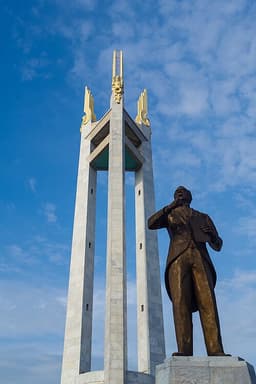
Manuel L. Quezon
Politician · Modern
53.8Total
Basic Information
Born
1958
1878
Died
—
1944
Era
Modern
Modern
Nationality
Estonia
Philippines
Occupation
Politician
Politician
Civilization
Western
Eastern
Score Comparison
Military (10%)
48.9
10.7
Political (20%)
33.6
72.0
Influence (20%)
47.9
62.0
Legacy (20%)
36.7
52.0
Leadership (15%)
65.7
66.0
Strategy (15%)
42.9
35.3
TOTAL
45.2
53.8
Alar Karis — Complete Timeline
2000 AD
Appointed Director of the Estonian National MuseumCultural
Karis was appointed Director of the Estonian National Museum, where he oversaw the development of the museum's new building and exhibitions. His leadership helped modernize the museum and promote Estonian cultural heritage.
MuseumCultureHeritage
Impact: nationalconstructive
2013 AD
Appointed Auditor General of EstoniaPolitical Action
Karis was appointed Auditor General, responsible for overseeing the use of public funds. He served in this role until 2018, ensuring transparency and accountability in government spending.
AuditTransparencyPublic Finance
Impact: nationalconstructive
2021 AD
Elected President of EstoniaPolitical Action◆ Major
Karis was elected as the sixth President of Estonia, succeeding Kersti Kaljulaid. His presidency focuses on social cohesion, digitalization, and environmental sustainability, building on Estonia's reputation as a digital leader.
PresidencyLeadershipDigital Estonia
Impact: nationalconstructive
Addressed the COVID-19 Pandemic ResponsePolitical Action
As president, Karis addressed the nation during the COVID-19 pandemic, emphasizing the importance of vaccination and public health measures. He supported the government's response while advocating for balanced policies.
COVID-19Public HealthPresidency
Impact: nationalconstructive
2022 AD
Promoted Environmental Sustainability InitiativesReform
Karis launched initiatives to promote environmental sustainability, including support for renewable energy and biodiversity conservation. He called for greater action on climate change and sustainable development in Estonia.
EnvironmentSustainabilityClimate Change
Impact: nationalprogressive
Manuel L. Quezon — Complete Timeline
1934 AD
Signed the Tydings-McDuffie ActPolitical Action◆ Major
Quezon, as president of the Philippine Senate, negotiated and secured the passage of the Tydings-McDuffie Act in the U.S. Congress. This act established the Philippine Commonwealth and set a 10-year transition period to full independence.
LegislationIndependenceU.S.-Philippines Relations
Impact: nationalconstructive
1935 AD
Became First President of the Philippine CommonwealthPolitical Action
Manuel L. Quezon was elected as the first president of the Philippine Commonwealth, a transitional government established under U.S. sovereignty leading to full independence. He was inaugurated on November 15, 1935.
PresidencyCommonwealthIndependence
Impact: nationalconstructive
1937 AD
Established the National Language (Filipino)Cultural◆ Major
Quezon proclaimed Tagalog as the basis of the national language of the Philippines, later named Filipino. This decision aimed to unify the diverse linguistic groups of the archipelago and promote national identity.
Language PolicyNational IdentityCultural Unification
Impact: nationalconstructive
1942 AD
Went into Exile During Japanese OccupationPolitical Action◆ Major
After the Japanese invasion of the Philippines, Quezon fled to the United States, establishing a government-in-exile in Washington, D.C. He continued to lead the Commonwealth government and advocate for Philippine interests during World War II.
ExileWorld War IIGovernment-in-Exile
Impact: national
1944 AD
Died in ExileOther
Quezon died of tuberculosis in Saranac Lake, New York, while still in exile. His death occurred before the liberation of the Philippines, and he was succeeded by Vice President Sergio Osme
DeathExileWorld War II
Impact: nationaltragic
Expert Analysis
Origins
Alar Karis was born on March 26, 1958, in Tartu, Estonia. His father was a biologist, and Karis himself pursued a career in biology, earning a PhD from the Estonian University of Life Sciences in 1999. He worked as a researcher and professor, specializing in molecular biology and genetics. His early career was academic, with no political background.
Manuel L. Quezon was born on August 19, 1878, in Baler, Tayabas (now Aurora), Philippines, to a Spanish mestizo family. He studied law at the University of Santo Tomas and became a lawyer in 1903. Quezon entered politics early, serving as a representative and later as a senator. His formative experiences included fighting in the Philippine-American War as a young officer.
Rise to Power
Karis's rise was gradual and technocratic. He became Director of the Estonian National Museum in 2000, overseeing its relocation and modernization. In 2013, he was appointed Auditor General of Estonia, a non-political role ensuring fiscal accountability. He served until 2018. In 2021, he was elected President of Estonia by the Riigikogu (parliament) with 72 votes out of 101, succeeding Kersti Kaljulaid. His presidency was a surprise to many, as he was not a career politician.
Quezon rose through political ranks. He was elected to the Philippine Assembly in 1907, then to the Senate in 1916, becoming Senate President. He negotiated the Tydings-McDuffie Act of 1934, which established the Philippine Commonwealth and set a timeline for independence. In 1935, he was elected as the first president of the Commonwealth, defeating Emilio Aguinaldo. His rise was marked by charisma and political maneuvering.
Leadership & Governance
Karis's leadership style is consensus-building and low-key. As president, he focuses on social cohesion, digitalization, and environmental sustainability. He has limited executive powers, serving mostly as a ceremonial head of state. His governance approach is technocratic: he launched initiatives for renewable energy and biodiversity conservation. He addressed the nation during the COVID-19 pandemic, emphasizing vaccination.
Quezon was a strong executive, wielding significant power as Commonwealth president. He established the National Language (Filipino) based on Tagalog, aiming to unify the archipelago. He implemented social reforms, including land redistribution and labor rights. However, his governance was also marked by authoritarian tendencies, such as suppressing political opponents and controlling the press. He scored 72.0 in political, reflecting his dominance.
Triumph & Tragedy
Karis's greatest success is maintaining stability and promoting digital governance in Estonia, a global leader in e-government. His presidency saw continued economic growth and EU integration. His failure is limited impact due to the ceremonial nature of his office; his political score is only 33.6. He has not faced major crises.
Quezon's triumphs include securing the Tydings-McDuffie Act, which paved the way for Philippine independence, and establishing a national language. His tragedy was his exile during World War II, dying in 1944 before seeing the Philippines liberated. He also faced criticism for his authoritarian streak and for failing to prepare the country for war. His military score is a low 10.7, reflecting his lack of combat leadership.
Character & Destiny
Karis is methodical, cautious, and academic. His background as a biologist and auditor makes him detail-oriented but not charismatic. His character shaped a presidency focused on data-driven policies rather than grand visions. Historical assessments view him as a competent but unremarkable leader.
Quezon was charismatic, ambitious, and pragmatic. He was known for his oratory and ability to negotiate with American officials. His character drove him to seek independence aggressively, but also led to centralization of power. Historians often describe him as a flawed founding father, whose strong leadership was necessary but came at a cost.
Legacy
Karis's legacy is still unfolding. He will likely be remembered as a transitional figure who upheld democratic norms in Estonia. His environmental initiatives may have long-term impact, but his overall influence score is 47.9, moderate.
Quezon's legacy is monumental. He is considered the father of the Philippine nation, with his image on the 20-peso bill and numerous streets named after him. The national language he established is spoken by millions. However, his legacy is also contested due to his authoritarian methods. His legacy score is 52.0, higher than Karis's 36.7.
Conclusion
Manuel L. Quezon had a greater impact than Alar Karis. Quezon's total score of 53.8 surpasses Karis's 45.2 by 8.6 points. Quezon shaped the destiny of a nation of over 100 million people, securing its path to independence and forging a national identity. Karis, while a competent leader, operates within a small Baltic state with limited global influence. Quezon's political and influence scores (72.0 and 62.0) dwarf Karis's (33.6 and 47.9). Despite Karis's higher leadership score (65.7 vs 66.0, nearly equal), Quezon's transformative role in founding a nation gives him a clear edge in historical significance.
Rankings
🥇
Manuel L. QuezonLeader
Mil: 10.7Pol: 72.0Inf: 62.0
53.8
🥈
Alar Karis
Mil: 48.9Pol: 33.6Inf: 47.9
45.2
+8.6 behind
How This Comparison Works
Algorithm
Each figure is scored on 6 dimensions (0—100 scale) based on structured historical data: Military (10%), Political (20%), Influence (20%), Legacy (20%), Leadership (15%), Strategy (15%). The weighted total produces the final ranking.
Data Sources
Scores are computed from structured sub-indicators in the database. Scale factors adjust for era (Ancient ×0.85, Modern ×1.0) and civilization size (Eastern ×1.05, Other ×0.80) to account for differences in population and military scale.
Maximum 3 Figures
Comparisons are limited to 2—3 figures to ensure readability and statistical meaningfulness.
Error Margins
±5 points per dimension — Sub-scores are derived from historical records with inherent uncertainty. Two figures within 5 points on a dimension should be considered roughly equivalent in that area.
Total Score Accuracy
±3 points overall — The weighted combination of 6 dimensions produces a total score with approximately ±3 points of uncertainty. Differences of less than 3 points are not statistically significant— the figures are effectively tied.
Known Limitations
- Historical records are incomplete and uneven across civilizations
- Figures from oral-tradition societies may be underrepresented
- Occupation labels can misclassify multi-role figures
- Scores measure capability and impact, not moral character
- Quantitative scoring is a comparison tool, not absolute truth
Capability Radar
Military (10%) — Battles & Warfare
Battles
32
16
Win Rate
33
20
Expansion
33
19
Political (20%) — Governance & Reform
Reform
20
70
Diplomacy
30
60
Economy
20
55
Influence (20%) — Cultural & Global Reach
Cultural
15
55
Global
10
55
Legacy (20%) — Historical Impact
Historical
10
60
Longevity
10
50
Leadership (15%) — Power & Stability
Tenure
30
65
Stability
35
50
Strategy (15%) — Tactics & Innovation
Strategy
37
22
Tactics
42
24
Reform
46
32
Similar Comparisons
Comments & Discussion
No comments yet. Be the first to share your thoughts!