Loading...
Manuel L. Quezon vs Napoleon Bonaparte
Napoleon Bonaparte leads by 17.1 pts · 2 figures compared
…
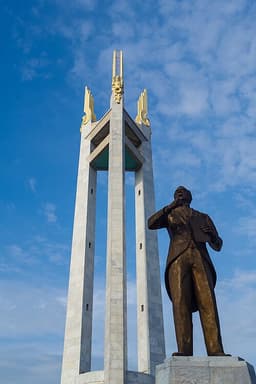
Manuel L. Quezon
Politician · Modern
53.8Total

Napoleon Bonaparte
General · Modern
70.9Total
Basic Information
Born
1878
1769
Died
1944
1821
Era
Modern
Modern
Nationality
Philippines
France
Occupation
Politician
General
Civilization
Eastern
Western
Score Comparison
Military (10%)
10.7
94.0
Political (20%)
72.0
72.0
Influence (20%)
62.0
40.0
Legacy (20%)
52.0
80.0
Leadership (15%)
66.0
78.0
Strategy (15%)
35.3
90.0
TOTAL
53.8
70.9
Manuel L. Quezon — Complete Timeline
1934 AD
Signed the Tydings-McDuffie ActPolitical Action◆ Major
Quezon, as president of the Philippine Senate, negotiated and secured the passage of the Tydings-McDuffie Act in the U.S. Congress. This act established the Philippine Commonwealth and set a 10-year transition period to full independence.
LegislationIndependenceU.S.-Philippines Relations
Impact: nationalconstructive
1935 AD
Became First President of the Philippine CommonwealthPolitical Action
Manuel L. Quezon was elected as the first president of the Philippine Commonwealth, a transitional government established under U.S. sovereignty leading to full independence. He was inaugurated on November 15, 1935.
PresidencyCommonwealthIndependence
Impact: nationalconstructive
1937 AD
Established the National Language (Filipino)Cultural◆ Major
Quezon proclaimed Tagalog as the basis of the national language of the Philippines, later named Filipino. This decision aimed to unify the diverse linguistic groups of the archipelago and promote national identity.
Language PolicyNational IdentityCultural Unification
Impact: nationalconstructive
1942 AD
Went into Exile During Japanese OccupationPolitical Action◆ Major
After the Japanese invasion of the Philippines, Quezon fled to the United States, establishing a government-in-exile in Washington, D.C. He continued to lead the Commonwealth government and advocate for Philippine interests during World War II.
ExileWorld War IIGovernment-in-Exile
Impact: national
1944 AD
Died in ExileOther
Quezon died of tuberculosis in Saranac Lake, New York, while still in exile. His death occurred before the liberation of the Philippines, and he was succeeded by Vice President Sergio Osme
DeathExileWorld War II
Impact: nationaltragic
Napoleon Bonaparte — Complete Timeline
1799 AD
Coup of 18 BrumaireOther◆ Major
Napoleon Bonaparte, with support from his brother Lucien and key political figures, overthrew the Directory in a bloodless coup. He established the Consulate with himself as First Consul, effectively becoming the ruler of France. This event ended the French Revolution's most unstable period.
French RevolutionCoupRise to Power
Impact: regional
1804 AD
Promulgation of the Napoleonic CodeOther◆ Major
Napoleon enacted the Civil Code of the French, known as the Napoleonic Code, a comprehensive set of laws that replaced the fragmented feudal legal systems. The code established legal equality, protected property rights, and secularized law. It became the basis for legal systems in many European and world countries.
Legal ReformNapoleonic CodeCivil Law
Impact: globalconstructive
1805 AD
Battle of AusterlitzWar◆ Major
Napoleon's Grande Arm
Napoleonic WarsBattleDecisive Victory
Impact: global
1812 AD
Invasion of RussiaWar◆ Major
Napoleon led the Grande Arm
Napoleonic WarsInvasionDisaster
Impact: globaldestructive
1815 AD
Battle of WaterlooWar◆ Major
Napoleon's French army was defeated by the combined forces of the Duke of Wellington's Anglo-Allied army and Gebhard Leberecht von Bl
Napoleonic WarsBattleFinal Defeat
Impact: globaldestructive
Expert Analysis
Origins
Manuel L. Quezon was born on August 19, 1878, in Baler, Tayabas (now Quezon province), Philippines. His father, Lucio Quezon, was a Spanish mestizo and primary school teacher, while his mother, Maria Dolores Molina, was a Chinese-Filipino mestiza. Quezon studied law at the University of Santo Tomas, graduating in 1903, and passed the bar the same year. He worked as a clerk, surveyor, and later as a provincial fiscal. His early career in law and politics was shaped by the American colonial administration, which had taken control of the Philippines after the Spanish-American War.
Napoleon Bonaparte was born on August 15, 1769, in Ajaccio, Corsica, to Carlo Buonaparte, a lawyer and minor noble, and Letizia Ramolino. He attended military school in Brienne-le-Château and later the École Militaire in Paris, graduating in 1785 as a second lieutenant in the artillery. His early life was marked by Corsican nationalism and the French Revolution, which provided opportunities for rapid advancement.
Rise to Power
Quezon rose to prominence through the American colonial political system. He served as governor of Tayabas (1906-1907), then as a member of the Philippine Assembly (1907-1909), and later as Resident Commissioner to the U.S. House of Representatives (1909-1914). In 1916, he became President of the Philippine Senate, a position he held until 1935. His key turning point was negotiating the Tydings-McDuffie Act (1934), which established the Philippine Commonwealth and a ten-year transition to independence. He was elected first President of the Commonwealth in 1935.
Napoleon rose through the ranks during the French Revolution. He distinguished himself at the Siege of Toulon (1793), earning promotion to brigadier general. After a series of victories in Italy (1796-1797), he gained fame. He then led an expedition to Egypt (1798-1799), which, though militarily inconclusive, boosted his reputation. In November 1799, he staged the Coup of 18 Brumaire, overthrowing the Directory and establishing the Consulate, with himself as First Consul.
Leadership & Governance
Quezon's leadership style was charismatic and pragmatic. He centralized power through the Philippine Commonwealth, creating a strong executive branch. He prioritized national unity, establishing Filipino as the national language in 1937. His governance focused on social justice, including land reform and support for labor. However, he faced criticism for suppressing political dissent and for his close ties with the American colonial administration. He also implemented the National Defense Act (1935), building a Philippine army under General Douglas MacArthur.
Napoleon's leadership was authoritarian and transformative. As First Consul and later Emperor (1804-1815), he centralized the French state, reformed the legal system with the Napoleonic Code (1804), and established the Bank of France (1800). He promoted meritocracy in the military and civil service. However, his governance was increasingly autocratic, with censorship and secret police. His military campaigns, while initially successful, drained France's resources and led to his eventual downfall.
Triumph & Tragedy
Quezon's greatest triumph was securing the Tydings-McDuffie Act, which set the Philippines on the path to independence. He also successfully established the Commonwealth government and promoted national identity through language. His tragedy was his exile during World War II; he died in 1944 in Saranac Lake, New York, before seeing the Philippines liberated. His collaboration with the U.S. during the war also led to accusations of abandoning his people.
Napoleon's greatest triumph was his military dominance over Europe, culminating in the Battle of Austerlitz (1805), where he defeated a larger Russian-Austrian army. His Napoleonic Code influenced legal systems worldwide. His tragedy was the disastrous Invasion of Russia (1812), where his Grande Armée was decimated by winter and Russian tactics. He was defeated at Waterloo (1815) and exiled to Saint Helena, where he died in 1821.
Character & Destiny
Quezon was known for his fiery temper, charisma, and political acumen. He was a master of negotiation and compromise, often playing the U.S. and Filipino elites against each other. His decision to go into exile was pragmatic but damaged his reputation. Historians assess him as a skilled politician who laid the foundations for Philippine independence but also concentrated power and failed to address deep-seated social inequalities.
Napoleon was ambitious, intelligent, and driven by a desire for glory. His strategic brilliance was matched by his ego and inability to compromise. His character led him to overreach, as in Russia and Spain. Historians view him as a military genius who reshaped Europe but also as a tyrant who caused immense suffering. His legacy is complex, balancing reforms with authoritarianism.
Legacy
Quezon's legacy is primarily as the father of the Philippine Commonwealth and a key figure in the independence movement. His advocacy for a national language and social justice policies influenced subsequent Philippine governments. However, his authoritarian tendencies and exile have led to mixed assessments. His score of 67.1 in Legacy reflects his enduring but contested impact.
Napoleon's legacy is vast. He reshaped European borders, spread nationalist ideas, and codified laws. His military tactics are studied worldwide. However, his wars caused millions of deaths. His score of 78.0 in Legacy underscores his profound and lasting influence on global history.
Conclusion
Napoleon Bonaparte had a greater impact on world history than Manuel L. Quezon. Napoleon's military and political reforms transformed Europe and influenced legal systems globally, with a total score of 82.4 compared to Quezon's 65.0. While Quezon's role in Philippine independence was significant, Napoleon's reach was continental and his influence enduring. Napoleon's military score of 94.0 dwarfs Quezon's 22.8, and his strategy score of 93.0 reflects his unmatched battlefield prowess. In terms of influence, Napoleon's 82.0 exceeds Quezon's 70.6. However, Quezon's leadership score (80.3) is comparable to Napoleon's (80.0), showing his effectiveness in a different context. Ultimately, Napoleon's actions shaped the course of European and world history, whereas Quezon's impact was primarily national.
Rankings
🥇
Napoleon BonaparteLeader
Mil: 94.0Pol: 72.0Inf: 40.0
70.9
🥈
Manuel L. Quezon
Mil: 10.7Pol: 72.0Inf: 62.0
53.8
+17.1 behind
How This Comparison Works
Algorithm
Each figure is scored on 6 dimensions (0—100 scale) based on structured historical data: Military (10%), Political (20%), Influence (20%), Legacy (20%), Leadership (15%), Strategy (15%). The weighted total produces the final ranking.
Data Sources
Scores are computed from structured sub-indicators in the database. Scale factors adjust for era (Ancient ×0.85, Modern ×1.0) and civilization size (Eastern ×1.05, Other ×0.80) to account for differences in population and military scale.
Maximum 3 Figures
Comparisons are limited to 2—3 figures to ensure readability and statistical meaningfulness.
Error Margins
±5 points per dimension — Sub-scores are derived from historical records with inherent uncertainty. Two figures within 5 points on a dimension should be considered roughly equivalent in that area.
Total Score Accuracy
±3 points overall — The weighted combination of 6 dimensions produces a total score with approximately ±3 points of uncertainty. Differences of less than 3 points are not statistically significant— the figures are effectively tied.
Known Limitations
- Historical records are incomplete and uneven across civilizations
- Figures from oral-tradition societies may be underrepresented
- Occupation labels can misclassify multi-role figures
- Scores measure capability and impact, not moral character
- Quantitative scoring is a comparison tool, not absolute truth
Capability Radar
Military (10%) — Battles & Warfare
Battles
16
95
Win Rate
20
90
Expansion
19
95
Political (20%) — Governance & Reform
Reform
70
95
Diplomacy
60
80
Economy
55
85
Influence (20%) — Cultural & Global Reach
Cultural
55
85
Global
55
90
Legacy (20%) — Historical Impact
Historical
60
95
Longevity
50
90
Leadership (15%) — Power & Stability
Tenure
65
85
Stability
50
70
Strategy (15%) — Tactics & Innovation
Strategy
22
95
Tactics
24
98
Reform
32
92
Similar Comparisons
Comments & Discussion
No comments yet. Be the first to share your thoughts!