Loading...
Mandhata vs Tanshihuai
Tanshihuai leads by 0.5 pts · 2 figures compared
…

Mandhata
Emperor · Ancient
58.7Total
Tanshihuai
Emperor · Ancient
59.2Total
Basic Information
Born
-1700
141
Died
-1650
181
Era
Ancient
Ancient
Nationality
Vedic India
Xianbei
Occupation
Emperor
Emperor
Civilization
Indian
Eastern
Score Comparison
Military (10%)
67.3
82.0
Political (20%)
45.0
68.0
Influence (20%)
55.0
52.5
Legacy (20%)
58.0
44.2
Leadership (15%)
80.0
74.0
Strategy (15%)
50.0
55.0
TOTAL
58.7
59.2
Mandhata — Complete Timeline
1700 BC
Conquest of Three WorldsWar
According to legend, Mandhata conquered the three worlds (earth, atmosphere, heaven) through military campaigns. This feat is recounted in the Mahabharata and Puranas as an example of imperial ambition.
Mythical ConquestThree WorldsEpic Narrative
Impact: regional
Universal Monarchy ClaimPolitical Action◆ Major
Mandhata is described in Puranic literature as a chakravartin (universal monarch) who ruled over all seven continents. This legendary status made him a model for later Indian kingship ideals.
Universal RuleKingship IdealPuranic Tradition
Impact: regionalconstructive
Tanshihuai — Complete Timeline
156 AD
Raid on the Han frontier (156 AD)War
Tanshihuai led a large-scale raid into Han territory, attacking commanderies in the northern provinces. The Han forces were unable to stop him, and the raid caused significant destruction and loss of life, demonstrating Xianbei military power.
Han-Xianbei WarRaid
Impact: regionaldestructive
Unification of the Xianbei tribesPolitical Action◆ Major
Tanshihuai united the disparate Xianbei tribes of the Mongolian steppe into a powerful confederation. He established a centralized leadership and expanded Xianbei territory, creating a major rival to the Han dynasty in the north.
UnificationXianbei Confederation
Impact: regionalconstructive
158 AD
Defeat of the Han army at the Battle of the Yinshan MountainsWar◆ Major
Tanshihuai ambushed and defeated a Han punitive expedition in the Yinshan Mountains. The Han commander was killed, and the Xianbei captured large amounts of supplies and weapons, solidifying Tanshihuai's reputation as a formidable military leader.
BattleHan-Xianbei War
Impact: regionaldestructive
160 AD
Establishment of a Xianbei legal codeReform
Tanshihuai implemented a unified legal code for the Xianbei confederation, replacing tribal customs with standardized laws. This reform strengthened central authority and facilitated the administration of the growing empire.
Legal ReformXianbei Empire
Impact: regionalconstructive
Expert Analysis
Origins
Mandhata is a legendary figure from ancient Indian texts, a king of the Ikshvaku dynasty. According to the Puranas, he was born to King Yuvanashva, who miraculously drank a potion meant for his wives and gave birth to Mandhata from his side. Mandhata's name means 'vigorous' or 'powerful'. He is described as a righteous ruler who adhered to dharma. His upbringing was in the royal court, learning statecraft and warfare.
Tanshihuai was a historical leader of the Xianbei, a nomadic confederation on the Mongolian steppe. Born around 130 AD, he was the son of a Xianbei chieftain. Little is known of his early life, but he rose to prominence by unifying tribes through a combination of diplomacy and military force. He established a centralized rule that contrasted with the fragmented tribal structure of his predecessors.
Rise to Power
Mandhata's rise is shrouded in myth. He is said to have performed the Rajasuya sacrifice, a ritual that proclaimed him as a chakravartin (universal monarch). His conquests extended across the three worlds: earth, atmosphere, and heaven. This is described in the Mahabharata and other texts. His power was based on divine favor and military prowess, but there is no historical record of his reign.
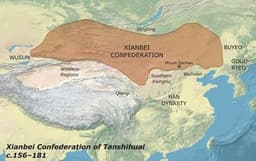
Tanshihuai's rise is better documented. He united the Xianbei tribes around 150 AD, creating a confederation that stretched from the Liao River to the Altai Mountains. He defeated the Han Chinese army at the Battle of the Yinshan Mountains in 158 AD, killing the Han commander and capturing supplies. This victory solidified his control over the steppe and allowed him to raid Han territory with impunity. By 160 AD, he had established a legal code that replaced tribal customs, centralizing authority.
Leadership & Governance
Mandhata's leadership is idealized. He is portrayed as a just king who followed the principles of dharma, ensuring prosperity and order. His governance was based on Vedic rituals and the caste system. He is said to have performed many sacrifices, which reinforced his divine mandate. However, as a legendary figure, his actual administrative methods are unknown.
Tanshihuai was a pragmatic leader. He implemented a unified legal code that standardized punishments and property rights, reducing internal conflicts. He organized the Xianbei into a military hierarchy, with appointed commanders instead of hereditary chiefs. This allowed for efficient mobilization. He also established a system of tribute from conquered tribes, which funded his campaigns. His leadership scored 74.0, reflecting his ability to command loyalty and organize a vast territory.
Triumph & Tragedy
Mandhata's greatest triumph was his universal conquest, establishing him as a chakravartin. His legacy as a model king influenced later Indian rulers. However, his tragedy is that his empire was ephemeral; after his death, his sons fought for succession, and the kingdom declined. There is no historical evidence of his reign, making him more myth than man.
Tanshihuai's triumph was the unification of the Xianbei and the defeat of Han armies. He expanded Xianbei territory and created a state that would later dominate northern China. His tragedy was that his confederation fragmented after his death around 180 AD due to lack of a strong successor. The Xianbei eventually split into rival groups, and their unity was lost. His legacy scored 44.2, indicating his impact was limited by his failure to establish a lasting dynasty.
Character & Destiny
Mandhata is depicted as ambitious and devout, driven by a desire for universal dominion. His destiny was tied to divine will, and his story serves as a moral lesson. Historians view him as a symbol of ancient Indian kingship rather than a real ruler.
Tanshihuai was a visionary strategist, skilled in diplomacy and warfare. He was ruthless in eliminating rivals but also pragmatic in adopting Chinese administrative practices. His character shaped his destiny: his success in uniting the Xianbei was due to his personal authority, but his inability to institutionalize succession led to the confederation's collapse. He scored 82.0 in military, reflecting his tactical brilliance.
Legacy
Mandhata's legacy is cultural. He is remembered in Hindu scriptures as an ideal king, and his story influenced the concept of chakravartin. He scored 55.0 in influence and 58.0 in legacy. His impact is more literary than historical.
Tanshihuai's legacy is political. He laid the foundation for later Xianbei states, such as the Northern Wei dynasty. His legal code and administrative reforms influenced subsequent steppe empires. However, his direct legacy was limited because his confederation dissolved. He scored 52.5 in influence and 44.2 in legacy.
Conclusion
Tanshihuai had a greater historical impact than Mandhata. While Mandhata is a mythical figure with no verifiable achievements, Tanshihuai's unification of the Xianbei and his military victories over Han China are historically documented. His scores in military (82.0 vs 67.3) and political (68.0 vs 45.0) reflect his real-world effectiveness. Although his legacy score is lower (44.2 vs 58.0), this is due to the brevity of his confederation. Tanshihuai's actions directly shaped the course of Chinese and steppe history, whereas Mandhata's influence is confined to mythology. Therefore, Tanshihuai is the more impactful figure.
Rankings
🥇
TanshihuaiLeader
Mil: 82.0Pol: 68.0Inf: 52.5
59.2
🥈
Mandhata
Mil: 67.3Pol: 45.0Inf: 55.0
58.7
+0.5 behind
How This Comparison Works
Algorithm
Each figure is scored on 6 dimensions (0—100 scale) based on structured historical data: Military (10%), Political (20%), Influence (20%), Legacy (20%), Leadership (15%), Strategy (15%). The weighted total produces the final ranking.
Data Sources
Scores are computed from structured sub-indicators in the database. Scale factors adjust for era (Ancient ×0.85, Modern ×1.0) and civilization size (Eastern ×1.05, Other ×0.80) to account for differences in population and military scale.
Maximum 3 Figures
Comparisons are limited to 2—3 figures to ensure readability and statistical meaningfulness.
Error Margins
±5 points per dimension — Sub-scores are derived from historical records with inherent uncertainty. Two figures within 5 points on a dimension should be considered roughly equivalent in that area.
Total Score Accuracy
±3 points overall — The weighted combination of 6 dimensions produces a total score with approximately ±3 points of uncertainty. Differences of less than 3 points are not statistically significant— the figures are effectively tied.
Known Limitations
- Historical records are incomplete and uneven across civilizations
- Figures from oral-tradition societies may be underrepresented
- Occupation labels can misclassify multi-role figures
- Scores measure capability and impact, not moral character
- Quantitative scoring is a comparison tool, not absolute truth
Capability Radar
Military (10%) — Battles & Warfare
Battles
60
65
Win Rate
70
70
Expansion
75
80
Political (20%) — Governance & Reform
Reform
60
50
Diplomacy
65
55
Economy
70
45
Influence (20%) — Cultural & Global Reach
Cultural
60
40
Global
55
35
Legacy (20%) — Historical Impact
Historical
65
55
Longevity
70
30
Leadership (15%) — Power & Stability
Tenure
80
60
Stability
75
50
Strategy (15%) — Tactics & Innovation
Strategy
65
75
Tactics
55
60
Reform
40
55
Similar Comparisons
Comments & Discussion
No comments yet. Be the first to share your thoughts!