Loading...
This comparison has not been analyzed yet.
One-time AI generation (~1 minute). Scores and timeline are already available below.
Mai Dunama Dabbalemi vs Nikephoros II Phokas
Nikephoros II Phokas leads by 5.4 pts · 2 figures compared
…

Mai Dunama Dabbalemi
Emperor · Medieval
59.8Total
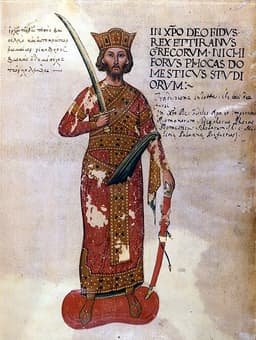
Nikephoros II Phokas
Emperor · Medieval
65.2Total
Basic Information
Born
1203
912
Died
1248
969
Era
Medieval
Medieval
Nationality
Kanem Empire
Byzantine Empire
Occupation
Emperor
Emperor
Civilization
Other
Western
Score Comparison
Military (10%)
67.5
85.0
Political (20%)
68.0
68.0
Influence (20%)
57.2
60.0
Legacy (20%)
49.2
56.0
Leadership (15%)
72.0
65.7
Strategy (15%)
55.0
76.0
TOTAL
59.8
65.2
Mai Dunama Dabbalemi — Complete Timeline
1230 AD
Destruction of the MuneCultural
Mai Dunama Dabbalemi destroyed the Mune, a sacred symbol of the Kanem Empire's traditional religion. This act was intended to assert the dominance of Islam over indigenous beliefs, but it caused deep divisions within the empire and alienated many subjects.
Religious ReformIconoclasmIslam
Impact: nationaldestructive
1240 AD
Expansion of the Kanem EmpireWar◆ Major
Mai Dunama Dabbalemi led military campaigns that expanded the Kanem Empire to its greatest territorial extent. He conquered territories in the Lake Chad region and beyond, including parts of Fezzan and the Hausa states, establishing Kanem as a major power.
WarExpansionKanem
Impact: regional
1248 AD
Death of Mai Dunama DabbalemiOther◆ Major
Mai Dunama Dabbalemi died, ending his reign of approximately 45 years. His death led to a period of instability and civil war in the Kanem Empire, as the divisions caused by his destruction of the Mune and his expansionist policies came to a head.
DeathInstability
Impact: nationaltragic
Nikephoros II Phokas — Complete Timeline
961 AD
Recapture of Crete (961)War◆ Major
Nikephoros II led a campaign that recaptured the island of Crete from the Arabs after a long siege of Chandax. This victory eliminated a major pirate base and restored Byzantine control over the eastern Mediterranean.
Byzantine-Arab WarsMilitary CampaignNaval
Impact: regionalconstructive
963 AD
Accession as Emperor (963)Political Action◆ Major
Nikephoros II Phokas was proclaimed emperor after the death of Romanos II. He was a successful general who had recaptured Crete. His accession was supported by the military aristocracy.
Accession
Impact: regional
964 AD
Campaigns in Syria and Cilicia (964-969)War◆ Major
Nikephoros II launched a series of campaigns against the Hamdanid Emirate, recapturing Tarsus, Adana, and other cities in Cilicia. He also invaded Syria, capturing Aleppo in 962. These victories expanded Byzantine territory.
Byzantine-Arab WarsMilitary Campaign
Impact: regional
969 AD
Assassination by John Tzimiskes (969)Political Action◆ Major
Nikephoros II was assassinated in his palace by a conspiracy led by his nephew John Tzimiskes and his wife Theophano. He was stabbed to death in his bedchamber. John Tzimiskes then became emperor.
AssassinationCoup
Impact: regionaltragic
This comparison has not been analyzed yet.
One-time AI generation (~1 minute). Scores and timeline are already available below.
Rankings
🥇
Nikephoros II PhokasLeader
Mil: 85.0Pol: 68.0Inf: 60.0
65.2
🥈
Mai Dunama Dabbalemi
Mil: 67.5Pol: 68.0Inf: 57.2
59.8
+5.4 behind
How This Comparison Works
Algorithm
Each figure is scored on 6 dimensions (0—100 scale) based on structured historical data: Military (10%), Political (20%), Influence (20%), Legacy (20%), Leadership (15%), Strategy (15%). The weighted total produces the final ranking.
Data Sources
Scores are computed from structured sub-indicators in the database. Scale factors adjust for era (Ancient ×0.85, Modern ×1.0) and civilization size (Eastern ×1.05, Other ×0.80) to account for differences in population and military scale.
Maximum 3 Figures
Comparisons are limited to 2—3 figures to ensure readability and statistical meaningfulness.
Error Margins
±5 points per dimension — Sub-scores are derived from historical records with inherent uncertainty. Two figures within 5 points on a dimension should be considered roughly equivalent in that area.
Total Score Accuracy
±3 points overall — The weighted combination of 6 dimensions produces a total score with approximately ±3 points of uncertainty. Differences of less than 3 points are not statistically significant— the figures are effectively tied.
Known Limitations
- Historical records are incomplete and uneven across civilizations
- Figures from oral-tradition societies may be underrepresented
- Occupation labels can misclassify multi-role figures
- Scores measure capability and impact, not moral character
- Quantitative scoring is a comparison tool, not absolute truth
Capability Radar
Military (10%) — Battles & Warfare
Battles
55
85
Win Rate
60
90
Expansion
75
80
Political (20%) — Governance & Reform
Reform
65
60
Diplomacy
55
55
Economy
60
50
Influence (20%) — Cultural & Global Reach
Cultural
50
55
Global
35
45
Legacy (20%) — Historical Impact
Historical
55
70
Longevity
40
50
Leadership (15%) — Power & Stability
Tenure
70
45
Stability
60
40
Strategy (15%) — Tactics & Innovation
Strategy
65
88
Tactics
50
92
Reform
70
85
Similar Comparisons
Comments & Discussion
No comments yet. Be the first to share your thoughts!