Loading...
This comparison has not been analyzed yet.
One-time AI generation (~1 minute). Scores and timeline are already available below.
Mai Dunama Dabbalemi vs Muhan Qaghan
Muhan Qaghan leads by 5.1 pts · 2 figures compared
…

Mai Dunama Dabbalemi
Emperor · Medieval
59.8Total
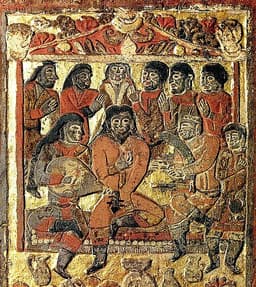
Muhan Qaghan
Emperor · Medieval
64.9Total
Basic Information
Born
1203
540
Died
1248
572
Era
Medieval
Medieval
Nationality
Kanem Empire
Gokturk Khaganate
Occupation
Emperor
Emperor
Civilization
Other
Eastern
Score Comparison
Military (10%)
67.5
74.0
Political (20%)
68.0
72.0
Influence (20%)
57.2
58.3
Legacy (20%)
49.2
54.0
Leadership (15%)
72.0
79.8
Strategy (15%)
55.0
66.3
TOTAL
59.8
64.9
Mai Dunama Dabbalemi — Complete Timeline
1230 AD
Destruction of the MuneCultural
Mai Dunama Dabbalemi destroyed the Mune, a sacred symbol of the Kanem Empire's traditional religion. This act was intended to assert the dominance of Islam over indigenous beliefs, but it caused deep divisions within the empire and alienated many subjects.
Religious ReformIconoclasmIslam
Impact: nationaldestructive
1240 AD
Expansion of the Kanem EmpireWar◆ Major
Mai Dunama Dabbalemi led military campaigns that expanded the Kanem Empire to its greatest territorial extent. He conquered territories in the Lake Chad region and beyond, including parts of Fezzan and the Hausa states, establishing Kanem as a major power.
WarExpansionKanem
Impact: regional
1248 AD
Death of Mai Dunama DabbalemiOther◆ Major
Mai Dunama Dabbalemi died, ending his reign of approximately 45 years. His death led to a period of instability and civil war in the Kanem Empire, as the divisions caused by his destruction of the Mune and his expansionist policies came to a head.
DeathInstability
Impact: nationaltragic
Muhan Qaghan — Complete Timeline
557 AD
Conquest of the Hephthalite EmpireWar◆ Major
Muhan Qaghan allied with the Sassanid Persian Empire to defeat the Hephthalite Empire in Central Asia. The Hephthalites were crushed, and their territory was divided between the Turks and Persians, with the Turks gaining the eastern regions.
ConquestHephthalites
Impact: regionaldestructive
560 AD
Expansion of the Turkic Khaganate to its greatest extentWar◆ Major
Muhan Qaghan led campaigns that expanded the Turkic Khaganate to its maximum territorial extent, stretching from the Caspian Sea to the borders of China. He conquered the Hephthalites in Central Asia and subjugated many tribes, making the khaganate a dominant power.
ExpansionTurkic Empire
Impact: regionalconstructive
565 AD
Suppression of internal revoltsWar
Muhan Qaghan faced revolts from subject tribes, including the Tiele and other steppe peoples. He brutally suppressed these uprisings, executing many leaders and forcibly relocating populations to maintain control over the vast khaganate.
Revolt SuppressionInternal Conflict
Impact: regionaldestructive
568 AD
Diplomatic relations with the Byzantine EmpirePolitical Action◆ Major
Muhan Qaghan sent an embassy to the Byzantine Empire, establishing diplomatic and trade relations. This alliance was aimed against the Sassanid Persians, and it opened the Silk Road to Turkic merchants, increasing the khaganate's wealth and influence.
DiplomacyByzantine-Turkic Alliance
Impact: globalconstructive
This comparison has not been analyzed yet.
One-time AI generation (~1 minute). Scores and timeline are already available below.
Rankings
🥇
Muhan QaghanLeader
Mil: 74.0Pol: 72.0Inf: 58.3
64.9
🥈
Mai Dunama Dabbalemi
Mil: 67.5Pol: 68.0Inf: 57.2
59.8
+5.1 behind
How This Comparison Works
Algorithm
Each figure is scored on 6 dimensions (0—100 scale) based on structured historical data: Military (10%), Political (20%), Influence (20%), Legacy (20%), Leadership (15%), Strategy (15%). The weighted total produces the final ranking.
Data Sources
Scores are computed from structured sub-indicators in the database. Scale factors adjust for era (Ancient ×0.85, Modern ×1.0) and civilization size (Eastern ×1.05, Other ×0.80) to account for differences in population and military scale.
Maximum 3 Figures
Comparisons are limited to 2—3 figures to ensure readability and statistical meaningfulness.
Error Margins
±5 points per dimension — Sub-scores are derived from historical records with inherent uncertainty. Two figures within 5 points on a dimension should be considered roughly equivalent in that area.
Total Score Accuracy
±3 points overall — The weighted combination of 6 dimensions produces a total score with approximately ±3 points of uncertainty. Differences of less than 3 points are not statistically significant— the figures are effectively tied.
Known Limitations
- Historical records are incomplete and uneven across civilizations
- Figures from oral-tradition societies may be underrepresented
- Occupation labels can misclassify multi-role figures
- Scores measure capability and impact, not moral character
- Quantitative scoring is a comparison tool, not absolute truth
Capability Radar
Military (10%) — Battles & Warfare
Battles
55
75
Win Rate
60
80
Expansion
75
90
Political (20%) — Governance & Reform
Reform
65
65
Diplomacy
55
75
Economy
60
60
Influence (20%) — Cultural & Global Reach
Cultural
50
55
Global
35
55
Legacy (20%) — Historical Impact
Historical
55
65
Longevity
40
50
Leadership (15%) — Power & Stability
Tenure
70
80
Stability
60
70
Strategy (15%) — Tactics & Innovation
Strategy
65
85
Tactics
50
70
Reform
70
60
Similar Comparisons
Comments & Discussion
No comments yet. Be the first to share your thoughts!