Loading...
This comparison has not been analyzed yet.
One-time AI generation (~1 minute). Scores and timeline are already available below.
Mahatma Gandhi vs Rached Ghannouchi
Mahatma Gandhi leads by 12.3 pts · 2 figures compared
…
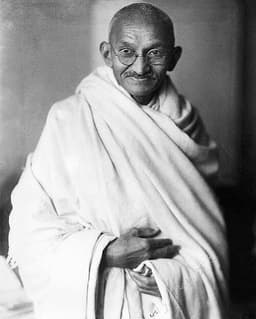
Mahatma Gandhi
Politician · Modern
68.7Total

Rached Ghannouchi
Politician · Modern
56.4Total
Basic Information
Born
1869
1941
Died
1948
—
Era
Modern
Modern
Nationality
India
Tunisia
Occupation
Politician
Politician
Civilization
Indian
Middle Eastern
Score Comparison
Military (10%)
42.3
27.3
Political (20%)
65.0
72.0
Influence (20%)
80.0
62.0
Legacy (20%)
75.0
49.2
Leadership (15%)
70.0
72.0
Strategy (15%)
55.0
43.0
TOTAL
68.7
56.4
Mahatma Gandhi — Complete Timeline
1917 AD
Champaran SatyagrahaPolitical Action
Gandhi led his first nonviolent protest in India, supporting indigo farmers in Champaran, Bihar, against exploitative British planters. He organized a campaign of civil disobedience and negotiations, resulting in the abolition of the oppressive tinkathia system.
Civil disobedienceFarmers' rightsBritish Raj
Impact: nationalprogressive
1919 AD
Jallianwala Bagh massacre aftermathPolitical Action◆ Major
After British troops killed hundreds of unarmed civilians in Amritsar, Gandhi organized a nationwide hartal (strike) and nonviolent protests. He returned his medals and launched the Rowlatt Satyagraha, marking a shift from cooperation to non-cooperation with British rule.
ProtestBritish RajMassacre
Impact: nationaltragic
1930 AD
Salt MarchPolitical Action
Gandhi led a 240-mile march from Sabarmati to Dandi, Gujarat, to defy the British salt monopoly. Thousands joined him, making salt from seawater. This act of civil disobedience sparked mass protests across India and drew global attention to the independence movement.
Civil disobedienceSalt taxIndependence movement
Impact: globalprogressive
1942 AD
Quit India Movement launchPolitical Action◆ Major
Gandhi launched the Quit India Movement, calling for an end to British rule with the slogan 'Do or Die'. The British arrested him and other leaders, but the movement led to widespread protests and repression, accelerating the end of colonial rule.
IndependenceCivil disobedienceBritish Raj
Impact: nationalprogressive
1948 AD
AssassinationPolitical Action
Gandhi was shot and killed by Nathuram Godse, a Hindu nationalist, during a prayer meeting in New Delhi. His assassination shocked the world and led to a wave of grief and violence, but also reinforced his legacy as a martyr for nonviolence.
AssassinationMartyrdomNonviolence
Impact: globaltragic
Rached Ghannouchi — Complete Timeline
1981 AD
Founding of the Ennahda MovementPolitical Action◆ Major
Rached Ghannouchi co-founded the Islamic Tendency Movement (MTI), later renamed Ennahda, in Tunisia. The movement advocated for a democratic system with Islamic values, becoming the main opposition to the secular Ben Ali regime.
Islamist movementOpposition
Impact: nationalconstructive
1992 AD
Exile and Imprisonment Under Ben AliPolitical Action◆ Major
Ghannouchi was sentenced to life in prison in absentia by a Tunisian military court in 1992 for plotting against the state. He lived in exile in London for over two decades, continuing to lead Ennahda from abroad.
RepressionExile
Impact: nationaltragic
2011 AD
Return to Tunisia After the Arab SpringPolitical Action
Following the ouster of Ben Ali, Ghannouchi returned to Tunisia on January 30, 2011, after 22 years in exile. He led Ennahda to victory in the 2011 Constituent Assembly elections, becoming a key figure in Tunisia's democratic transition.
Arab SpringReturn from exile
Impact: nationalconstructive
2019 AD
Election as Speaker of the Assembly of the Representatives of the PeoplePolitical Action◆ Major
Ghannouchi was elected Speaker of the Tunisian parliament in November 2019, a position he held until 2022. This role made him the second-highest official in the state, reflecting Ennahda's continued political influence.
ParliamentPolitical power
Impact: nationalconstructive
This comparison has not been analyzed yet.
One-time AI generation (~1 minute). Scores and timeline are already available below.
Rankings
🥇
Mahatma GandhiLeader
Mil: 42.3Pol: 65.0Inf: 80.0
68.7
🥈
Rached Ghannouchi
Mil: 27.3Pol: 72.0Inf: 62.0
56.4
+12.3 behind
How This Comparison Works
Algorithm
Each figure is scored on 6 dimensions (0—100 scale) based on structured historical data: Military (10%), Political (20%), Influence (20%), Legacy (20%), Leadership (15%), Strategy (15%). The weighted total produces the final ranking.
Data Sources
Scores are computed from structured sub-indicators in the database. Scale factors adjust for era (Ancient ×0.85, Modern ×1.0) and civilization size (Eastern ×1.05, Other ×0.80) to account for differences in population and military scale.
Maximum 3 Figures
Comparisons are limited to 2—3 figures to ensure readability and statistical meaningfulness.
Error Margins
±5 points per dimension — Sub-scores are derived from historical records with inherent uncertainty. Two figures within 5 points on a dimension should be considered roughly equivalent in that area.
Total Score Accuracy
±3 points overall — The weighted combination of 6 dimensions produces a total score with approximately ±3 points of uncertainty. Differences of less than 3 points are not statistically significant— the figures are effectively tied.
Known Limitations
- Historical records are incomplete and uneven across civilizations
- Figures from oral-tradition societies may be underrepresented
- Occupation labels can misclassify multi-role figures
- Scores measure capability and impact, not moral character
- Quantitative scoring is a comparison tool, not absolute truth
Capability Radar
Military (10%) — Battles & Warfare
Battles
45
21
Win Rate
46
25
Expansion
51
25
Political (20%) — Governance & Reform
Reform
85
60
Diplomacy
80
55
Economy
40
40
Influence (20%) — Cultural & Global Reach
Cultural
85
50
Global
90
50
Legacy (20%) — Historical Impact
Historical
90
55
Longevity
85
40
Leadership (15%) — Power & Stability
Tenure
60
65
Stability
55
35
Strategy (15%) — Tactics & Innovation
Strategy
52
30
Tactics
56
35
Reform
55
36
Similar Comparisons
Comments & Discussion
No comments yet. Be the first to share your thoughts!