Loading...
Mahamadou Issoufou vs Napoleon Bonaparte
Napoleon Bonaparte leads by 18.8 pts · 2 figures compared
…
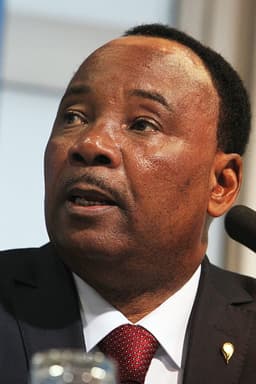
Mahamadou Issoufou
Politician · Modern
52.1Total

Napoleon Bonaparte
General · Modern
70.9Total
Basic Information
Born
1952
1769
Died
—
1821
Era
Modern
Modern
Nationality
Niger
France
Occupation
Politician
General
Civilization
Other
Western
Score Comparison
Military (10%)
42.3
94.0
Political (20%)
68.0
72.0
Influence (20%)
51.8
40.0
Legacy (20%)
41.7
80.0
Leadership (15%)
66.0
78.0
Strategy (15%)
43.7
90.0
TOTAL
52.1
70.9
Mahamadou Issoufou — Complete Timeline
2011 AD
Elected President of NigerPolitical Action◆ Major
Mahamadou Issoufou won the Nigerien presidential election in a runoff, defeating former prime minister Seini Oumarou. His victory marked a transition to civilian rule after a 2010 military coup.
ElectionDemocracyCivilian Rule
Impact: nationalconstructive
2015 AD
Led Fight Against Boko HaramWar◆ Major
Issoufou committed Nigerien troops to the Multinational Joint Task Force against Boko Haram in the Lake Chad region. Niger faced repeated attacks, and the campaign strained resources but contained the insurgency.
Boko HaramCounterterrorismMilitary
Impact: regional
2016 AD
Re-elected President of NigerPolitical Action◆ Major
Issoufou won a second term with 92% of the vote in an election boycotted by the main opposition. The result was criticized internationally as lacking credibility, though Issoufou remained in power.
ElectionControversySecond Term
Impact: national
2021 AD
Stepped Down After Two TermsPolitical Action
Issoufou voluntarily stepped down after completing two terms, handing power to elected successor Mohamed Bazoum. This was a rare peaceful transfer of power in Niger's history, strengthening democratic norms.
DemocracyPeaceful TransitionLegacy
Impact: nationalconstructive
Napoleon Bonaparte — Complete Timeline
1799 AD
Coup of 18 BrumaireOther◆ Major
Napoleon Bonaparte, with support from his brother Lucien and key political figures, overthrew the Directory in a bloodless coup. He established the Consulate with himself as First Consul, effectively becoming the ruler of France. This event ended the French Revolution's most unstable period.
French RevolutionCoupRise to Power
Impact: regional
1804 AD
Promulgation of the Napoleonic CodeOther◆ Major
Napoleon enacted the Civil Code of the French, known as the Napoleonic Code, a comprehensive set of laws that replaced the fragmented feudal legal systems. The code established legal equality, protected property rights, and secularized law. It became the basis for legal systems in many European and world countries.
Legal ReformNapoleonic CodeCivil Law
Impact: globalconstructive
1805 AD
Battle of AusterlitzWar◆ Major
Napoleon's Grande Arm
Napoleonic WarsBattleDecisive Victory
Impact: global
1812 AD
Invasion of RussiaWar◆ Major
Napoleon led the Grande Arm
Napoleonic WarsInvasionDisaster
Impact: globaldestructive
1815 AD
Battle of WaterlooWar◆ Major
Napoleon's French army was defeated by the combined forces of the Duke of Wellington's Anglo-Allied army and Gebhard Leberecht von Bl
Napoleonic WarsBattleFinal Defeat
Impact: globaldestructive
Expert Analysis
mahamadou-issoufou-vs-napoleon-bonaparte
# The Emperor and the Democrat
On a spring morning in 1815, Napoleon Bonaparte stood before his army, returned from exile, ready to reclaim an empire. In April of 2021, Mahamadou Issoufou walked out of the presidential palace in Niamey, Niger, having voluntarily surrendered power after two terms. One man died in isolation on a remote Atlantic island, his final years consumed by bitterness. The other retired to a life of quiet statesmanship, hailed across Africa as a rare example of democratic virtue. How did two leaders, both shaped by the same basic human ambition, arrive at such radically different ends?
Origins
Napoleon was born in 1769 on Corsica, an island that had just become French. His family was minor nobility, poor but proud. The young boy devoured histories of Alexander and Caesar, dreaming of glory in an age when the French Revolution had cracked open the old order and made ambition the only currency that mattered. He entered military school at nine, mocked by wealthy classmates for his accent and provincial manners. That wound never healed. It drove him to prove, again and again, that the outsider could conquer them all.
Mahamadou Issoufou was born in 1952 in the desert town of Doutchi, Niger, into a Hausa family of modest means. His world was not the glittering salons of Paris but the Sahel, where life was hard and the state was weak. He trained as a mining engineer, then entered politics in the 1990s as Niger stumbled toward democracy after decades of military rule. If Napoleon was forged by revolution, Issoufou was forged by something quieter: the slow, grinding work of building institutions in a country that had almost none.
Rise to Power
Napoleon’s ascent was a thunderclap. In 1793, at 24, he drove the British out of Toulon with a brilliant artillery plan. By 1796 he commanded the Army of Italy, and within months he had shattered the Austrian Empire, marching into Milan as a conqueror. His genius was not merely military—he understood that victory had to be seen, celebrated, mythologized. He wrote his own bulletins, staged his own triumphs, and made himself the hero of every story. In 1799 he seized power in a coup, and by 1804 he crowned himself Emperor of the French.
Issoufou’s rise was measured in decades, not days. He became a prominent opposition figure under Niger’s military dictatorships, was arrested, imprisoned, and exiled. In 2011, after years of political maneuvering and a democratic opening, he won the presidency in a runoff election. There was no coup, no grand spectacle. He simply campaigned, won, and took office. The contrast is stark: Napoleon seized history by the throat; Issoufou waited for history to open a door.
Leadership & Governance
As emperor, Napoleon was a force of nature. He reformed French law with the Napoleonic Code, centralizing and rationalizing a chaotic legal system. He built schools, roads, and canals. He negotiated the Concordat with the Pope, stabilizing the Church’s role in France. But his greatest talent was war. He fought more than sixty battles and lost only seven, a record that still stuns military historians. His strategy was speed, deception, and the crushing concentration of force at the decisive point. His political score of 75 reflects that he was a capable administrator, but his military score of 94 and strategy of 93 place him among the greatest commanders in history.
Issoufou governed a country that was desperately poor, landlocked, and threatened by terrorism. His military score of 30 is not a measure of personal failure but of context: Niger’s army was small, underfunded, and fighting an asymmetric war against Boko Haram and other jihadist groups. He committed Nigerien troops to the Multinational Joint Task Force in 2015, a necessary but unpopular move. His political score of 73 and leadership of 74 reflect a steady, unglamorous competence. He did not transform Niger into a paradise, but he kept it from collapsing. He built no empire, wrote no code. He kept the lights on.
Triumph & Tragedy
Napoleon’s greatest moment was Austerlitz in 1805, where he destroyed the combined armies of Russia and Austria in a single day. His worst was the invasion of Russia in 1812, where hubris and logistics consumed half a million men. He was exiled to Elba, escaped, and then came Waterloo in 1815—a battle he should have won but lost to a combination of bad luck, Prussian reinforcements, and his own overconfidence. He died in 1821 on Saint Helena, a prisoner of the British, dictating memoirs to justify his life.
Issoufou’s triumph was subtler. In 2016 he was re-elected with 92% of the vote, but the opposition boycotted, and the result was criticized internationally. Yet his true victory came in 2021, when he stepped down after two terms and handed power to his elected successor, Mohamed Bazoum. In a region where presidents routinely change constitutions to stay in power—Blaise Compaoré in Burkina Faso, Paul Biya in Cameroon, Idriss Déby in Chad—Issoufou did something remarkable: he left. His tragedy was not a battlefield defeat but the quiet knowledge that his country remained one of the poorest on earth, that the jihadists were not defeated, and that democracy in Niger was still fragile.
Character & Destiny
Napoleon was driven by an insatiable hunger for glory. “I live only for posterity,” he once said, and he meant it. He could not stop. Even in exile, he plotted escape. His personality—brilliant, impatient, contemptuous of limits—made him a conqueror and a prisoner of his own ambition. He could not share power, could not delegate, could not rest. That is why he died alone.
Issoufou was driven by something more modest: a sense of duty and a respect for rules. He was not a charismatic speaker or a military genius. He was an engineer, methodical and patient. He understood that in a country as fragile as Niger, the greatest gift a leader could give was a peaceful transition. His personality—cautious, disciplined, unflashy—made him a democrat and, in the eyes of many, a hero.
Legacy
Napoleon is remembered as a titan: the man who reshaped Europe, spread the ideals of the French Revolution even as he betrayed them, and left a legal and administrative legacy that endures. His name is carved into the Arc de Triomphe, his body lies in the Invalides. He is studied, debated, romanticized, and condemned. His legacy score of 78 is strong, but not perfect—because the cost of his ambition was so high.
Issoufou’s legacy is quieter but perhaps more instructive. His legacy score of 54 reflects a leader who did not transform the world. But in a continent where democratic backsliding has become the norm, his voluntary departure stands as a rare and precious example. He proved that power does not have to corrupt, that a leader can leave. That is not a small thing.
Conclusion
Napoleon once said, “Glory is fleeting, but obscurity is forever.” He was wrong. Issoufou embraced obscurity, and that choice may prove more lasting than a hundred battlefield victories. The emperor and the democrat both wanted to lead. One wanted to be remembered for what he conquered; the other, for what he surrendered. In the end, the man who gave up power may have taught us more about its true nature than the man who died grasping for it.
Rankings
🥇
Napoleon BonaparteLeader
Mil: 94.0Pol: 72.0Inf: 40.0
70.9
🥈
Mahamadou Issoufou
Mil: 42.3Pol: 68.0Inf: 51.8
52.1
+18.8 behind
How This Comparison Works
Algorithm
Each figure is scored on 6 dimensions (0—100 scale) based on structured historical data: Military (10%), Political (20%), Influence (20%), Legacy (20%), Leadership (15%), Strategy (15%). The weighted total produces the final ranking.
Data Sources
Scores are computed from structured sub-indicators in the database. Scale factors adjust for era (Ancient ×0.85, Modern ×1.0) and civilization size (Eastern ×1.05, Other ×0.80) to account for differences in population and military scale.
Maximum 3 Figures
Comparisons are limited to 2—3 figures to ensure readability and statistical meaningfulness.
Error Margins
±5 points per dimension — Sub-scores are derived from historical records with inherent uncertainty. Two figures within 5 points on a dimension should be considered roughly equivalent in that area.
Total Score Accuracy
±3 points overall — The weighted combination of 6 dimensions produces a total score with approximately ±3 points of uncertainty. Differences of less than 3 points are not statistically significant— the figures are effectively tied.
Known Limitations
- Historical records are incomplete and uneven across civilizations
- Figures from oral-tradition societies may be underrepresented
- Occupation labels can misclassify multi-role figures
- Scores measure capability and impact, not moral character
- Quantitative scoring is a comparison tool, not absolute truth
Capability Radar
Military (10%) — Battles & Warfare
Battles
23
95
Win Rate
23
90
Expansion
27
95
Political (20%) — Governance & Reform
Reform
55
95
Diplomacy
60
80
Economy
50
85
Influence (20%) — Cultural & Global Reach
Cultural
20
85
Global
20
90
Legacy (20%) — Historical Impact
Historical
30
95
Longevity
20
90
Leadership (15%) — Power & Stability
Tenure
60
85
Stability
55
70
Strategy (15%) — Tactics & Innovation
Strategy
31
95
Tactics
33
98
Reform
37
92
Similar Comparisons
Comments & Discussion
REVENGE-OF-CORSICA6/17/2026
Napoleon wasn't just ambitious—he was a walking identity crisis. Born Corsican, made French, he used military genius as therapy for childhood humiliation. Issoufou, by contrast, never had to prove anything to anyone except voters. That's the difference: Napoleon's empire was built on daddy issues and gunpowder; Issoufou's legacy rests on a simple handshake goodbye. Call me when Napoleon voluntarily steps down from anything.
IRON-ORE-ISSUE6/17/2026
用采矿工程师的标准来看,拿破仑就是个破产的矿主——资源耗尽、规划混乱、最后流放收场。伊素福才是真正的开发高手:他给尼日尔留下的不是战争债,而是尼日尔河上的坎达吉水坝和民主制度。煤矿测不准储量,但人心测得了。前者埋骨圣赫勒拿,后者安享退休金,高下立判。
SANDSTORM-SAGE6/17/2026
Let's be honest: comparing a Sahel democrat to a European emperor is like comparing a dromedary to a warhorse. Issoufou's greatest victory wasn't Austerlitz—it was keeping Niger together through coups and jihadis. Napoleon's greatest defeat wasn't Waterloo—it was thinking his ego could outlast reality. One man built a nation; the other built a tombstone. I know which architect I'd hire.
影子矿工6/17/2026
我查过数据:伊素福任内尼日尔GDP涨了60%,极端贫困率从48%降到43%。拿破仑呢?法国人口减少10%,战争烧掉150万条命。一个是挖铀矿的工程师,一个是玩火药的赌徒。数字不撒谎,民主比帝制更保值。别跟我谈什么革命遗产,你问问滑铁卢的寡妇同不同意?