Loading...
This comparison has not been analyzed yet.
One-time AI generation (~1 minute). Scores and timeline are already available below.
Mahamadou Issoufou vs Manuel Valls
Mahamadou Issoufou leads by 2.5 pts · 2 figures compared
…
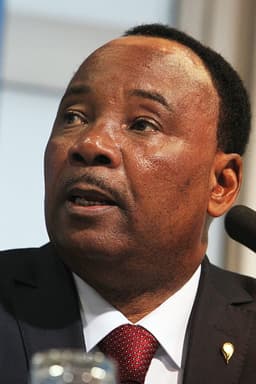
Mahamadou Issoufou
Politician · Modern
52.1Total

Manuel Valls
Politician · Modern
49.6Total
Basic Information
Born
1952
1962
Died
—
—
Era
Modern
Modern
Nationality
Niger
France
Occupation
Politician
Politician
Civilization
Other
Western
Score Comparison
Military (10%)
42.3
46.3
Political (20%)
68.0
45.1
Influence (20%)
51.8
51.0
Legacy (20%)
41.7
38.3
Leadership (15%)
66.0
65.7
Strategy (15%)
43.7
60.0
TOTAL
52.1
49.6
Mahamadou Issoufou — Complete Timeline
2011 AD
Elected President of NigerPolitical Action◆ Major
Mahamadou Issoufou won the Nigerien presidential election in a runoff, defeating former prime minister Seini Oumarou. His victory marked a transition to civilian rule after a 2010 military coup.
ElectionDemocracyCivilian Rule
Impact: nationalconstructive
2015 AD
Led Fight Against Boko HaramWar◆ Major
Issoufou committed Nigerien troops to the Multinational Joint Task Force against Boko Haram in the Lake Chad region. Niger faced repeated attacks, and the campaign strained resources but contained the insurgency.
Boko HaramCounterterrorismMilitary
Impact: regional
2016 AD
Re-elected President of NigerPolitical Action◆ Major
Issoufou won a second term with 92% of the vote in an election boycotted by the main opposition. The result was criticized internationally as lacking credibility, though Issoufou remained in power.
ElectionControversySecond Term
Impact: national
2021 AD
Stepped Down After Two TermsPolitical Action
Issoufou voluntarily stepped down after completing two terms, handing power to elected successor Mohamed Bazoum. This was a rare peaceful transfer of power in Niger's history, strengthening democratic norms.
DemocracyPeaceful TransitionLegacy
Impact: nationalconstructive
Manuel Valls — Complete Timeline
2014 AD
Appointed Prime Minister of FrancePolitical Action◆ Major
President Fran
French GovernmentAppointment
Impact: national
2016 AD
Resigned as Prime MinisterPolitical Action◆ Major
Valls resigned as Prime Minister to run for the Socialist Party nomination in the 2017 presidential election. He was succeeded by Bernard Cazeneuve.
ResignationPresidential Campaign
Impact: national
2017 AD
Failed to secure Socialist presidential nominationPolitical Action◆ Major
Valls lost the Socialist Party primary to Beno
Election DefeatPrimary
Impact: nationaltragic
This comparison has not been analyzed yet.
One-time AI generation (~1 minute). Scores and timeline are already available below.
Rankings
🥇
Mahamadou IssoufouLeader
Mil: 42.3Pol: 68.0Inf: 51.8
52.1
🥈
Manuel Valls
Mil: 46.3Pol: 45.1Inf: 51.0
49.6
+2.5 behind
How This Comparison Works
Algorithm
Each figure is scored on 6 dimensions (0—100 scale) based on structured historical data: Military (10%), Political (20%), Influence (20%), Legacy (20%), Leadership (15%), Strategy (15%). The weighted total produces the final ranking.
Data Sources
Scores are computed from structured sub-indicators in the database. Scale factors adjust for era (Ancient ×0.85, Modern ×1.0) and civilization size (Eastern ×1.05, Other ×0.80) to account for differences in population and military scale.
Maximum 3 Figures
Comparisons are limited to 2—3 figures to ensure readability and statistical meaningfulness.
Error Margins
±5 points per dimension — Sub-scores are derived from historical records with inherent uncertainty. Two figures within 5 points on a dimension should be considered roughly equivalent in that area.
Total Score Accuracy
±3 points overall — The weighted combination of 6 dimensions produces a total score with approximately ±3 points of uncertainty. Differences of less than 3 points are not statistically significant— the figures are effectively tied.
Known Limitations
- Historical records are incomplete and uneven across civilizations
- Figures from oral-tradition societies may be underrepresented
- Occupation labels can misclassify multi-role figures
- Scores measure capability and impact, not moral character
- Quantitative scoring is a comparison tool, not absolute truth
Capability Radar
Military (10%) — Battles & Warfare
Battles
23
49
Win Rate
23
47
Expansion
27
52
Political (20%) — Governance & Reform
Reform
55
35
Diplomacy
60
45
Economy
50
30
Influence (20%) — Cultural & Global Reach
Cultural
20
15
Global
20
20
Legacy (20%) — Historical Impact
Historical
30
20
Longevity
20
10
Leadership (15%) — Power & Stability
Tenure
60
40
Stability
55
25
Strategy (15%) — Tactics & Innovation
Strategy
31
58
Tactics
33
61
Reform
37
64
Similar Comparisons
Comments & Discussion
No comments yet. Be the first to share your thoughts!