Loading...
Macbeth of Scotland vs Ottokar II of Bohemia
Ottokar II of Bohemia leads by 13.3 pts · 2 figures compared
…
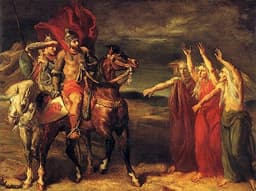
Macbeth of Scotland
Emperor · Medieval
48.6Total

Ottokar II of Bohemia
Emperor · Medieval
61.9Total
Basic Information
Born
1005
1233
Died
1057
1278
Era
Medieval
Medieval
Nationality
Scotland
Bohemia
Occupation
Emperor
Emperor
Civilization
Western
Western
Score Comparison
Military (10%)
55.0
74.7
Political (20%)
26.4
72.0
Influence (20%)
55.0
56.7
Legacy (20%)
55.0
54.0
Leadership (15%)
48.4
68.0
Strategy (15%)
43.7
58.0
TOTAL
48.6
61.9
Macbeth of Scotland — Complete Timeline
1040 AD
Battle of PitgavenyWar
Macbeth defeated and killed King Duncan I in battle at Pitgaveny near Elgin. Macbeth then claimed the Scottish throne, becoming King of Scots. This event is the basis for Shakespeare's play, though the historical circumstances differ from the fictional account.
BattleSuccessionDuncan
Impact: national
1050 AD
Pilgrimage to RomeCultural◆ Major
Macbeth made a pilgrimage to Rome, where he was received by Pope Leo IX and distributed alms to the poor. This was a significant act of piety and diplomacy, demonstrating Macbeth's legitimacy as a Christian king and his connections to the wider European church.
PilgrimageRomePiety
Impact: regionalconstructive
1054 AD
Battle of DunsinaneWar◆ Major
Macbeth was defeated at the Battle of Dunsinane by an army led by Siward, Earl of Northumbria, acting on behalf of Malcolm Canmore. The defeat weakened Macbeth's position but did not immediately end his reign, as he continued to rule for three more years.
BattleNorthumbriaMalcolm
Impact: regional
1057 AD
Battle of LumphananWar◆ Major
Macbeth was killed at the Battle of Lumphanan in Aberdeenshire, fighting against Malcolm Canmore's forces. His death ended his 17-year reign and allowed Malcolm to claim the throne. Macbeth's stepson Lulach succeeded briefly before being killed by Malcolm.
BattleDeathSuccession
Impact: national
Ottokar II of Bohemia — Complete Timeline
1260 AD
Battle of KressenbrunnWar◆ Major
Ottokar II defeated King B
Territorial ExpansionBattleAustria
Impact: regional
1273 AD
Election as King of GermanyPolitical Action◆ Major
Ottokar II was elected King of Germany by a faction of prince-electors, but he refused to accept the election of Rudolf I of Habsburg. This dispute led to conflict with Rudolf, who claimed the throne and challenged Ottokar's authority.
ElectionConflictHabsburg
Impact: regional
1278 AD
Battle on the MarchfeldWar
Ottokar II was defeated and killed by Rudolf I of Habsburg at the Battle on the Marchfeld. This battle ended Bohemian expansion and allowed the Habsburgs to gain control of Austria, Styria, and Carinthia.
BattleDeathHabsburg Rise
Impact: regionaltragic
Expert Analysis
Origins
Macbeth mac Findláich (c. 1005–1057) was born into the Scottish nobility, the son of Findláech of Moray, a regional ruler. His mother was possibly a daughter of Malcolm II, giving him a claim to the throne. Little is known of his early education, but he likely trained as a warrior in the Norse-Gaelic culture of northern Scotland.
Ottokar II (c. 1233–1278) was born into the Přemyslid dynasty, the son of King Wenceslaus I of Bohemia and Kunigunde of Hohenstaufen. He received a thorough education in chivalry, Latin, and governance, befitting a medieval prince. His father groomed him for rule, and he gained experience as Margrave of Moravia from age 14.
Rise to Power
Macbeth rose to power in 1040 by killing King Duncan I at the Battle of Pitgaveny. The exact circumstances are debated, but Macbeth's claim may have been strengthened by his marriage to Gruoch, a granddaughter of King Kenneth III. He was crowned at Scone, the traditional coronation site, and ruled for 17 years—a relatively long reign for the period.
Ottokar II became King of Bohemia in 1253 upon his father's death. He quickly expanded his territory by leveraging his Hohenstaufen connections. In 1260, he defeated King Béla IV of Hungary at the Battle of Kressenbrunn, securing the Duchies of Austria, Styria, Carinthia, and Carniola. By 1273, he was the most powerful prince in the Holy Roman Empire, controlling lands from Bohemia to the Adriatic.
Leadership & Governance
Macbeth's leadership was characterized by consolidation rather than expansion. He maintained peace with England and Norway, and in 1050 made a pilgrimage to Rome, where he distributed alms to the poor—a act of piety that also strengthened his diplomatic standing. He ruled through local mormaers (regional lords) and upheld traditional Scottish laws. However, his reign was marked by periodic rebellions, particularly from the family of Duncan I.
Ottokar II was an ambitious builder and administrator. He founded numerous towns, including the city of Königsberg (now Kaliningrad), and promoted German colonization of his lands. He established a strong central government, minted coins, and codified laws. His rule brought economic prosperity, but his autocratic style alienated the Bohemian nobility. He scored 68.0 in leadership, compared to Macbeth's 48.4, reflecting his more active governance.
Triumph & Tragedy
Macbeth's greatest success was his 17-year reign, which brought stability to Scotland after Duncan's chaotic rule. He also secured the kingdom against external threats. His tragedy was his death at the Battle of Lumphanan in 1057, defeated by Malcolm Canmore's forces. His historical reputation was later distorted by Shakespeare, who portrayed him as a usurper and tyrant, though contemporary chronicles describe him as a generous king.
Ottokar's triumph was the Battle of Kressenbrunn in 1260, where he defeated a Hungarian army twice his size, cementing his control over Austria and Styria. His tragedy came at the Battle on the Marchfeld in 1278, where he was defeated and killed by Rudolf I of Habsburg. Ottokar's refusal to accept Rudolf's election as King of Germany led to war, and his death allowed the Habsburgs to rise as a dominant European dynasty.
Character & Destiny
Macbeth was pragmatic and diplomatic, as shown by his pilgrimage to Rome and his avoidance of major wars. However, his claim to the throne was always contested, and his death in battle reflected the violent politics of medieval Scotland. His character, as depicted by Shakespeare, overshadows the historical figure, but contemporary sources suggest he was neither as evil nor as guilt-ridden as the play suggests.
Ottokar was ambitious and proud, earning the epithets "Iron King" for his military prowess and "Golden King" for his wealth. His refusal to compromise with Rudolf I proved fatal. He scored 58.0 in strategy, lower than his military score of 74.7, indicating that his tactical skills were not matched by strategic foresight. His hubris led him to underestimate the Habsburg coalition.
Legacy
Macbeth's legacy is overwhelmingly shaped by Shakespeare's play, which turned him into a symbol of ambition and guilt. Historically, he is remembered as a competent ruler who maintained Scottish independence. His reign is a footnote in Scottish history, overshadowed by the later Bruce and Stewart dynasties. His influence score of 55.0 reflects this cultural impact.
Ottokar II's legacy is more substantial: he expanded Bohemian power to its medieval zenith and left a network of towns and institutions that endured for centuries. However, his defeat allowed the Habsburgs to rise, altering the course of Central European history. His total score of 61.9 reflects his greater historical impact compared to Macbeth's 48.6.
Conclusion
Ottokar II of Bohemia had a greater impact on history than Macbeth of Scotland. Ottokar's military (74.7 vs. 55.0), political (72.0 vs. 26.4), and leadership (68.0 vs. 48.4) scores were all higher. While Macbeth's cultural legacy is immense due to Shakespeare, Ottokar's concrete achievements—territorial expansion, town foundations, and legal reforms—directly shaped Central Europe. Ottokar's tragedy, his defeat at Marchfeld, was a pivotal event that enabled the Habsburgs, while Macbeth's defeat merely returned the Scottish throne to the previous dynasty. In terms of measurable historical influence, Ottokar II clearly surpasses Macbeth.
Rankings
🥇
Ottokar II of BohemiaLeader
Mil: 74.7Pol: 72.0Inf: 56.7
61.9
🥈
Macbeth of Scotland
Mil: 55.0Pol: 26.4Inf: 55.0
48.6
+13.3 behind
How This Comparison Works
Algorithm
Each figure is scored on 6 dimensions (0—100 scale) based on structured historical data: Military (10%), Political (20%), Influence (20%), Legacy (20%), Leadership (15%), Strategy (15%). The weighted total produces the final ranking.
Data Sources
Scores are computed from structured sub-indicators in the database. Scale factors adjust for era (Ancient ×0.85, Modern ×1.0) and civilization size (Eastern ×1.05, Other ×0.80) to account for differences in population and military scale.
Maximum 3 Figures
Comparisons are limited to 2—3 figures to ensure readability and statistical meaningfulness.
Error Margins
±5 points per dimension — Sub-scores are derived from historical records with inherent uncertainty. Two figures within 5 points on a dimension should be considered roughly equivalent in that area.
Total Score Accuracy
±3 points overall — The weighted combination of 6 dimensions produces a total score with approximately ±3 points of uncertainty. Differences of less than 3 points are not statistically significant— the figures are effectively tied.
Known Limitations
- Historical records are incomplete and uneven across civilizations
- Figures from oral-tradition societies may be underrepresented
- Occupation labels can misclassify multi-role figures
- Scores measure capability and impact, not moral character
- Quantitative scoring is a comparison tool, not absolute truth
Capability Radar
Military (10%) — Battles & Warfare
Battles
30
75
Win Rate
35
70
Expansion
25
75
Political (20%) — Governance & Reform
Reform
15
65
Diplomacy
20
65
Economy
15
70
Influence (20%) — Cultural & Global Reach
Cultural
70
60
Global
60
55
Legacy (20%) — Historical Impact
Historical
65
65
Longevity
75
50
Leadership (15%) — Power & Stability
Tenure
40
70
Stability
20
55
Strategy (15%) — Tactics & Innovation
Strategy
20
70
Tactics
25
65
Reform
10
60
Similar Comparisons
Comments & Discussion
No comments yet. Be the first to share your thoughts!