Loading...
This comparison has not been analyzed yet.
One-time AI generation (~1 minute). Scores and timeline are already available below.
Louis the Pious vs Stefan Nemanja
Stefan Nemanja leads by 16.4 pts · 2 figures compared
…
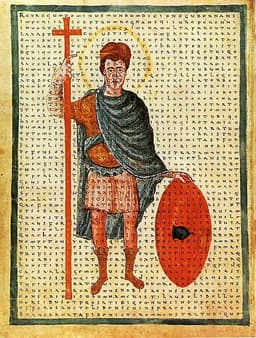
Louis the Pious
Emperor · Medieval
48.9Total
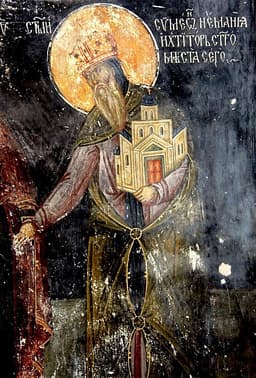
Stefan Nemanja
Emperor · Medieval
65.3Total
Basic Information
Born
778
1113
Died
840
1199
Era
Medieval
Medieval
Nationality
Frankish Empire
Serbia
Occupation
Emperor
Emperor
Civilization
Western
Western
Score Comparison
Military (10%)
50.0
61.7
Political (20%)
39.4
60.0
Influence (20%)
54.1
68.0
Legacy (20%)
45.0
65.0
Leadership (15%)
62.2
72.0
Strategy (15%)
38.6
60.7
TOTAL
48.9
65.3
Louis the Pious — Complete Timeline
817 AD
Ordinatio ImperiiPolitical Action◆ Major
Louis issued the Ordinatio Imperii, dividing the Frankish Empire among his three sons: Lothair, Pepin, and Louis the German. This plan aimed to maintain unity under Lothair's seniority but led to civil wars after Pepin's death.
SuccessionDivisionCivil War
Impact: regional
822 AD
Penance at AttignyPolitical Action
Louis performed public penance at Attigny for the death of his nephew Bernard of Italy, whom he had blinded. This act weakened his authority and set a precedent for ecclesiastical intervention in royal affairs.
PenanceChurchBernard of Italy
Impact: nationaltragic
841 AD
Battle of FontenoyWar◆ Major
After Louis's death, his sons fought the Battle of Fontenoy, where Charles the Bald and Louis the German defeated Lothair. This battle was a key event in the Carolingian civil wars that led to the empire's fragmentation.
Civil WarCarolingianDivision
Impact: regionaldestructive
Stefan Nemanja — Complete Timeline
1166 AD
Grand Župan of RaškaPolitical Action◆ Major
Stefan Nemanja overthrew his brothers Tihomir, Stracimir, and Miroslav to become the sole Grand
Serbian unificationDynasty foundationPower consolidation
Impact: regionalconstructive
1186 AD
Council of 1186 against BogomilismPolitical Action
Stefan Nemanja convened a church council that condemned Bogomilism as heresy. He ordered the persecution of Bogomils, confiscating their property and expelling them from Serbia. This action aligned the Serbian church with Orthodox orthodoxy and strengthened state control over religious life.
Religious persecutionOrthodox consolidationHeresy suppression
Impact: nationaldestructive
1190 AD
Construction of the Studenica MonasteryCultural◆ Major
Stefan Nemanja founded the Studenica Monastery, which became the most important monastic foundation of the Nemanji
Monastery foundationCultural legacyReligious architecture
Impact: nationalconstructive
1196 AD
Abdication and monastic tonsure as SimeonPolitical Action
Stefan Nemanja abdicated the throne in favor of his son Stefan (later Stefan the First-Crowned) and took monastic vows under the name Simeon. He retired to the Hilandar Monastery on Mount Athos, which he had helped restore. This act set a precedent for Serbian rulers retiring to monastic life.
AbdicationMonasticismHilandar
Impact: national
1200 AD
Canonization as Saint Simeon the Myrrh-streamingCultural◆ Major
Stefan Nemanja, as the monk Simeon, was canonized by the Serbian Orthodox Church shortly after his death. His relics at Studenica were reported to exude myrrh, leading to his veneration as a saint. This canonization elevated the Nemanji
CanonizationSaint venerationDynastic legitimacy
Impact: nationalconstructive
This comparison has not been analyzed yet.
One-time AI generation (~1 minute). Scores and timeline are already available below.
Rankings
🥇
Stefan NemanjaLeader
Mil: 61.7Pol: 60.0Inf: 68.0
65.3
🥈
Louis the Pious
Mil: 50.0Pol: 39.4Inf: 54.1
48.9
+16.4 behind
How This Comparison Works
Algorithm
Each figure is scored on 6 dimensions (0—100 scale) based on structured historical data: Military (10%), Political (20%), Influence (20%), Legacy (20%), Leadership (15%), Strategy (15%). The weighted total produces the final ranking.
Data Sources
Scores are computed from structured sub-indicators in the database. Scale factors adjust for era (Ancient ×0.85, Modern ×1.0) and civilization size (Eastern ×1.05, Other ×0.80) to account for differences in population and military scale.
Maximum 3 Figures
Comparisons are limited to 2—3 figures to ensure readability and statistical meaningfulness.
Error Margins
±5 points per dimension — Sub-scores are derived from historical records with inherent uncertainty. Two figures within 5 points on a dimension should be considered roughly equivalent in that area.
Total Score Accuracy
±3 points overall — The weighted combination of 6 dimensions produces a total score with approximately ±3 points of uncertainty. Differences of less than 3 points are not statistically significant— the figures are effectively tied.
Known Limitations
- Historical records are incomplete and uneven across civilizations
- Figures from oral-tradition societies may be underrepresented
- Occupation labels can misclassify multi-role figures
- Scores measure capability and impact, not moral character
- Quantitative scoring is a comparison tool, not absolute truth
Capability Radar
Military (10%) — Battles & Warfare
Battles
25
65
Win Rate
30
70
Expansion
10
70
Political (20%) — Governance & Reform
Reform
40
80
Diplomacy
35
70
Economy
30
60
Influence (20%) — Cultural & Global Reach
Cultural
30
75
Global
25
60
Legacy (20%) — Historical Impact
Historical
40
80
Longevity
30
85
Leadership (15%) — Power & Stability
Tenure
60
75
Stability
20
65
Strategy (15%) — Tactics & Innovation
Strategy
25
65
Tactics
20
60
Reform
15
55
Similar Comparisons
Comments & Discussion
No comments yet. Be the first to share your thoughts!