Loading...
This comparison has not been analyzed yet.
One-time AI generation (~1 minute). Scores and timeline are already available below.
Louis IV the Bavarian vs Ouchi Yoshioki
Louis IV the Bavarian leads by 2.9 pts · 2 figures compared
…
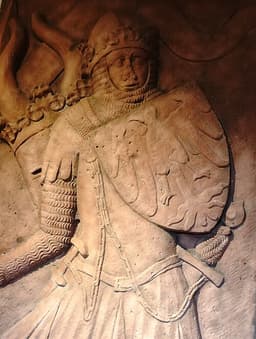
Louis IV the Bavarian
Emperor · Medieval
58.3Total

Ouchi Yoshioki
Emperor · Medieval
55.4Total
Basic Information
Born
1282
1477
Died
1347
1528
Era
Medieval
Medieval
Nationality
Holy Roman Empire
Japan
Occupation
Emperor
Emperor
Civilization
Western
Eastern
Score Comparison
Military (10%)
47.5
52.5
Political (20%)
68.0
53.8
Influence (20%)
55.7
56.4
Legacy (20%)
49.2
48.3
Leadership (15%)
74.0
66.0
Strategy (15%)
60.0
60.0
TOTAL
58.3
55.4
Louis IV the Bavarian — Complete Timeline
1314 AD
Election as King of GermanyPolitical Action◆ Major
Louis, Duke of Bavaria, was elected King of Germany by a faction of electors, while Frederick the Fair of Habsburg was elected by another faction. This led to a double election and civil war.
Double ElectionCivil War
Impact: national
1322 AD
Battle of MühldorfWar
Louis IV decisively defeated his rival Frederick the Fair at the Battle of M
BattleCivil War Victory
Impact: national
1324 AD
Conflict with the PapacyPolitical Action◆ Major
Pope John XXII excommunicated Louis IV for exercising imperial authority without papal approval. Louis responded by declaring the pope a heretic and invading Italy, leading to a prolonged conflict between empire and papacy.
ExcommunicationImperial-Papal Conflict
Impact: globaldestructive
1338 AD
Promulgation of the Declaration of RhensePolitical Action
Louis IV issued the Declaration of Rhense, asserting that the German king's authority derived from election by the prince-electors, not papal approval. This strengthened the independence of the German monarchy.
DeclarationElectoral Independence
Impact: nationalconstructive
Ouchi Yoshioki — Complete Timeline
1508 AD
Restoration of Ashikaga YoshitanePolitical Action◆ Major
Ouchi Yoshioki marched his army to Kyoto and restored Ashikaga Yoshitane as shogun, ending the exile of the Ashikaga shogunate. This action reasserted Ouchi influence over central politics and demonstrated his military power.
Ashikaga RestorationKyoto CampaignShogunate Politics
Impact: nationalconstructive
1511 AD
Battle of FunaokayamaWar◆ Major
Ouchi Yoshioki defeated the forces of Hosokawa Takakuni at Funaokayama in Kyoto, securing the position of the restored shogun Ashikaga Yoshitane. The victory solidified Ouchi control over the capital region.
BattleKyotoHosokawa Conflict
Impact: national
1518 AD
Return to YamaguchiPolitical Action
Ouchi Yoshioki returned to his domain in Yamaguchi after a decade in Kyoto, leaving central politics. This withdrawal allowed the Hosokawa clan to regain influence in the capital and marked the end of Ouchi direct involvement in shogunate affairs.
Political WithdrawalYamaguchiPower Shift
Impact: regional
This comparison has not been analyzed yet.
One-time AI generation (~1 minute). Scores and timeline are already available below.
Rankings
🥇
Louis IV the BavarianLeader
Mil: 47.5Pol: 68.0Inf: 55.7
58.3
🥈
Ouchi Yoshioki
Mil: 52.5Pol: 53.8Inf: 56.4
55.4
+2.9 behind
How This Comparison Works
Algorithm
Each figure is scored on 6 dimensions (0—100 scale) based on structured historical data: Military (10%), Political (20%), Influence (20%), Legacy (20%), Leadership (15%), Strategy (15%). The weighted total produces the final ranking.
Data Sources
Scores are computed from structured sub-indicators in the database. Scale factors adjust for era (Ancient ×0.85, Modern ×1.0) and civilization size (Eastern ×1.05, Other ×0.80) to account for differences in population and military scale.
Maximum 3 Figures
Comparisons are limited to 2—3 figures to ensure readability and statistical meaningfulness.
Error Margins
±5 points per dimension — Sub-scores are derived from historical records with inherent uncertainty. Two figures within 5 points on a dimension should be considered roughly equivalent in that area.
Total Score Accuracy
±3 points overall — The weighted combination of 6 dimensions produces a total score with approximately ±3 points of uncertainty. Differences of less than 3 points are not statistically significant— the figures are effectively tied.
Known Limitations
- Historical records are incomplete and uneven across civilizations
- Figures from oral-tradition societies may be underrepresented
- Occupation labels can misclassify multi-role figures
- Scores measure capability and impact, not moral character
- Quantitative scoring is a comparison tool, not absolute truth
Capability Radar
Military (10%) — Battles & Warfare
Battles
55
55
Win Rate
50
60
Expansion
50
50
Political (20%) — Governance & Reform
Reform
50
45
Diplomacy
60
65
Economy
40
50
Influence (20%) — Cultural & Global Reach
Cultural
40
40
Global
35
30
Legacy (20%) — Historical Impact
Historical
55
50
Longevity
40
40
Leadership (15%) — Power & Stability
Tenure
65
60
Stability
45
55
Strategy (15%) — Tactics & Innovation
Strategy
45
55
Tactics
40
50
Reform
30
40
Similar Comparisons
Comments & Discussion
No comments yet. Be the first to share your thoughts!