Loading...
This comparison has not been analyzed yet.
One-time AI generation (~1 minute). Scores and timeline are already available below.
Lon Nol vs Su Yu
Su Yu leads by 22.7 pts · 2 figures compared
…
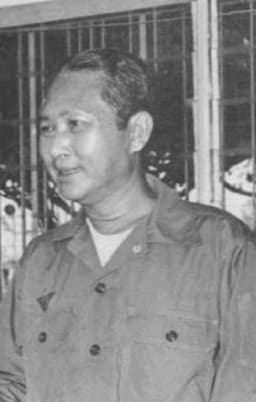
Lon Nol
General · Modern
41.5Total

Su Yu
General · Modern
64.2Total
Basic Information
Born
1913
1907
Died
1985
1984
Era
Modern
Modern
Nationality
Cambodia
China
Occupation
General
General
Civilization
Eastern
Eastern
Score Comparison
Military (10%)
25.9
78.0
Political (20%)
30.8
68.0
Influence (20%)
47.9
62.0
Legacy (20%)
38.3
52.0
Leadership (15%)
61.1
70.0
Strategy (15%)
35.7
72.0
TOTAL
41.5
64.2
Lon Nol — Complete Timeline
1970 AD
Coup against Norodom SihanoukPolitical Action
Lon Nol led a military coup that overthrew King Sihanouk while he was abroad. He established the Khmer Republic, ending the monarchy and aligning Cambodia with the United States during the Vietnam War.
CoupKhmer RepublicUS alliance
Impact: nationaldestructive
Declaration of the Khmer RepublicPolitical Action◆ Major
Lon Nol officially proclaimed the Khmer Republic, abolishing the monarchy. He became president and implemented a pro-American, anti-communist regime, which led to civil war with the Khmer Rouge and North Vietnamese forces.
RepublicRegime changeCivil War
Impact: national
1975 AD
Fall of Phnom PenhWar
Lon Nol's government collapsed as Khmer Rouge forces captured Phnom Penh. He fled into exile in the United States, ending the Khmer Republic and leading to the establishment of Democratic Kampuchea under Pol Pot.
Khmer Rouge victoryExileRegime collapse
Impact: nationaltragic
Su Yu — Complete Timeline
1947 AD
Commander of the East China Field ArmyWar◆ Major
Su Yu was appointed commander of the East China Field Army (later the Third Field Army). He led this force in major campaigns against the Kuomintang, including the Huaihai Campaign, where his outnumbered forces achieved decisive victories through superior tactics.
Chinese Civil WarEast China Field ArmyMilitary Command
Impact: nationalconstructive
1948 AD
Victory in the Huaihai CampaignWar
Su Yu played a key role in the Huaihai Campaign, a major engagement of the Chinese Civil War. His forces encircled and destroyed a large Kuomintang army, capturing over 500,000 troops. This victory was crucial for the Communist takeover of eastern China.
Chinese Civil WarHuaihai CampaignDecisive Victory
Impact: nationalconstructive
1967 AD
Purged during the Cultural RevolutionPolitical Action◆ Major
Su Yu was purged during the Cultural Revolution, accused of being a 'capitalist roader' and a 'military revisionist'. He was removed from his posts and subjected to criticism, though he was later rehabilitated after Mao's death.
Cultural RevolutionPurgePersecution
Impact: nationaldestructive
This comparison has not been analyzed yet.
One-time AI generation (~1 minute). Scores and timeline are already available below.
Rankings
🥇
Su YuLeader
Mil: 78.0Pol: 68.0Inf: 62.0
64.2
🥈
Lon Nol
Mil: 25.9Pol: 30.8Inf: 47.9
41.5
+22.7 behind
How This Comparison Works
Algorithm
Each figure is scored on 6 dimensions (0—100 scale) based on structured historical data: Military (10%), Political (20%), Influence (20%), Legacy (20%), Leadership (15%), Strategy (15%). The weighted total produces the final ranking.
Data Sources
Scores are computed from structured sub-indicators in the database. Scale factors adjust for era (Ancient ×0.85, Modern ×1.0) and civilization size (Eastern ×1.05, Other ×0.80) to account for differences in population and military scale.
Maximum 3 Figures
Comparisons are limited to 2—3 figures to ensure readability and statistical meaningfulness.
Error Margins
±5 points per dimension — Sub-scores are derived from historical records with inherent uncertainty. Two figures within 5 points on a dimension should be considered roughly equivalent in that area.
Total Score Accuracy
±3 points overall — The weighted combination of 6 dimensions produces a total score with approximately ±3 points of uncertainty. Differences of less than 3 points are not statistically significant— the figures are effectively tied.
Known Limitations
- Historical records are incomplete and uneven across civilizations
- Figures from oral-tradition societies may be underrepresented
- Occupation labels can misclassify multi-role figures
- Scores measure capability and impact, not moral character
- Quantitative scoring is a comparison tool, not absolute truth
Capability Radar
Military (10%) — Battles & Warfare
Battles
15
85
Win Rate
10
90
Expansion
5
75
Political (20%) — Governance & Reform
Reform
10
40
Diplomacy
15
50
Economy
5
30
Influence (20%) — Cultural & Global Reach
Cultural
5
55
Global
10
45
Legacy (20%) — Historical Impact
Historical
15
70
Longevity
5
50
Leadership (15%) — Power & Stability
Tenure
40
60
Stability
5
55
Strategy (15%) — Tactics & Innovation
Strategy
15
88
Tactics
20
92
Reform
10
70
Similar Comparisons
Comments & Discussion
No comments yet. Be the first to share your thoughts!