Loading...
Liu Biao vs Zhuge Liang
Zhuge Liang leads by 16.6 pts · 2 figures compared
…

Liu Biao
Politician · Ancient
45.3Total
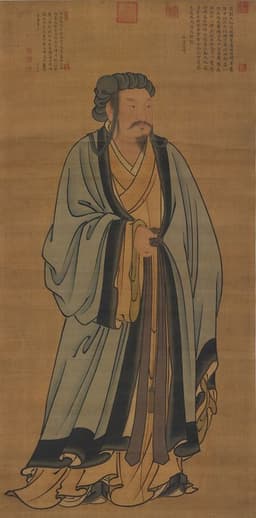
Zhuge Liang
Politician · Ancient
61.9Total
Basic Information
Born
142
181
Died
208
234
Era
Ancient
Ancient
Nationality
China
China
Occupation
Politician
Politician
Civilization
Eastern
Eastern
Score Comparison
Military (10%)
21.2
45.0
Political (20%)
43.7
72.0
Influence (20%)
50.2
40.0
Legacy (20%)
40.0
71.4
Leadership (15%)
64.0
80.0
Strategy (15%)
45.0
67.2
TOTAL
45.3
61.9
Liu Biao — Complete Timeline
190 AD
Governorship of Jing ProvincePolitical Action◆ Major
Liu Biao was appointed Governor of Jing Province by the Han court. He established a stable administration, attracting scholars and refugees, and maintained neutrality during the early warlord conflicts, but failed to expand his territory.
Three KingdomsGovernanceStability
Impact: regionalconstructive
200 AD
Refusal to support Cao Cao at the Battle of GuanduPolitical Action◆ Major
Liu Biao declined to ally with Cao Cao against Yuan Shao at the Battle of Guandu, choosing to remain neutral. This indecision allowed Cao Cao to defeat Yuan Shao and later turn against Liu Biao's successors.
Three KingdomsNeutralityMissed Opportunity
Impact: national
208 AD
Death and succession crisisPolitical Action◆ Major
Liu Biao died, leaving a succession dispute between his sons Liu Qi and Liu Cong. Liu Cong surrendered Jing Province to Cao Cao, while Liu Qi allied with Liu Bei, leading to the fragmentation of Liu Biao's domain.
Three KingdomsSuccessionDecline
Impact: regionaldestructive
Zhuge Liang — Complete Timeline
207 AD
Formulation of the Longzhong PlanPolitical Action
During a meeting at Longzhong, Zhuge Liang presented Liu Bei with a strategic plan to divide China into three spheres of influence. The plan advocated for alliance with Sun Quan, control of Jing and Yi provinces, and eventual restoration of the Han dynasty.
StrategyLongzhongLiu Bei
Impact: regionalconstructive
221 AD
Appointment as Chancellor of Shu HanPolitical Action◆ Major
After Liu Bei founded the Shu Han dynasty, Zhuge Liang was appointed Chancellor and regent. He assumed full administrative and military responsibility, governing the state with efficiency and integrity during the reign of the young emperor Liu Shan.
ChancellorShu HanGovernment
Impact: nationalconstructive
225 AD
Southern Campaign (Nanzhong)War◆ Major
Zhuge Liang led a military campaign to pacify the southern tribes in Nanzhong (modern Yunnan and Guizhou). He used a combination of force and diplomacy, winning over the local chieftain Meng Huo, and secured Shu's southern border.
CampaignSouthern TribesPacification
Impact: regional
227 AD
Composition of the Chu Shi BiaoCultural◆ Major
Before the first Northern Expedition, Zhuge Liang wrote the 'Chu Shi Biao' (Memorial on the State of the Realm) to Emperor Liu Shan. This document outlined his loyalty, strategic reasoning, and advice for governance, becoming a classic of Chinese literature.
LiteratureMemorialLoyalty
Impact: nationalconstructive
228 AD
Northern Expeditions against WeiWar◆ Major
Zhuge Liang launched five major military campaigns from 228 to 234 to attack the Kingdom of Wei and restore Han rule. Despite tactical brilliance, the expeditions failed to achieve decisive victory due to logistical challenges and Wei's strong defenses.
ExpeditionsWeiWar
Impact: regional
Expert Analysis
Origins
Liu Biao (142–208) was born into a prominent scholarly family in Shanyang, what is now Shandong. He gained fame as one of the Eight Talents of Jiangxia, a group of intellectuals who criticized the eunuch-dominated court. His early career was marked by his involvement in the Partisan Prohibitions, but he later received an official appointment due to his reputation. In 190, the Han court appointed him Governor of Jing Province, a strategic region covering much of central China.
Zhuge Liang (181–234) was born in Langya, Shandong, into a family of modest officials. His father died when he was young, and he was raised by his uncle. To escape the chaos of the Yellow Turban Rebellion, his family moved to Longzhong in Jing Province. There, Zhuge Liang lived a reclusive life, studying history, military strategy, and governance. He was known as the "Sleeping Dragon" for his latent talent, and his reputation attracted the attention of Liu Bei.
Rise to Power
Liu Biao's rise came through his appointment as Governor of Jing Province, a position he secured with the support of the influential Cai and Kuai families. He quickly established control by cooperating with local powerful clans and maintaining a stable administration. His major turning point was the Battle of Guandu (200), where he chose neutrality between Cao Cao and Yuan Shao. This indecision allowed Cao Cao to defeat Yuan Shao and later turn against Jing. Liu Biao's failure to expand or form decisive alliances kept his power regional.
Zhuge Liang's rise began in 207 when Liu Bei, seeking a strategist, visited him three times at his Longzhong cottage. During this meeting, Zhuge Liang presented the Longzhong Plan, a strategy to ally with Sun Quan, take Jing Province, and then attack Cao Cao from two fronts. Liu Bei immediately recognized his brilliance and appointed him as his chief advisor. In 214, after Liu Bei took Yi Province, Zhuge Liang was tasked with governing the newly conquered territories, showcasing his administrative skills. In 221, after Liu Bei declared himself emperor of Shu Han, Zhuge Liang became Chancellor and regent for the young emperor Liu Shan.
Leadership & Governance
Liu Biao's leadership was characterized by cautious stability. He governed Jing Province for 18 years, maintaining peace and attracting refugees and scholars. He established schools, promoted Confucian learning, and managed the economy well. However, his indecisiveness in military and political matters was a critical flaw. He failed to support either Cao Cao or Yuan Shao at Guandu, missing the chance to influence the outcome. He also mishandled his sons' succession, leading to a civil war after his death. His political score of 43.7 reflects his competent but passive governance.
Zhuge Liang's leadership was proactive and comprehensive. As Chancellor, he implemented strict laws, improved agriculture, and built irrigation systems. He reorganized the military, emphasizing training and logistics. His political score of 72.0 reflects his effective administration. He personally led five Northern Expeditions against Wei, demonstrating hands-on leadership. However, his meticulous nature sometimes led to overcentralization, as he insisted on reviewing minor details, which exhausted him. His leadership score of 80.0 underscores his dedication but also his inability to delegate.
Triumph & Tragedy
Liu Biao's greatest success was establishing a stable and prosperous Jing Province that became a haven for refugees and intellectuals. He successfully maintained neutrality between warring factions for years. His greatest failure was his refusal to act decisively at Guandu, which allowed Cao Cao to grow too powerful. Additionally, his failure to choose a clear successor led to the surrender of Jing to Cao Cao after his death, undoing his life's work. His legacy score of 40.0 reflects how his achievements were overshadowed by his passivity.
Zhuge Liang's triumph was the Longzhong Plan, which provided the blueprint for Shu Han's existence. His Southern Campaign (225) expanded Shu's territory and secured resources. He also wrote the "Chu Shi Biao," a memorial that exemplified his loyalty and foresight. His tragedy was the failure of the Northern Expeditions; despite tactical brilliance (e.g., the Battle of Wuzhang Plains), he could not overcome Wei's numerical superiority. He died of illness at age 54 during the final campaign, leaving Shu Han vulnerable. His military score of 45.0 reflects his mixed results on the battlefield.
Character & Destiny
Liu Biao was a cultured scholar who valued stability over ambition. His cautious nature made him reluctant to take risks, which in the chaotic Three Kingdoms era was a fatal flaw. He trusted powerful local families, which kept him in power but also made him dependent on them. His indecision at critical moments sealed his legacy as a governor who could not seize opportunities. Historians note that his character was better suited for peacetime than for the turbulent end of Han.
Zhuge Liang was known for his intelligence, diligence, and unwavering loyalty. He was a perfectionist who micromanaged affairs, leading to his early death. His decision-making was strategic, but he sometimes underestimated the logistical challenges of the Northern Expeditions. His character inspired devotion among his troops and officials, but his refusal to take greater risks (e.g., using Wei Yan's bold plan) may have limited his success. His total score of 61.9 reflects a high overall capability, but his destiny was tied to a weak state.
Legacy
Liu Biao's legacy is mixed. He is remembered as a capable administrator who provided a temporary haven, but also as a symbol of indecision. His governance of Jing Province set a precedent for regional autonomy, but his failure to act allowed Cao Cao to dominate the north. In popular culture, he is often depicted as a weak and ineffective ruler. His influence score of 50.2 indicates a moderate but transient impact.
Zhuge Liang's legacy is immense. He is revered as the archetype of the wise and loyal minister in Chinese history. His Longzhong Plan influenced subsequent strategies, and his administrative reforms were studied for centuries. The "Chu Shi Biao" is a classic of Chinese literature. His legacy score of 71.4 reflects his enduring cultural impact. He is also deified in some folk traditions. However, his military failures caution against overreliance on strategy without sufficient resources.
Conclusion
When comparing Liu Biao and Zhuge Liang, the difference in impact is clear. Liu Biao scored 45.3 total, with high leadership (64.0) but low military (21.2) and political (43.7) scores. Zhuge Liang scored 61.9 total, with superior political (72.0), legacy (71.4), and leadership (80.0) scores. While Liu Biao maintained a stable province, his indecisiveness prevented him from shaping the broader conflict. Zhuge Liang, despite his lower military score (45.0), fundamentally altered the Three Kingdoms landscape by creating and sustaining Shu Han. His strategic vision and administrative reforms had a lasting impact on Chinese governance. Therefore, Zhuge Liang's greater impact is supported by his higher scores and more substantial legacy. Liu Biao was a competent governor in a time that demanded more; Zhuge Liang was a visionary who, despite limitations, left an indelible mark.
Rankings
🥇
Zhuge LiangLeader
Mil: 45.0Pol: 72.0Inf: 40.0
61.9
🥈
Liu Biao
Mil: 21.2Pol: 43.7Inf: 50.2
45.3
+16.6 behind
How This Comparison Works
Algorithm
Each figure is scored on 6 dimensions (0—100 scale) based on structured historical data: Military (10%), Political (20%), Influence (20%), Legacy (20%), Leadership (15%), Strategy (15%). The weighted total produces the final ranking.
Data Sources
Scores are computed from structured sub-indicators in the database. Scale factors adjust for era (Ancient ×0.85, Modern ×1.0) and civilization size (Eastern ×1.05, Other ×0.80) to account for differences in population and military scale.
Maximum 3 Figures
Comparisons are limited to 2—3 figures to ensure readability and statistical meaningfulness.
Error Margins
±5 points per dimension — Sub-scores are derived from historical records with inherent uncertainty. Two figures within 5 points on a dimension should be considered roughly equivalent in that area.
Total Score Accuracy
±3 points overall — The weighted combination of 6 dimensions produces a total score with approximately ±3 points of uncertainty. Differences of less than 3 points are not statistically significant— the figures are effectively tied.
Known Limitations
- Historical records are incomplete and uneven across civilizations
- Figures from oral-tradition societies may be underrepresented
- Occupation labels can misclassify multi-role figures
- Scores measure capability and impact, not moral character
- Quantitative scoring is a comparison tool, not absolute truth
Capability Radar
Military (10%) — Battles & Warfare
Battles
20
65
Win Rate
25
60
Expansion
15
55
Political (20%) — Governance & Reform
Reform
30
80
Diplomacy
40
75
Economy
35
70
Influence (20%) — Cultural & Global Reach
Cultural
20
95
Global
10
70
Legacy (20%) — Historical Impact
Historical
25
95
Longevity
15
95
Leadership (15%) — Power & Stability
Tenure
45
70
Stability
30
65
Strategy (15%) — Tactics & Innovation
Strategy
20
90
Tactics
15
85
Reform
10
75
Similar Comparisons
Comments & Discussion
No comments yet. Be the first to share your thoughts!