Loading...
Dou Wu vs Zhuge Liang
Zhuge Liang leads by 13.6 pts · 2 figures compared
…

Dou Wu
Politician · Ancient
48.3Total
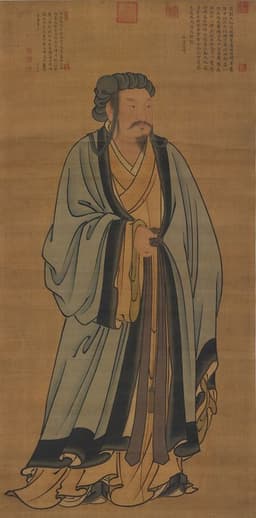
Zhuge Liang
Politician · Ancient
61.9Total
Basic Information
Born
60
181
Died
168
234
Era
Ancient
Ancient
Nationality
China
China
Occupation
Politician
Politician
Civilization
Eastern
Eastern
Score Comparison
Military (10%)
48.1
45.0
Political (20%)
54.7
72.0
Influence (20%)
50.2
40.0
Legacy (20%)
41.7
71.4
Leadership (15%)
55.3
80.0
Strategy (15%)
40.1
67.2
TOTAL
48.3
61.9
Dou Wu — Complete Timeline
165 AD
Appointed as Grand TutorPolitical Action◆ Major
Dou Wu was appointed Grand Tutor (Taifu) to the young Emperor Huan of Han. As a senior Confucian scholar, he sought to reform the court by reducing the influence of eunuchs and promoting Confucian officials.
Han DynastyGovernmentConfucianism
Impact: nationalconstructive
168 AD
Attempted to Purge the EunuchsPolitical Action◆ Major
Dou Wu, along with the scholar-official Chen Fan, plotted to eliminate the powerful eunuch faction at court. They planned to arrest the eunuch leaders, but the plot was leaked, leading to a violent confrontation.
Han DynastyEunuch PowerPolitical Struggle
Impact: national
Executed by EunuchsPolitical Action◆ Major
After the failed coup, the eunuchs seized control of the capital and executed Dou Wu. His death marked a major victory for the eunuch faction and intensified the political decay of the Eastern Han dynasty.
Han DynastyExecutionEunuch Power
Impact: nationaltragic
Zhuge Liang — Complete Timeline
207 AD
Formulation of the Longzhong PlanPolitical Action
During a meeting at Longzhong, Zhuge Liang presented Liu Bei with a strategic plan to divide China into three spheres of influence. The plan advocated for alliance with Sun Quan, control of Jing and Yi provinces, and eventual restoration of the Han dynasty.
StrategyLongzhongLiu Bei
Impact: regionalconstructive
221 AD
Appointment as Chancellor of Shu HanPolitical Action◆ Major
After Liu Bei founded the Shu Han dynasty, Zhuge Liang was appointed Chancellor and regent. He assumed full administrative and military responsibility, governing the state with efficiency and integrity during the reign of the young emperor Liu Shan.
ChancellorShu HanGovernment
Impact: nationalconstructive
225 AD
Southern Campaign (Nanzhong)War◆ Major
Zhuge Liang led a military campaign to pacify the southern tribes in Nanzhong (modern Yunnan and Guizhou). He used a combination of force and diplomacy, winning over the local chieftain Meng Huo, and secured Shu's southern border.
CampaignSouthern TribesPacification
Impact: regional
227 AD
Composition of the Chu Shi BiaoCultural◆ Major
Before the first Northern Expedition, Zhuge Liang wrote the 'Chu Shi Biao' (Memorial on the State of the Realm) to Emperor Liu Shan. This document outlined his loyalty, strategic reasoning, and advice for governance, becoming a classic of Chinese literature.
LiteratureMemorialLoyalty
Impact: nationalconstructive
228 AD
Northern Expeditions against WeiWar◆ Major
Zhuge Liang launched five major military campaigns from 228 to 234 to attack the Kingdom of Wei and restore Han rule. Despite tactical brilliance, the expeditions failed to achieve decisive victory due to logistical challenges and Wei's strong defenses.
ExpeditionsWeiWar
Impact: regional
Expert Analysis
Origins
Dou Wu (born c. 130 AD) came from a prominent family; his daughter was Empress Dou, wife of Emperor Huan. He was a Confucian scholar who rose through the ranks, eventually becoming Grand Tutor. Zhuge Liang (181–234) was born in a declining official family in Langya. Orphaned early, he lived in seclusion at Longzhong, studying and farming, until Liu Bei visited him.
Rise to Power
Dou Wu's rise was tied to his imperial connection. After Emperor Huan's death, he served as regent for the young Emperor Ling, controlling the court. Zhuge Liang's rise came through his strategic advice to Liu Bei, culminating in the Longzhong Plan (207) that envisioned a tripartite division of China. He became Chancellor of Shu Han after Liu Bei's ascension.
Leadership & Governance
Dou Wu's governance focused on Confucian reform, attempting to curb eunuch power and restore scholar-official influence. He scored 73.5 in leadership, but his political maneuvering was clumsy. Zhuge Liang, with a leadership score of 80.0, was an efficient administrator, implementing agricultural reforms, improving tax systems, and maintaining a stable state. His 'Chu Shi Biao' exemplifies his dedication.
Triumph & Tragedy
Dou Wu's greatest triumph was becoming Grand Tutor and initiating a purge against eunuchs. His tragedy: the failed coup led to his execution (168 AD), strengthening eunuch control. Zhuge Liang's triumph: the Southern Campaign (225) pacified Nanzhong and secured Shu's southern flank. His tragedy: the Northern Expeditions failed to defeat Wei, and he died of illness in 234 at Wuzhang Plains.
Character & Destiny
Dou Wu was idealistic but indecisive; he hesitated during the coup, allowing eunuchs to counterattack. Zhuge Liang was meticulous and loyal, dedicating himself to Shu's cause. His caution in strategy (strategy score 67.2) limited his military success but preserved Shu's resources.
Legacy
Dou Wu's legacy is mixed: posthumously rehabilitated, he is remembered as a martyr against eunuch corruption. Zhuge Liang's legacy is immense: he is a symbol of wisdom and loyalty in Chinese culture, with temples and legends. His military score of 45.0 vs Dou Wu's 30.2 reflects his greater tactical impact.
Conclusion
Zhuge Liang had greater overall impact. Despite Dou Wu's higher total score (62.8 vs 61.9), Zhuge Liang's political and military achievements shaped an era. Dou Wu's failure led to the decline of the Han, while Zhuge Liang's governance and strategies influenced Chinese statecraft for centuries. Zhuge Liang's legacy score of 71.4 far surpasses Dou Wu's 59.7, confirming his enduring significance.
Rankings
🥇
Zhuge LiangLeader
Mil: 45.0Pol: 72.0Inf: 40.0
61.9
🥈
Dou Wu
Mil: 48.1Pol: 54.7Inf: 50.2
48.3
+13.6 behind
How This Comparison Works
Algorithm
Each figure is scored on 6 dimensions (0—100 scale) based on structured historical data: Military (10%), Political (20%), Influence (20%), Legacy (20%), Leadership (15%), Strategy (15%). The weighted total produces the final ranking.
Data Sources
Scores are computed from structured sub-indicators in the database. Scale factors adjust for era (Ancient ×0.85, Modern ×1.0) and civilization size (Eastern ×1.05, Other ×0.80) to account for differences in population and military scale.
Maximum 3 Figures
Comparisons are limited to 2—3 figures to ensure readability and statistical meaningfulness.
Error Margins
±5 points per dimension — Sub-scores are derived from historical records with inherent uncertainty. Two figures within 5 points on a dimension should be considered roughly equivalent in that area.
Total Score Accuracy
±3 points overall — The weighted combination of 6 dimensions produces a total score with approximately ±3 points of uncertainty. Differences of less than 3 points are not statistically significant— the figures are effectively tied.
Known Limitations
- Historical records are incomplete and uneven across civilizations
- Figures from oral-tradition societies may be underrepresented
- Occupation labels can misclassify multi-role figures
- Scores measure capability and impact, not moral character
- Quantitative scoring is a comparison tool, not absolute truth
Capability Radar
Military (10%) — Battles & Warfare
Battles
21
65
Win Rate
26
60
Expansion
28
55
Political (20%) — Governance & Reform
Reform
60
80
Diplomacy
30
75
Economy
20
70
Influence (20%) — Cultural & Global Reach
Cultural
20
95
Global
10
70
Legacy (20%) — Historical Impact
Historical
30
95
Longevity
20
95
Leadership (15%) — Power & Stability
Tenure
40
70
Stability
10
65
Strategy (15%) — Tactics & Innovation
Strategy
31
90
Tactics
34
85
Reform
36
75
Similar Comparisons
Comments & Discussion
No comments yet. Be the first to share your thoughts!