Loading...
Liao Hua vs Zu Ti
Zu Ti leads by 9.5 pts · 2 figures compared
…

Liao Hua
General · Ancient
40.3Total
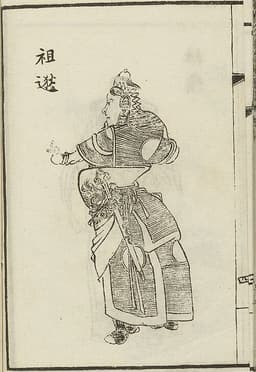
Zu Ti
General · Ancient
49.8Total
Basic Information
Born
185
266
Died
264
321
Era
Ancient
Ancient
Nationality
China
China
Occupation
General
General
Civilization
Eastern
Eastern
Score Comparison
Military (10%)
40.0
74.7
Political (20%)
35.0
27.9
Influence (20%)
45.5
54.9
Legacy (20%)
37.5
49.2
Leadership (15%)
40.9
36.9
Strategy (15%)
41.7
66.3
TOTAL
40.3
49.8
Liao Hua — Complete Timeline
184 AD
Participated in Yellow Turban RebellionWar
Liao Hua joined Liu Bei's forces during the Yellow Turban Rebellion, fighting against the rebel armies. This marked the beginning of his long military career, which spanned from the Han dynasty's decline to the fall of Shu.
Yellow TurbanShu HanMilitary Service
228 AD
Defended Shu During Northern ExpeditionsWar
Liao Hua served as a general under Zhuge Liang during the Northern Expeditions against Wei. He commanded rear-guard forces and participated in several battles, including the defense of Hanzhong.
Northern ExpeditionsShu HanBattle
Impact: regional
263 AD
Witnessed Fall of ShuWar◆ Major
Liao Hua was one of the last surviving generals of Shu when Wei invaded in 263. He advised against surrender but was overruled. After the fall of Shu, he was taken to Luoyang as a prisoner, where he died the following year.
Fall of ShuThree KingdomsEnd of Era
Impact: regionaltragic
Zu Ti — Complete Timeline
313 AD
Crossed the Yellow River with volunteersWar◆ Major
Zu Ti led a small force of volunteers across the Yellow River to attack the Xiongnu and other northern tribes. He successfully reclaimed several territories for the Eastern Jin dynasty, becoming a symbol of resistance against northern invaders.
Northern ExpeditionJin DynastyResistance
Impact: regionalconstructive
321 AD
Death from frustrationOther◆ Major
Zu Ti died of illness after becoming frustrated by court intrigues and lack of support from the Eastern Jin court. His death ended his campaign to reclaim the north, and his territories were gradually lost.
DeathFrustrationEnd of Campaign
Impact: regionaltragic
Expert Analysis
Origins
Liao Hua was born around 180 AD in Xiangyang, Jing Province. He joined Liu Bei's forces during the Yellow Turban Rebellion (184 AD), serving as a low-ranking officer. His early career spanned decades of warfare, including the campaigns against Cao Cao and the establishment of Shu-Han. Liao Hua's longevity in service, from 184 to 263 AD, made him a living chronicle of the Three Kingdoms era.
Zu Ti was born in 266 AD in Fanyang, Hebei, during the Western Jin dynasty. His family was of official lineage; his grandfather Zu He was a governor. Zu Ti studied classics and showed ambition from youth. After the fall of Western Jin to the Xiongnu in 316, he led a group of refugees south to the Eastern Jin capital, where he sought permission to lead a campaign to recover northern territories.
Rise to Power
Liao Hua rose slowly through the ranks. He served as a county magistrate and later as a general under Zhuge Liang during the Northern Expeditions (228-234). After Zhuge Liang's death, he became a key commander under Jiang Wei, participating in multiple campaigns against Wei. His promotion was steady but unspectacular, relying on seniority and loyalty rather than exceptional talent. By 263, he was the highest-ranking surviving general of Shu.
Zu Ti's rise was more dramatic. In 313, he gathered a volunteer force of 100 men and crossed the Yellow River northward. He famously struck the water with his oar, vowing to reclaim lost territory. Through military skill and diplomacy, he recaptured large parts of Henan and Shandong from the Xiongnu and local warlords. By 321, he controlled a significant buffer zone for Eastern Jin, earning the title General of the Expeditionary Army.
Leadership & Governance
Liao Hua's leadership was characterized by endurance and loyalty. He advised Jiang Wei against risky campaigns but was overruled. He commanded rear-guard actions, ensuring orderly retreats. In 263, when Wei invaded, Liao Hua urged the emperor to avoid surrender and retreat to the mountains, but his advice was ignored. His governance style was conservative, focused on preserving Shu's remaining strength.
Zu Ti demonstrated proactive leadership. He recruited volunteers from refugees and local Chinese, offering them land and rewards. He treated surrendered Xiongnu and Qiang tribes with leniency, integrating them into his forces. He also promoted agriculture and trade in recovered areas, stabilizing the region. However, his independent power base alarmed the Eastern Jin court, which refused to send reinforcements.
Triumph & Tragedy
Liao Hua's greatest success was his survival and service through Shu's entire history. He participated in the Yellow Turban Rebellion, the Northern Expeditions, and the final defense. His failure was his inability to prevent Shu's collapse. He witnessed the surrender of the last emperor and was forced to relocate to Luoyang, where he died shortly after.
Zu Ti's triumph was the recovery of significant territory north of the Yellow River. He defeated the Xiongnu general Shi Le in several battles, restoring Jin authority in the region. His tragedy came from court intrigue. The Eastern Jin emperor, fearing Zu Ti's power, appointed a rival general to oversee him. Zu Ti died of illness in 321, reportedly from frustration, at age 55. His campaign collapsed, and the north was lost again.
Character & Destiny
Liao Hua's character was defined by patience and loyalty. He served under multiple leaders (Liu Bei, Zhuge Liang, Jiang Wei) without seeking personal glory. His destiny was to be a witness rather than a shaper of history. He scored 40.9 in leadership and 41.7 in strategy, reflecting his competent but unremarkable abilities.
Zu Ti was ambitious and charismatic. His oath at the Yellow River showed his determination. But his independence made him a threat to the court. His strategy score of 66.3 highlights his tactical skill, while his low political score of 27.9 explains his failure to secure court support. His death marked the end of Eastern Jin's best chance to reclaim the north.
Legacy
Liao Hua is remembered as a symbol of endurance and loyalty in Shu. In Chinese folklore, he is often depicted as a veteran general who outlived his era. His legacy is minor, with no lasting institutions or reforms.
Zu Ti's legacy is more significant. His volunteer campaign became a model for later Chinese resistance against northern invaders. The idiom "to strike the oar and vow" (jījí) originates from his story. He is celebrated as a patriotic hero in Chinese history. However, his failure to secure lasting gains due to court politics is a cautionary tale.
Conclusion
Zu Ti had the greater impact. His military score of 74.7 far exceeds Liao Hua's 40.0, and his total score of 49.8 vs 40.3 reflects a more decisive role in history. While Liao Hua's long service is notable, Zu Ti's campaign directly challenged the fragmentation of China and inspired future generations. Zu Ti's failure was due to external factors, whereas Liao Hua's mediocrity was innate. Thus, Zu Ti's life, though shorter, carried more weight in the struggle to unify China.
Rankings
🥇
Zu TiLeader
Mil: 74.7Pol: 27.9Inf: 54.9
49.8
🥈
Liao Hua
Mil: 40.0Pol: 35.0Inf: 45.5
40.3
+9.5 behind
How This Comparison Works
Algorithm
Each figure is scored on 6 dimensions (0—100 scale) based on structured historical data: Military (10%), Political (20%), Influence (20%), Legacy (20%), Leadership (15%), Strategy (15%). The weighted total produces the final ranking.
Data Sources
Scores are computed from structured sub-indicators in the database. Scale factors adjust for era (Ancient ×0.85, Modern ×1.0) and civilization size (Eastern ×1.05, Other ×0.80) to account for differences in population and military scale.
Maximum 3 Figures
Comparisons are limited to 2—3 figures to ensure readability and statistical meaningfulness.
Error Margins
±5 points per dimension — Sub-scores are derived from historical records with inherent uncertainty. Two figures within 5 points on a dimension should be considered roughly equivalent in that area.
Total Score Accuracy
±3 points overall — The weighted combination of 6 dimensions produces a total score with approximately ±3 points of uncertainty. Differences of less than 3 points are not statistically significant— the figures are effectively tied.
Known Limitations
- Historical records are incomplete and uneven across civilizations
- Figures from oral-tradition societies may be underrepresented
- Occupation labels can misclassify multi-role figures
- Scores measure capability and impact, not moral character
- Quantitative scoring is a comparison tool, not absolute truth
Capability Radar
Military (10%) — Battles & Warfare
Battles
25
55
Win Rate
30
60
Expansion
5
55
Political (20%) — Governance & Reform
Reform
5
30
Diplomacy
15
45
Economy
5
35
Influence (20%) — Cultural & Global Reach
Cultural
15
40
Global
5
30
Legacy (20%) — Historical Impact
Historical
20
50
Longevity
15
45
Leadership (15%) — Power & Stability
Tenure
40
40
Stability
10
30
Strategy (15%) — Tactics & Innovation
Strategy
20
70
Tactics
20
65
Reform
5
50
Similar Comparisons
Comments & Discussion
No comments yet. Be the first to share your thoughts!