Loading...
Laurent Gbagbo vs Napoleon Bonaparte
Napoleon Bonaparte leads by 23.4 pts · 2 figures compared
…
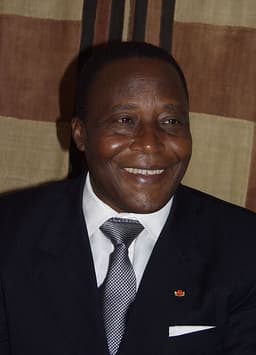
Laurent Gbagbo
Politician · Modern
47.5Total

Napoleon Bonaparte
General · Modern
70.9Total
Basic Information
Born
1945
1769
Died
—
1821
Era
Modern
Modern
Nationality
Ivory Coast
France
Occupation
Politician
General
Civilization
Other
Western
Score Comparison
Military (10%)
45.0
94.0
Political (20%)
37.9
72.0
Influence (20%)
51.8
40.0
Legacy (20%)
40.0
80.0
Leadership (15%)
65.7
78.0
Strategy (15%)
45.0
90.0
TOTAL
47.5
70.9
Laurent Gbagbo — Complete Timeline
2000 AD
Elected President of Ivory CoastPolitical Action◆ Major
Gbagbo won the presidential election as the candidate of the Ivorian Popular Front, defeating incumbent Robert Gu
ElectionIvory CoastExclusion
Impact: national
2002 AD
Survived Failed Coup AttemptWar◆ Major
A failed coup attempt by disgruntled soldiers escalated into a civil war, splitting Ivory Coast into a government-controlled south and rebel-held north. The conflict resulted in thousands of deaths and displacement.
Civil WarCoupIvory Coast
Impact: nationaldestructive
2010 AD
Refused to Step Down After 2010 ElectionPolitical Action
Gbagbo refused to concede defeat after losing the presidential election to Alassane Ouattara, despite international recognition of Ouattara's victory. This sparked a second civil war that lasted five months and caused over 3,000 deaths.
Election CrisisCivil WarIvory Coast
Impact: regionaldestructive
2011 AD
Arrested and Sent to International Criminal CourtPolitical Action◆ Major
Gbagbo was arrested by forces loyal to Ouattara with French and UN support. He was transferred to the International Criminal Court in The Hague to face charges of crimes against humanity for his role in the post-election violence.
ICCCrimes Against HumanityArrest
Impact: globaldestructive
2019 AD
Acquitted by International Criminal CourtPolitical Action◆ Major
The ICC acquitted Gbagbo of all charges of crimes against humanity, citing insufficient evidence. The acquittal was controversial, with victims' groups expressing disappointment. Gbagbo was later allowed to return to Ivory Coast.
AcquittalICCIvory Coast
Impact: global
Napoleon Bonaparte — Complete Timeline
1799 AD
Coup of 18 BrumaireOther◆ Major
Napoleon Bonaparte, with support from his brother Lucien and key political figures, overthrew the Directory in a bloodless coup. He established the Consulate with himself as First Consul, effectively becoming the ruler of France. This event ended the French Revolution's most unstable period.
French RevolutionCoupRise to Power
Impact: regional
1804 AD
Promulgation of the Napoleonic CodeOther◆ Major
Napoleon enacted the Civil Code of the French, known as the Napoleonic Code, a comprehensive set of laws that replaced the fragmented feudal legal systems. The code established legal equality, protected property rights, and secularized law. It became the basis for legal systems in many European and world countries.
Legal ReformNapoleonic CodeCivil Law
Impact: globalconstructive
1805 AD
Battle of AusterlitzWar◆ Major
Napoleon's Grande Arm
Napoleonic WarsBattleDecisive Victory
Impact: global
1812 AD
Invasion of RussiaWar◆ Major
Napoleon led the Grande Arm
Napoleonic WarsInvasionDisaster
Impact: globaldestructive
1815 AD
Battle of WaterlooWar◆ Major
Napoleon's French army was defeated by the combined forces of the Duke of Wellington's Anglo-Allied army and Gebhard Leberecht von Bl
Napoleonic WarsBattleFinal Defeat
Impact: globaldestructive
Expert Analysis
laurent-gbagbo-vs-napoleon-bonaparte
# The Emperor and the Strongman
On a June morning in 1815, Napoleon Bonaparte stood on a muddy field near Waterloo, watching his Imperial Guard march into cannon fire for the last time. Nearly two centuries later, in April 2011, Laurent Gbagbo huddled in an underground bunker in Abidjan as French helicopters pounded his presidential palace. Both men had refused to let go of power. Both had seen their worlds collapse. But the forces that brought them down—and the worlds they built—could not have been more different.
Origins
Napoleon was born in 1769 on the island of Corsica, a place that had become French only months before his birth. His family was minor nobility, poor enough to feel the sting of class but privileged enough to send him to French military academies. There, the awkward, accented boy was mocked by aristocrats. That humiliation forged something cold in him. He read Plutarch's lives of great men, devoured military treatises, and dreamed of glory. The French Revolution, which erupted when he was twenty, shattered the old order and opened a path for talent over birth.
Laurent Gbagbo was born in 1945 in Gagnoa, Ivory Coast, then a French colony. His father was a poor Catholic farmer, and Gbagbo grew up under the paternalist rule of Félix Houphouët-Boigny, the founding father who kept Ivory Coast stable by keeping it close to France. Gbagbo was a historian by training, a Marxist by inclination, and a trade union activist by necessity. He spent years in exile, was imprisoned, and emerged as the voice of opposition to Houphouët-Boigny's long shadow. Where Napoleon was forged in revolution's fire, Gbagbo was molded in the slow heat of postcolonial resentment.
Rise to Power
Napoleon's ascent was meteoric. In 1793, at age twenty-four, he drove British forces from Toulon and was made a brigadier general. In 1796, he took command of a starving, unpaid army in Italy and turned it into a conquering force. Victory followed victory: the Battle of Arcole, the Battle of the Pyramids in Egypt, the coup of 18 Brumaire in 1799 that made him First Consul. By 1804, he crowned himself Emperor of the French. In a decade, he went from obscure artillery officer to master of Europe. His genius was not just military—with a Strategy score of 93, he ranks among history's greatest commanders—but political. He understood that the Revolution had created a vacuum, and he filled it.
Gbagbo's path was slower and more fragile. He was elected President of Ivory Coast in 2000, defeating the military ruler Robert Guéï in an election that was itself a product of crisis. But Gbagbo inherited a country already fractured along north-south, Muslim-Christian, and native-immigrant lines. His political score of 53.3 reflects a man who won power but never truly consolidated it. Where Napoleon seized a continent with armies, Gbagbo held a country by balancing ethnic factions, and the balance was always unstable.
Leadership & Governance
Napoleon governed with a genius that rivaled his military mind. He centralized the French state, created the Bank of France, established lycées for education, and most enduringly, codified French law into the Napoleonic Code—a legal framework that influenced civil law across Europe and the Americas. He was a reformer who believed in merit, efficiency, and order. His Leadership score of 80 and Political score of 75 reflect a ruler who could inspire armies and manage bureaucracies. Yet his governance had a fatal flaw: he could not stop. Every victory demanded another. Every peace treaty was a breathing spell for the next war.
Gbagbo governed in the shadow of Houphouët-Boigny's legacy, which had kept peace through patronage and French backing. Gbagbo tried to build a nationalist identity, but his policies—particularly the concept of "Ivoirité," which questioned the citizenship of northerners—deepened ethnic divisions. His Leadership score of 72.6 suggests a man capable of holding loyalty, but his Strategy score of 31.9 reveals a catastrophic inability to plan beyond the immediate crisis. He was a tactician, not a strategist.
Triumph & Tragedy
Napoleon's greatest moment was Austerlitz in 1805, where he crushed the combined armies of Russia and Austria. It was a masterpiece of deception, timing, and nerve. His worst was the 1812 invasion of Russia, where he lost half a million men to winter, hunger, and Cossack raids. Then came Leipzig in 1813, where the allies finally outmaneuvered him. And finally Waterloo in 1815, where he staked everything on one last gamble and lost. His total score of 82.4 reflects a figure of immense achievement shadowed by immense ruin.
Gbagbo's triumph was surviving the 2002 coup attempt that sparked civil war. For nearly a decade, he held the south while rebels held the north, and he remained president. His tragedy came in 2010, when he lost the election to Alassane Ouattara—and refused to leave. The refusal triggered a second civil war that killed thousands. In 2011, French and UN forces arrested him in his bunker. He was sent to the International Criminal Court in The Hague, charged with crimes against humanity. In 2019, the ICC acquitted him, citing insufficient evidence. He returned to Ivory Coast a free man but a broken symbol.
Character & Destiny
Napoleon was driven by an insatiable hunger for glory. "I am not a man," he once said, "but a thing." He saw himself as an instrument of destiny, and that belief gave him courage, energy, and ruthlessness. It also made him incapable of compromise. He could not share Europe. He could not stop conquering. His character created his rise and ensured his fall.
Gbagbo was driven by a different hunger: the need to be recognized as legitimate. A historian who had spent years in the opposition, he saw himself as the authentic voice of Ivorian nationalism. But that conviction became blindness. He could not see that his claim to power had expired. Where Napoleon's flaw was ambition, Gbagbo's was stubbornness—the refusal to admit that the game was over.
Legacy
Napoleon's legacy is written into the fabric of modern Europe. The Napoleonic Code, the metric system, the structure of French education, the very idea of a unified Italy and Germany—all bear his mark. His Military score of 94 and Influence score of 82 place him among the most consequential figures in history. He is remembered as both liberator and tyrant, reformer and warmonger.
Gbagbo's legacy is smaller and sadder. His Legacy score of 52.3 reflects a man who will be remembered primarily for what he destroyed: a stable country, a democratic transition, and his own reputation. In Ivory Coast, he is either a martyr for sovereignty or a spoiler who burned his nation for a chair. The ICC acquittal cleared his name legally but not historically.
Conclusion
Napoleon and Gbagbo both gripped power until it shattered in their hands. But Napoleon reshaped the world; Gbagbo could not hold his own country. The difference lies not in will—both men had iron wills—but in the scale of the stage and the depth of the foundations they inherited. Napoleon built on the ruins of an ancient monarchy with the tools of a revolution. Gbagbo built on the fragile legacy of a colony with the tools of a fragile state. One was a titan who fell from heaven; the other was a man who fell from a balcony he should never have climbed. History remembers the titan. It buries the rest.
Rankings
🥇
Napoleon BonaparteLeader
Mil: 94.0Pol: 72.0Inf: 40.0
70.9
🥈
Laurent Gbagbo
Mil: 45.0Pol: 37.9Inf: 51.8
47.5
+23.4 behind
How This Comparison Works
Algorithm
Each figure is scored on 6 dimensions (0—100 scale) based on structured historical data: Military (10%), Political (20%), Influence (20%), Legacy (20%), Leadership (15%), Strategy (15%). The weighted total produces the final ranking.
Data Sources
Scores are computed from structured sub-indicators in the database. Scale factors adjust for era (Ancient ×0.85, Modern ×1.0) and civilization size (Eastern ×1.05, Other ×0.80) to account for differences in population and military scale.
Maximum 3 Figures
Comparisons are limited to 2—3 figures to ensure readability and statistical meaningfulness.
Error Margins
±5 points per dimension — Sub-scores are derived from historical records with inherent uncertainty. Two figures within 5 points on a dimension should be considered roughly equivalent in that area.
Total Score Accuracy
±3 points overall — The weighted combination of 6 dimensions produces a total score with approximately ±3 points of uncertainty. Differences of less than 3 points are not statistically significant— the figures are effectively tied.
Known Limitations
- Historical records are incomplete and uneven across civilizations
- Figures from oral-tradition societies may be underrepresented
- Occupation labels can misclassify multi-role figures
- Scores measure capability and impact, not moral character
- Quantitative scoring is a comparison tool, not absolute truth
Capability Radar
Military (10%) — Battles & Warfare
Battles
15
95
Win Rate
10
90
Expansion
5
95
Political (20%) — Governance & Reform
Reform
30
95
Diplomacy
25
80
Economy
30
85
Influence (20%) — Cultural & Global Reach
Cultural
20
85
Global
20
90
Legacy (20%) — Historical Impact
Historical
25
95
Longevity
15
90
Leadership (15%) — Power & Stability
Tenure
55
85
Stability
10
70
Strategy (15%) — Tactics & Innovation
Strategy
15
95
Tactics
20
98
Reform
10
92
Similar Comparisons
Comments & Discussion
水瓶座拿破仑6/17/2026
拿破仑不是孤独的征服者,而是历史偶然性的完美产物。滑铁卢那场雨来得太巧,巧到让人怀疑老天爷写好了剧本。一个外来的科西嘉小子凭一己之力撕裂旧欧洲,却输给了一颗湿透的炮弹。反观今天的非洲强人们,哪个不是靠着祖传的民族牌和家族势力坐稳江山?拿破仑至少证明了一个人能改变时代。比肩,还早着呢。