Loading...
Kuroda Kanbei vs Rana Pratap
Kuroda Kanbei leads by 0.8 pts · 2 figures compared
…

Kuroda Kanbei
General · Modern
55.2Total
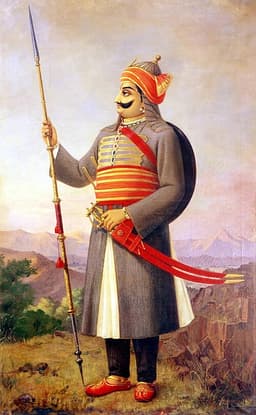
Rana Pratap
General · Modern
54.4Total
Basic Information
Born
1546
1540
Died
1604
1597
Era
Modern
Modern
Nationality
Japan
India
Occupation
General
General
Civilization
Eastern
Indian
Score Comparison
Military (10%)
74.7
40.0
Political (20%)
45.0
43.7
Influence (20%)
57.2
60.0
Legacy (20%)
50.0
54.0
Leadership (15%)
48.8
62.2
Strategy (15%)
68.1
60.0
TOTAL
55.2
54.4
Kuroda Kanbei — Complete Timeline
1583 AD
Conversion to ChristianityCultural
Kuroda Kanbei converted to Roman Catholicism under Jesuit influence, taking the name 'Don Simeon'. He became a Christian daimyo, supporting missionary activities in his domain.
ChristianityDaimyoReligion
constructive
1590 AD
Siege of OdawaraWar◆ Major
Kuroda Kanbei advised Toyotomi Hideyoshi during the siege of Odawara Castle. His strategies helped force the Hojo clan's surrender, contributing to Hideyoshi's unification of Japan.
OdawaraSiegeHideyoshi
Impact: nationalconstructive
1600 AD
Battle of SekigaharaWar
Kuroda Kanbei served as a strategist for Tokugawa Ieyasu at Sekigahara. His planning and intelligence gathering contributed to the Eastern Army's victory, securing Tokugawa's rise to power.
SekigaharaStrategyTokugawa
Impact: nationalconstructive
Rana Pratap — Complete Timeline
1576 AD
Battle of HaldighatiWar◆ Major
Rana Pratap led Rajput forces against the Mughal army commanded by Raja Man Singh near Haldighati. Though defeated, Pratap escaped and continued guerrilla resistance. The battle became a symbol of Rajput defiance against Mughal expansion.
Mughal-Rajput WarsBattleResistance
Impact: regional
1577 AD
Alliance with the Bhil TribePolitical Action
Rana Pratap formed an alliance with the Bhil tribal chieftains, securing their support for his guerrilla campaign against the Mughals. This alliance provided him with local knowledge and resources.
AllianceGuerrilla WarfareTribal
constructive
1585 AD
Recapture of Chittor FortWar◆ Major
After years of guerrilla warfare, Rana Pratap recaptured the Chittor Fort from Mughal control. This victory restored Mewar's independence and solidified his legacy as a symbol of Rajput resistance.
MewarFortressIndependence
Impact: regionalconstructive
Expert Analysis
Origins
Kuroda Kanbei (1546-1604) was born in Gochaku, Japan, into the Kuroda clan, vassals of the Oda. His father, Kuroda Shigetaka, served the Oda family. Kanbei was educated in military tactics and Confucian philosophy. In his youth, he converted to Roman Catholicism under Jesuit influence, taking the name 'Don Simeon'. This conversion shaped his later diplomacy and openness to foreign ideas.
Rana Pratap (1540-1597) was born in Kumbhalgarh Fort, Mewar, India, into the Sisodia Rajput dynasty. His father, Maharana Udai Singh II, founded Udaipur. Pratap was trained in martial arts, horsemanship, and Rajput code of honor. His upbringing emphasized resistance against external threats, preparing him for his lifelong struggle against the Mughals.
Rise to Power
Kuroda Kanbei rose to prominence as a strategist under Oda Nobunaga. He distinguished himself at the Battle of Sekigahara (1600), where he served Tokugawa Ieyasu. Kanbei's intelligence network and planning were crucial in securing the Eastern Army's victory. His role in the Siege of Odawara (1590) also elevated his status, where he advised Toyotomi Hideyoshi to use psychological warfare to force the Hojo clan's surrender.
Rana Pratap ascended the throne of Mewar in 1572 after his father's death. His refusal to accept Mughal suzerainty made him a symbol of Rajput independence. The Battle of Haldighati (1576) was his major confrontation, where he led 20,000 Rajputs against 80,000 Mughals. Despite defeat, his escape and subsequent guerrilla warfare earned him legendary status.
Leadership & Governance
Kuroda Kanbei's leadership was characterized by strategic calculation and political pragmatism. He scored 48.8 in leadership and 45.0 in political metrics. As a Christian daimyo, he protected missionaries in his domain, fostering cultural exchange. His governance focused on efficient administration and intelligence gathering. At Sekigahara, his ability to shift alliances from Ishida Mitsunari to Tokugawa Ieyasu demonstrated his political acumen.
Rana Pratap's leadership scored 62.2, reflecting his inspirational command. He governed through Rajput traditions and tribal alliances, notably with the Bhil tribe, who provided guerrilla support. His leadership was more about symbolic resistance than administrative reform. His fort recapture in 1585 restored Mewar's independence, but his rule lacked long-term institutional development.
Triumph & Tragedy
Kuroda Kanbei's greatest success was at the Battle of Sekigahara, where his strategic planning led to the Eastern Army's victory. He also succeeded in the Siege of Odawara, using famine and negotiation to end a siege without massive casualties. However, his conversion to Christianity created tensions; after the Tokugawa shogunate banned Christianity, his legacy was suppressed. His political score of 45.0 reflects this vulnerability.
Rana Pratap's triumph was the recapture of Chittor Fort in 1585 after years of guerrilla warfare. This victory restored Mewar's pride and secured his place in Rajput history. His tragedy was the heavy loss at Haldighati, where many family members and allies died. Despite escaping, he lost territory and resources, forcing him into a life of austerity.
Character & Destiny
Kuroda Kanbei was a pragmatic and adaptable strategist. His conversion to Christianity shows openness to new ideas, but his shifting allegiances (from Hideyoshi to Ieyasu) indicate political flexibility. His character shaped his destiny as a behind-the-scenes influencer rather than a ruler. He scored 68.1 in strategy, reflecting his intellectual approach.
Rana Pratap was stubborn and honor-bound. His refusal to submit to Akbar despite overwhelming odds defined his destiny. His military score of 40.0 shows his limitations in conventional warfare, but his guerrilla tactics scored 60.0 in strategy. His character made him a folk hero but limited his territorial gains.
Legacy
Kuroda Kanbei's legacy is subtle but significant. His strategies influenced Tokugawa Ieyasu's consolidation of power. He scored 50.0 in legacy, partly because his Christian identity was downplayed during the Edo period. However, his descendants became prominent in the Meiji Restoration. His contributions to Japanese unification are recognized by historians.
Rana Pratap's legacy is immense in Indian culture. He scored 54.0 in legacy, with annual festivals and folk songs celebrating his resistance. He inspired later Indian independence movements. The Bhil alliance remains a symbol of Hindu-Muslim cooperation. His fort recapture is a key date in Rajput history.
Conclusion
Kuroda Kanbei had a greater measurable impact overall, with a total score of 55.2 vs 54.4. His strategic contributions at Sekigahara shaped Japan's unification, while Rana Pratap's resistance, though culturally significant, did not alter Mughal dominance. Kanbei's influence extended through the Tokugawa shogunate, whereas Pratap's legacy remained regional. Thus, Kanbei's impact was more far-reaching in historical terms.
Rankings
🥇
Kuroda KanbeiLeader
Mil: 74.7Pol: 45.0Inf: 57.2
55.2
🥈
Rana Pratap
Mil: 40.0Pol: 43.7Inf: 60.0
54.4
+0.8 behind
How This Comparison Works
Algorithm
Each figure is scored on 6 dimensions (0—100 scale) based on structured historical data: Military (10%), Political (20%), Influence (20%), Legacy (20%), Leadership (15%), Strategy (15%). The weighted total produces the final ranking.
Data Sources
Scores are computed from structured sub-indicators in the database. Scale factors adjust for era (Ancient ×0.85, Modern ×1.0) and civilization size (Eastern ×1.05, Other ×0.80) to account for differences in population and military scale.
Maximum 3 Figures
Comparisons are limited to 2—3 figures to ensure readability and statistical meaningfulness.
Error Margins
±5 points per dimension — Sub-scores are derived from historical records with inherent uncertainty. Two figures within 5 points on a dimension should be considered roughly equivalent in that area.
Total Score Accuracy
±3 points overall — The weighted combination of 6 dimensions produces a total score with approximately ±3 points of uncertainty. Differences of less than 3 points are not statistically significant— the figures are effectively tied.
Known Limitations
- Historical records are incomplete and uneven across civilizations
- Figures from oral-tradition societies may be underrepresented
- Occupation labels can misclassify multi-role figures
- Scores measure capability and impact, not moral character
- Quantitative scoring is a comparison tool, not absolute truth
Capability Radar
Military (10%) — Battles & Warfare
Battles
65
45
Win Rate
70
30
Expansion
75
25
Political (20%) — Governance & Reform
Reform
50
30
Diplomacy
70
35
Economy
45
25
Influence (20%) — Cultural & Global Reach
Cultural
40
60
Global
35
30
Legacy (20%) — Historical Impact
Historical
55
55
Longevity
50
50
Leadership (15%) — Power & Stability
Tenure
55
40
Stability
50
20
Strategy (15%) — Tactics & Innovation
Strategy
85
40
Tactics
80
55
Reform
60
20
Similar Comparisons
Comments & Discussion
No comments yet. Be the first to share your thoughts!