Loading...
Charles George Gordon vs Rana Pratap
Rana Pratap leads by 0.4 pts · 2 figures compared
…

Charles George Gordon
General · Modern
54.0Total
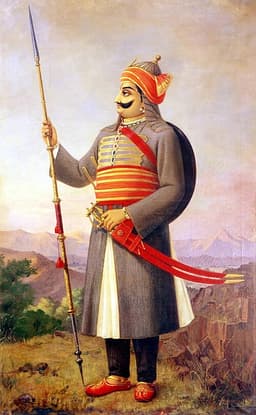
Rana Pratap
General · Modern
54.4Total
Basic Information
Born
1833
1540
Died
1885
1597
Era
Modern
Modern
Nationality
Great Britain
India
Occupation
General
General
Civilization
Western
Indian
Score Comparison
Military (10%)
45.0
40.0
Political (20%)
45.1
43.7
Influence (20%)
58.3
60.0
Legacy (20%)
56.0
54.0
Leadership (15%)
61.1
62.2
Strategy (15%)
50.0
60.0
TOTAL
54.0
54.4
Charles George Gordon — Complete Timeline
1863 AD
Led the Ever Victorious Army in ChinaWar◆ Major
Gordon commanded the 'Ever Victorious Army,' a Chinese imperial force, during the Taiping Rebellion. He led successful campaigns that helped suppress the rebellion, earning the nickname 'Chinese Gordon' and international fame.
Military CampaignTaiping RebellionChina
Impact: regional
1877 AD
Appointed Governor-General of SudanPolitical Action◆ Major
Gordon was appointed Governor-General of Sudan by the Khedive of Egypt. He worked to suppress the slave trade and improve administration, but his efforts were hampered by limited resources and local resistance.
Colonial AdministrationSudanAnti-Slavery
Impact: regionalconstructive
1885 AD
Killed at the Siege of KhartoumWar◆ Major
Gordon was killed when Mahdist forces stormed Khartoum after a 10-month siege. His death occurred two days before a British relief force arrived, becoming a symbol of imperial failure and prompting public outrage in Britain.
SiegeKhartoumMahdist War
Impact: globaltragic
Rana Pratap — Complete Timeline
1576 AD
Battle of HaldighatiWar◆ Major
Rana Pratap led Rajput forces against the Mughal army commanded by Raja Man Singh near Haldighati. Though defeated, Pratap escaped and continued guerrilla resistance. The battle became a symbol of Rajput defiance against Mughal expansion.
Mughal-Rajput WarsBattleResistance
Impact: regional
1577 AD
Alliance with the Bhil TribePolitical Action
Rana Pratap formed an alliance with the Bhil tribal chieftains, securing their support for his guerrilla campaign against the Mughals. This alliance provided him with local knowledge and resources.
AllianceGuerrilla WarfareTribal
constructive
1585 AD
Recapture of Chittor FortWar◆ Major
After years of guerrilla warfare, Rana Pratap recaptured the Chittor Fort from Mughal control. This victory restored Mewar's independence and solidified his legacy as a symbol of Rajput resistance.
MewarFortressIndependence
Impact: regionalconstructive
Expert Analysis
Origins
**Charles George Gordon** was born on January 28, 1833, in Woolwich, England, to a military family. His father was a lieutenant general in the Royal Artillery. Gordon entered the Royal Military Academy at Woolwich at age 14, graduating in 1852 as a second lieutenant in the Royal Engineers. His early career included service in the Crimean War, where he participated in the Siege of Sevastopol (1854–1855), gaining practical engineering experience.
**Rana Pratap** was born on May 9, 1540, in Kumbhalgarh, Mewar (present-day Rajasthan, India), into the Sisodia Rajput clan. His father, Maharana Udai Singh II, founded Udaipur. Pratap received training in martial arts, swordsmanship, and statecraft from a young age. He succeeded to the throne in 1572 after his father's death, inheriting a kingdom under pressure from the expanding Mughal Empire under Akbar.
Rise to Power
Gordon's rise came through his role in China. In 1863, he took command of the 'Ever Victorious Army,' a Chinese imperial force fighting the Taiping Rebellion. Gordon led successful campaigns, capturing key cities like Suzhou and Changzhou. His military discipline and tactical acumen earned him the nickname 'Chinese Gordon' and a promotion to colonel. He returned to Britain in 1865 as a national hero.
Rana Pratap's rise was tied to his defiance of Mughal suzerainty. After his coronation in 1572, Akbar sent diplomatic missions demanding submission. Pratap refused, leading to the Battle of Haldighati on June 18, 1576. Though outnumbered, Pratap's forces fought fiercely. The Mughal army, commanded by Raja Man Singh, defeated the Rajputs, but Pratap escaped and continued a guerrilla campaign from the hills.
Leadership & Governance
Gordon's leadership style was marked by personal bravery and moral conviction. As Governor-General of Sudan (1877–1880), he attempted to suppress the slave trade, but his efforts were hampered by limited resources and corruption. He was known for his strict integrity and hands-on approach, often personally inspecting posts. However, his governance lacked administrative finesse, leading to mixed results.
Rana Pratap's leadership focused on preserving Rajput independence. He ruled from remote areas, using guerrilla tactics to harass Mughal garrisons. He fostered alliances with local tribes like the Bhils, who provided manpower and local knowledge. His governance was decentralized, relying on loyal chieftains. While he lacked a formal administrative apparatus, his leadership inspired fierce loyalty.
Triumph & Tragedy
Gordon's greatest triumph was his role in suppressing the Taiping Rebellion, scoring 45.0 in military and 50.0 in strategy. However, his greatest tragedy was the Siege of Khartoum (1884–1885). Sent to evacuate Egyptian forces from Sudan, he chose to defend the city against Mahdist forces. After a 10-month siege, Khartoum fell on January 26, 1885, and Gordon was killed two days before a British relief force arrived. His death became a symbol of imperial failure.
Rana Pratap's triumph was the recapture of Chittor Fort in 1585 after years of guerrilla warfare. This victory restored Mewar's independence and solidified his legacy as a symbol of resistance. His tragedy was the defeat at Haldighati, where he lost many nobles and family members. He spent years in exile, relying on tribal support. Despite eventual success, he never fully expelled Mughal influence from Mewar.
Character & Destiny
Gordon was a complex figure: devoutly Christian, ascetic, and stubborn. His decision to stay in Khartoum despite orders to evacuate reflected his sense of duty and refusal to abandon the Sudanese people. Historians note his score of 61.1 in leadership, but his inflexibility contributed to his downfall. He was praised for his courage but criticized for poor judgment in Khartoum.
Rana Pratap was characterized by resilience and pride. His refusal to submit to Akbar, even after defeat, defined his destiny. He scored 62.2 in leadership, higher than Gordon, due to his ability to maintain loyalty among disparate groups. His guerrilla strategy (60.0) compensated for military weaknesses. His character of unwavering resistance became a rallying point for Rajput identity.
Legacy
Gordon's legacy is mixed. In Britain, he is remembered as a martyr and hero of empire, with statues and schools named after him. However, his failure in Sudan is often seen as a cautionary tale of overreach. His score of 56.0 in legacy reflects this duality. In Sudan, he is viewed as a colonial figure. His influence on British military policy was limited.
Rana Pratap's legacy is enduring in India. He is celebrated as a symbol of Rajput valor and resistance against Mughal imperialism. His score of 54.0 in legacy is comparable to Gordon's, but his impact on regional identity is more profound. He inspired later movements for independence. The Battle of Haldighati remains a potent symbol in Rajasthan. His alliance with the Bhils is remembered as an early example of inter-community cooperation.
Conclusion
In comparing Charles George Gordon and Rana Pratap, both scored similarly overall (Gordon 54.0, Pratap 54.4), but their impacts differ. Gordon's achievements in China were significant, but his failure in Khartoum tarnished his legacy. Pratap's guerrilla resistance, though less spectacular, had a lasting influence on Indian identity and resistance narratives. While Gordon's score in leadership (61.1) is slightly lower than Pratap's (62.2), Pratap's ability to sustain a long-term insurgency against a superior power demonstrates greater strategic resilience. Therefore, Rana Pratap had a greater impact in terms of enduring cultural and political legacy, despite Gordon's higher immediate fame. Pratap's model of asymmetric warfare influenced later movements, while Gordon's legacy is more tied to imperial tragedy.
Rankings
🥇
Rana PratapLeader
Mil: 40.0Pol: 43.7Inf: 60.0
54.4
🥈
Charles George Gordon
Mil: 45.0Pol: 45.1Inf: 58.3
54.0
+0.4 behind
How This Comparison Works
Algorithm
Each figure is scored on 6 dimensions (0—100 scale) based on structured historical data: Military (10%), Political (20%), Influence (20%), Legacy (20%), Leadership (15%), Strategy (15%). The weighted total produces the final ranking.
Data Sources
Scores are computed from structured sub-indicators in the database. Scale factors adjust for era (Ancient ×0.85, Modern ×1.0) and civilization size (Eastern ×1.05, Other ×0.80) to account for differences in population and military scale.
Maximum 3 Figures
Comparisons are limited to 2—3 figures to ensure readability and statistical meaningfulness.
Error Margins
±5 points per dimension — Sub-scores are derived from historical records with inherent uncertainty. Two figures within 5 points on a dimension should be considered roughly equivalent in that area.
Total Score Accuracy
±3 points overall — The weighted combination of 6 dimensions produces a total score with approximately ±3 points of uncertainty. Differences of less than 3 points are not statistically significant— the figures are effectively tied.
Known Limitations
- Historical records are incomplete and uneven across civilizations
- Figures from oral-tradition societies may be underrepresented
- Occupation labels can misclassify multi-role figures
- Scores measure capability and impact, not moral character
- Quantitative scoring is a comparison tool, not absolute truth
Capability Radar
Military (10%) — Battles & Warfare
Battles
55
45
Win Rate
50
30
Expansion
35
25
Political (20%) — Governance & Reform
Reform
30
30
Diplomacy
40
35
Economy
25
25
Influence (20%) — Cultural & Global Reach
Cultural
55
60
Global
55
30
Legacy (20%) — Historical Impact
Historical
60
55
Longevity
50
50
Leadership (15%) — Power & Stability
Tenure
45
40
Stability
20
20
Strategy (15%) — Tactics & Innovation
Strategy
60
40
Tactics
65
55
Reform
40
20
Similar Comparisons
Comments & Discussion
No comments yet. Be the first to share your thoughts!